
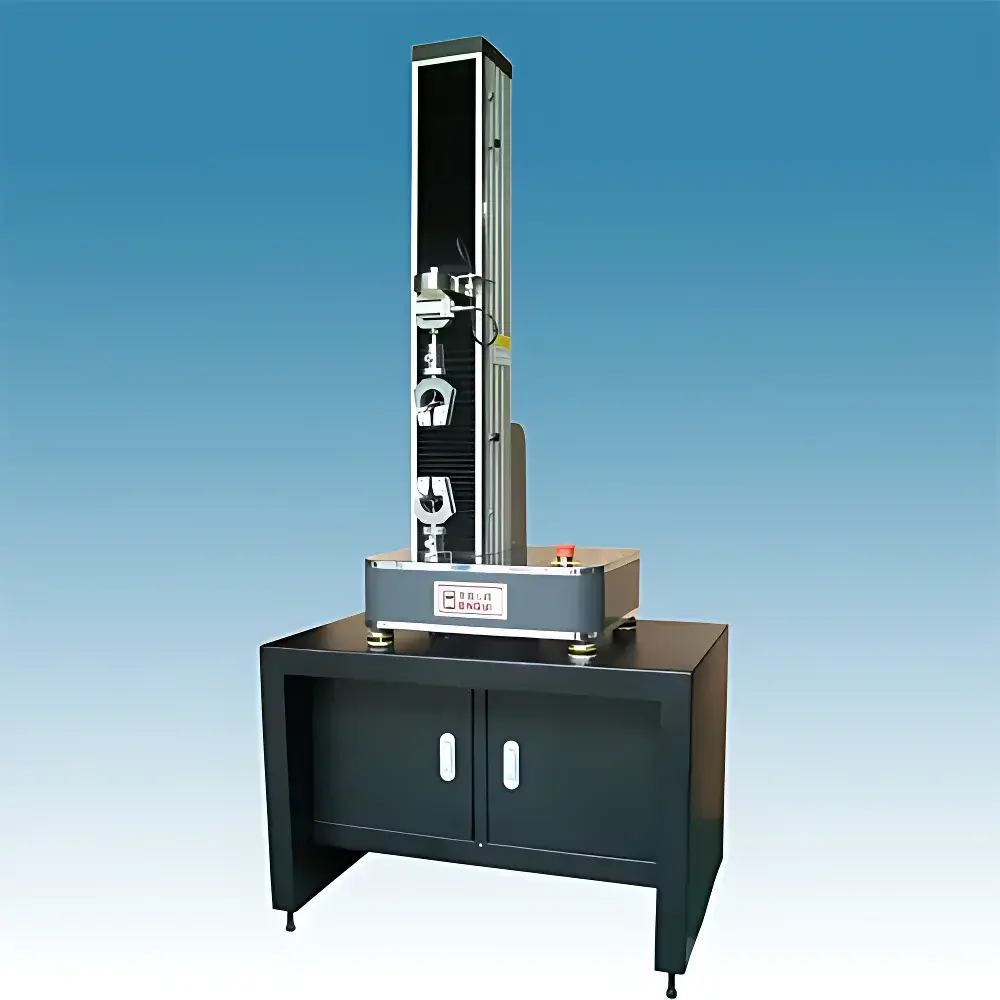
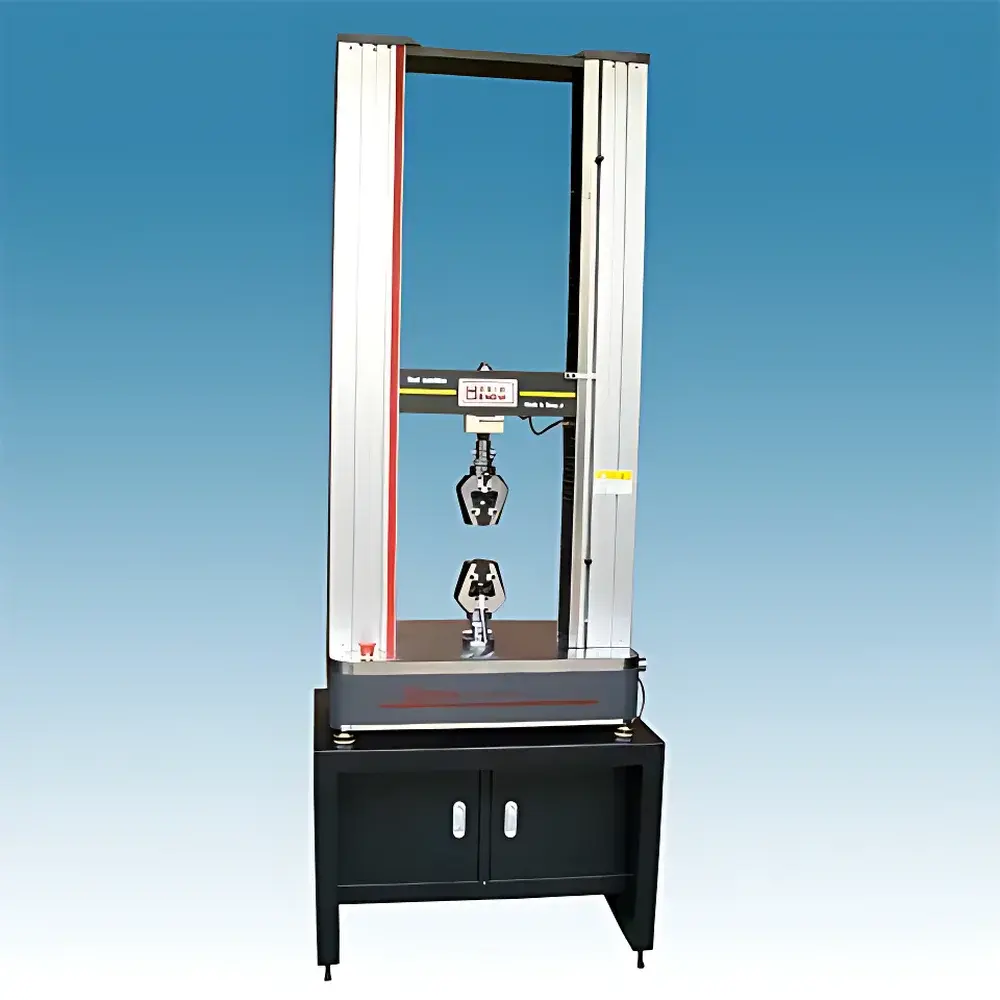
Hengyi HY-0580ERG Orthopedic Bending Strength Testing Machine
| Brand | Hengyi / Hengyitest |
|---|---|
| Origin | Shanghai, China |
| Manufacturer Type | Direct Manufacturer |
| Product Category | Domestic |
| Model | HY-0580ERG |
| Price Range | USD 1,400 – 7,200 |
| Instrument Type | Electromechanical Universal Testing Machine |
| Load Capacity Options | 1 N to 5,000 N (interchangeable load cells) |
| Force Accuracy | ≤ ±0.5% of reading (Class 0.5 per ISO 7500-1) |
| Effective Test Width | 120 mm |
| Vertical Test Space | 800 mm |
| Speed Range | 0.001–500 mm/min (programmable, closed-loop control) |
| Speed Accuracy | ±0.5% of set value |
| Displacement & Strain Measurement Accuracy | ±0.5% of reading |
| Force Resolution | ±500,000 counts (full-scale, no range switching) |
| Stress/Strain Control Rate Range | 0.002–6% FS/s |
| Constant-Load/Displacement/Deformation Control Range | 0.5–100% FS |
| Safety Features | Electronic travel limits, overload protection (110% FS), auto-diagnostic system |
| Power Supply | 220 V AC, 50 Hz, 750 W |
| Net Weight | 95 kg |
| Dimensions (W×D×H) | 470 × 400 × 1510 mm |
| Operating Environment | 20–40 °C, 20–80% RH |
Overview
The Hengyi HY-0580ERG Orthopedic Bending Strength Testing Machine is a high-precision electromechanical universal testing system engineered for biomechanical evaluation of orthopedic implants, biomaterials, and structural components under static and quasi-static loading conditions. It operates on the principle of servo-controlled axial force application combined with real-time displacement and strain feedback, enabling compliant execution of tension, compression, bending, shear, peel, puncture, and cyclic fatigue tests per internationally recognized mechanical testing standards. Designed specifically for regulatory-compliant testing in orthopedic R&D, quality assurance, and preclinical validation labs, the HY-0580ERG delivers traceable, repeatable mechanical data required for ISO 14801, ASTM F2193, and FDA-submission-ready test reports.
Key Features
- Modular load cell architecture supporting interchangeable transducers from 1 N to 5,000 N—enabling single-system validation across micro-scale suture anchors and macro-scale spinal rods.
- Class 0.5 force accuracy (per ISO 7500-1) with ±500,000-count resolution and zero-range-switching operation ensures consistent sensitivity across full dynamic range.
- Closed-loop speed control with programmable ramp profiles (0.001–500 mm/min) and ±0.5% speed fidelity supports both slow-rate creep studies and rapid failure characterization.
- Dual-mode motion control: manual jog for rapid specimen alignment and automated return-to-start post-test—reducing operator intervention and improving throughput.
- Integrated electronic limit switches, over-travel cutoff, and 110% overload shutdown meet ISO 12100 functional safety requirements for laboratory equipment.
- Self-diagnostic firmware continuously monitors drive current, encoder feedback, and amplifier voltage—logging anomalies and triggering protective halts before hardware damage occurs.
- Compact footprint (470 × 400 × 1510 mm) optimized for ISO 17025-accredited lab spaces with controlled temperature (20–40 °C) and humidity (20–80% RH) environments.
Sample Compatibility & Compliance
The HY-0580ERG accommodates diverse orthopedic and biomaterial specimens—including metallic plates (titanium, stainless steel), polymer-based interbody cages (PEEK, UHMWPE), bioresorbable screws (PLLA, PDLLA), cortical bone analogs, vascular grafts, and soft-tissue fixation devices. Its 120 mm effective test width and 800 mm vertical stroke enable full-length testing of femoral nails, vertebral body replacements, and modular hip stems without sectioning. The system is preconfigured to execute test protocols aligned with YY/T 0342–2002 (bone plate bending stiffness), YY/T 0662–2008 (asymmetric screw mechanics), YY/T 1504–2016 (axial pullout of osteosynthetic screws), and GB/T 228.1–2010 (metal tensile behavior at ambient temperature). All control algorithms and data acquisition routines are structured to support audit-ready GLP documentation and 21 CFR Part 11–compliant electronic records when paired with validated software modules.
Software & Data Management
Bundled Hengyi TestSuite v4.x provides ISO/IEC 17025–aligned test method templates, real-time curve overlay (load vs. displacement, stress vs. strain), automatic yield point detection (0.2% offset method), and export of raw ASCII/CSV datasets for third-party statistical analysis (e.g., JMP, Minitab). Calibration certificates include NIST-traceable force verification reports with uncertainty budgets. Software supports user-defined pass/fail criteria, batch reporting, PDF certificate generation with digital signature fields, and role-based access control (administrator, technician, reviewer). Audit trail functionality logs all parameter changes, test initiations, and data exports with timestamps and operator IDs—meeting FDA 21 CFR Part 11 requirements for electronic signatures and record integrity.
Applications
- Mechanical validation of orthopedic implants per ISO 14801 (dental implants) and ASTM F2193 (spinal fixation systems).
- Bending moment and flexural rigidity assessment of locking compression plates (LCP), intramedullary nails, and pedicle screws.
- Static pullout strength quantification of cancellous bone screws under simulated physiological density conditions.
- Cyclic fatigue life evaluation of knee arthroplasty components using waveform-controlled sinusoidal or staircase loading.
- Tensile property mapping of electrospun collagen scaffolds and decellularized tendon matrices.
- Compression testing of porous titanium scaffolds per ASTM F2792 (additive manufacturing standards).
- Shear strength determination of bone–cement interfaces in revision hip arthroplasty models.
FAQ
Is the HY-0580ERG compliant with ISO 17025 calibration requirements?
Yes—the system supports external verification using Class E2 reference weights and certified torque calibrators; factory calibration certificates include measurement uncertainty statements per ILAC P14 guidelines.
Can the machine perform ASTM F2193-compliant spinal rod bending tests?
Yes—its 800 mm vertical clearance, 120 mm test width, and programmable three-point bending fixtures satisfy the span-to-diameter ratio and support geometry requirements defined in Section 7.3 of ASTM F2193.
Does the system support multi-axis synchronized testing?
No—the HY-0580ERG is a uniaxial electromechanical tester. For biaxial or torsional biomechanics, Hengyi offers the HY-TM8000 series as a complementary platform.
What is the recommended maintenance interval for the load cell and drive system?
Annual verification of force transducer linearity and encoder resolution is advised; routine cleaning of lead screws and lubrication of guide rails every 200 operational hours maintains positional fidelity.
Is third-party software integration (e.g., LabVIEW, MATLAB) supported?
Yes—TCP/IP and RS-232 communication protocols are exposed via documented API libraries, enabling custom automation scripts and real-time data streaming into external analysis environments.



