
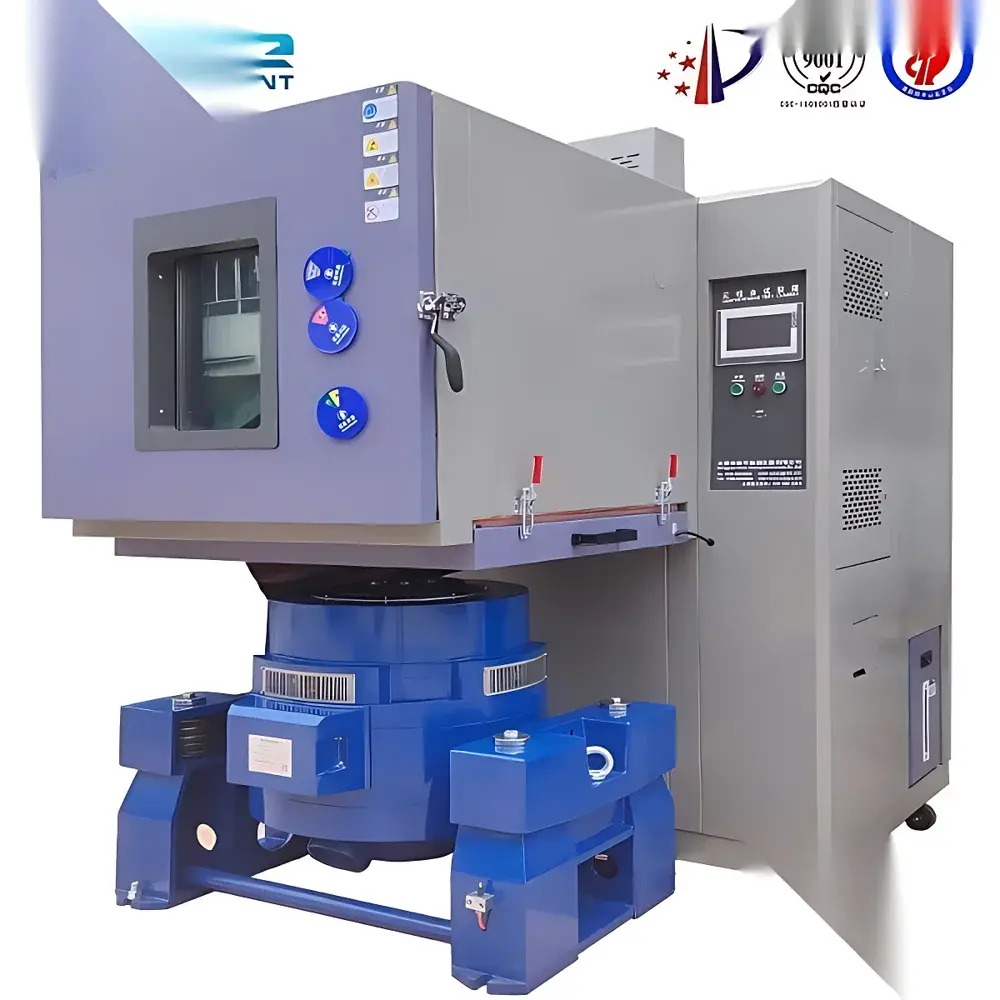
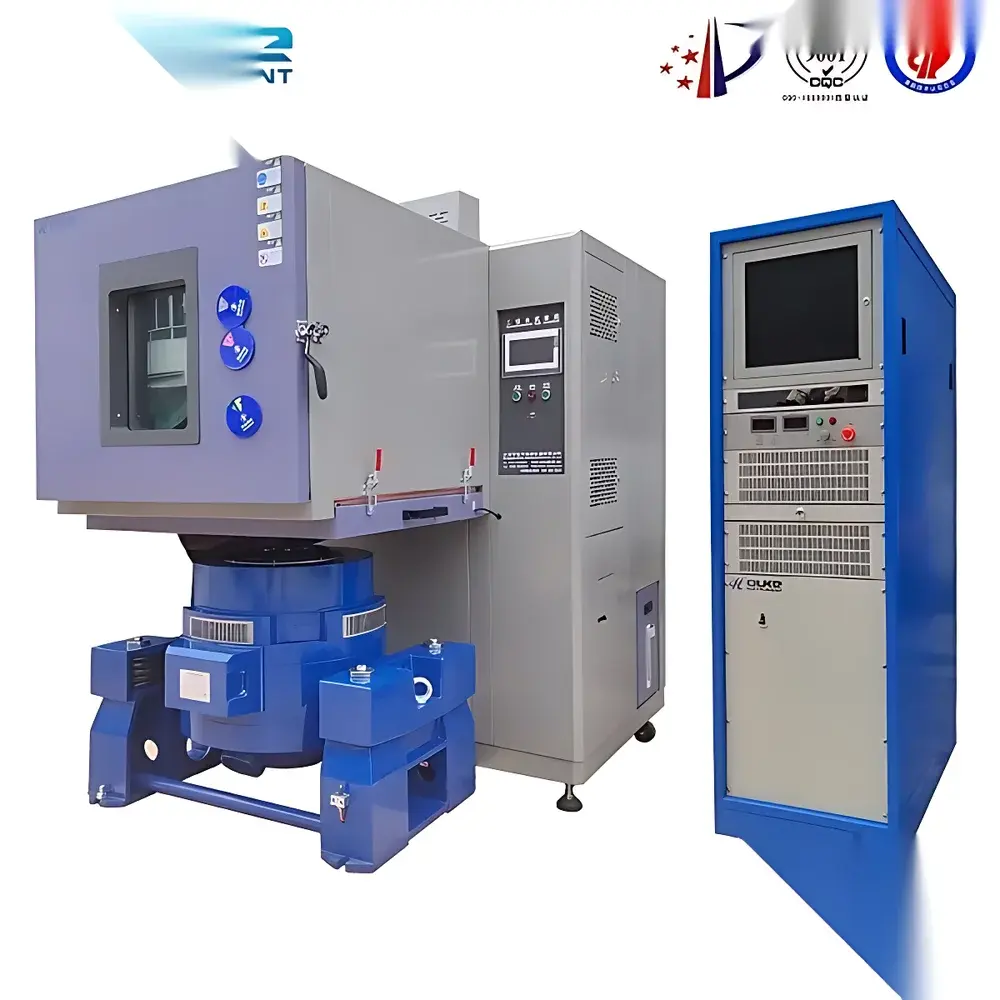
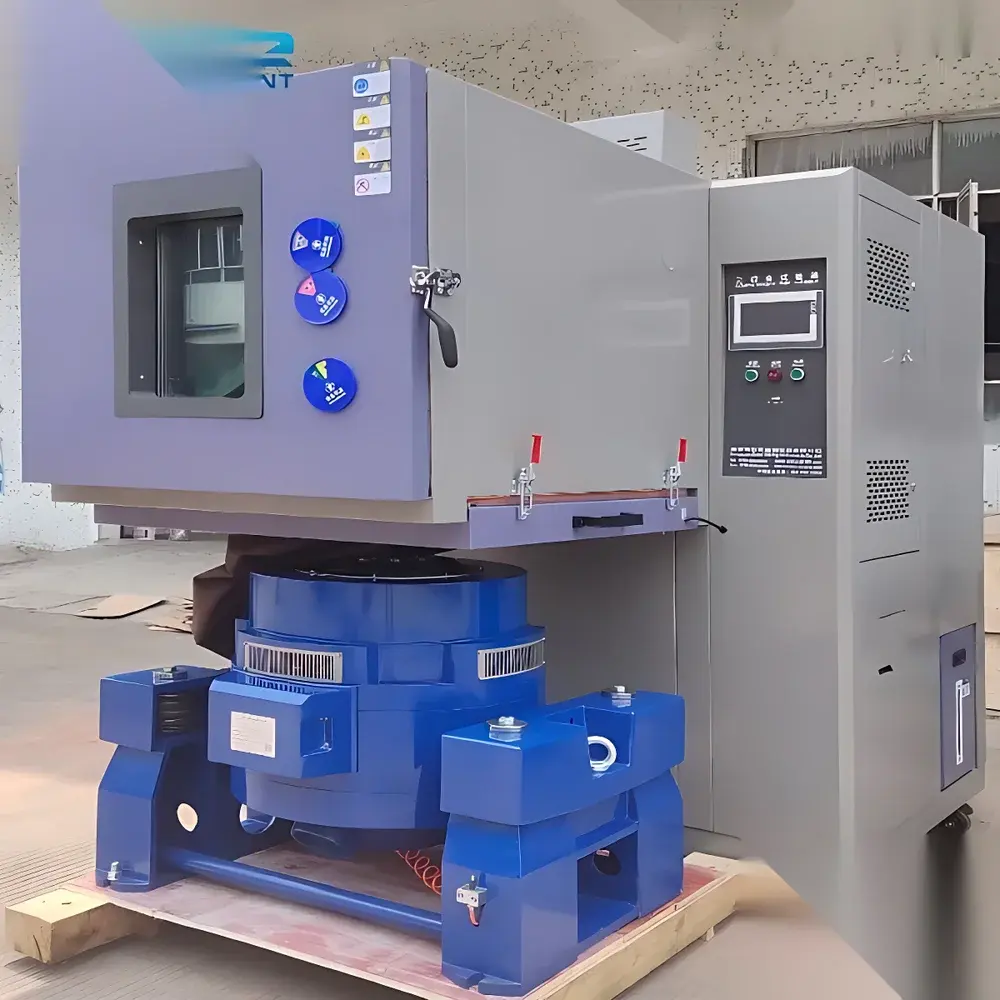
Combined Environmental Test Chamber – Temperature, Humidity & Vibration Integration System
| Brand | OEM / Custom-Built |
|---|---|
| Origin | Imported |
| Manufacturer Type | Authorized Distributor |
| Price | USD 21,500 (FOB) |
| Temperature Range | −70 °C to +150 °C |
| Humidity Range | 30–98 %RH |
| Temp. Uniformity | ≤ ±2.0 °C |
| Temp. Stability | ≤ ±0.5 °C |
| Humidity Stability | +2 / −3 %RH |
| Cooling Rate (no load) | 0.7–1.0 °C/min |
| Heating Rate (no load) | 1.0–3.0 °C/min |
| Refrigeration | Twin-stage cascade system with Tecumseh (France) hermetic piston compressors |
| Refrigerants | R404A / R23 / R14 (ODP-zero, GWP-optimized blend) |
| Expansion Control | Danfoss (Denmark) thermostatic expansion valves + capillary tubes |
| Solenoid Valves | SMC (Italy) |
| Evaporator & Condenser | Stainless-steel finned-tube assemblies, domestically fabricated per ASME BPVC Section VIII compliance |
Overview
The Combined Temperature-Humidity-Vibration Test Chamber is an integrated environmental simulation platform engineered for concurrent or sequential exposure of test specimens to controlled thermal, hygrothermal, and mechanical stress conditions. Based on the principle of accelerated environmental aging, it replicates real-world service environments—including extreme ambient temperature cycling, condensation-prone humidity profiles, and broadband random or sine vibration spectra—to assess product robustness, material integrity, and functional reliability under combined stress loads. This chamber conforms to the structural and operational requirements defined in IEC 60068-2-1 (cold), IEC 60068-2-2 (dry heat), IEC 60068-2-30 (damp heat cyclic), and ISO 16750-4 (road vehicle environmental conditions), enabling standardized qualification testing for electronics, aerospace components, automotive ECUs, medical devices, and industrial control systems.
Key Features
- Triple-stress integration architecture supporting simultaneous or programmable sequential application of temperature, humidity, and electrodynamic vibration—fully synchronized via a master control interface with sub-second time alignment.
- Cascade refrigeration system featuring dual-stage Tecumseh hermetic piston compressors, optimized for rapid transition across the full −70 °C to +150 °C range while maintaining stable low-temperature hold capability at −70 °C for ≥48 h.
- Humidity generation via steam injection with PID-controlled stainless-steel immersion heaters; dehumidification achieved through deep-cooling coil condensation coupled with hot-gas bypass modulation.
- Vibration subsystem integrates a 1000 kgf electrodynamic shaker with 76 mm stroke, capable of delivering 5–2000 Hz random spectra (up to 70 grms) and 5–3000 Hz sine sweeps (up to 100 gpeak), compliant with ISO 10816-1 and MIL-STD-810H Method 514.8.
- Chamber interior constructed from SUS304 stainless steel with seamless welds and electropolished finish; insulated with 150 mm thick polyurethane foam (λ = 0.022 W/m·K), achieving thermal loss <0.8 kW at −70 °C.
- Touchscreen HMI with embedded real-time data logging (100 Hz sampling), alarm history with timestamped event tagging, and configurable safety interlocks including door switch monitoring, overtemperature cutoff, and vibration emergency stop.
Sample Compatibility & Compliance
The chamber accommodates test specimens up to 1000 mm × 1000 mm × 1000 mm (W×D×H) with payload capacity of 150 kg on the vibration table. It supports standard mounting configurations including bolt-down fixtures, slip-table interfaces, and isolation mounts compatible with ISO 5344 mechanical interface specifications. All thermal and humidity performance metrics are verified per IEC 60068-3-5 (methods for determining performance characteristics) and ASTM E145-22 (standard specification for gravity-convection and forced-ventilation ovens). Calibration traceability follows ISO/IEC 17025:2017 through third-party accredited laboratories, with optional NIST-traceable certificate delivery.
Software & Data Management
Control and data acquisition are managed via proprietary Windows-based software compliant with FDA 21 CFR Part 11 requirements—including electronic signatures, audit trail logging (user actions, parameter changes, alarm triggers), and role-based access control (Administrator, Operator, Viewer). The software enables creation of multi-step test profiles with conditional branching (e.g., “if humidity exceeds 95%RH, reduce temperature ramp rate by 30%”), real-time overlay of vibration PSD vs. thermal/humidity trends, and automated export of CSV/Excel reports conforming to GLP/GMP documentation standards. Raw data archives are stored in encrypted SQLite databases with SHA-256 checksum verification and optional cloud backup integration.
Applications
This system serves as a core validation tool in design verification (DV), production validation (PV), and reliability growth testing (RGT) programs. Typical use cases include: thermal shock evaluation of BGA solder joints under combined humidity-induced swelling and vibration-induced fatigue; condensation resistance testing of optical sensor housings per ISO 9022-3; accelerated life testing of battery management systems exposed to −40 °C soak followed by 85 °C/85%RH dwell and 10–2000 Hz random vibration; and qualification of avionics enclosures per RTCA DO-160G Section 25 (temperature), Section 26 (humidity), and Section 20 (vibration). It is widely deployed in Tier-1 automotive suppliers, defense contractors certified to AS9100D, and ISO 13485-certified medical device manufacturers.
FAQ
What standards does this chamber support for combined environmental testing?
It natively supports test execution per IEC 60068-2-60 (combined temperature/humidity/vibration), MIL-STD-810H Method 520.5 (combined stresses), and RTCA DO-160G Sections 20/25/26 — with profile scripting flexibility for custom composite stress sequences.
Can vibration be applied during extreme low-temperature operation (e.g., −70 °C)?
Yes. The shaker’s cold-rated armature and reinforced suspension allow continuous operation down to −70 °C, with real-time compensation for thermal drift in force output and displacement feedback.
Is remote monitoring and control supported?
Standard Ethernet (TCP/IP) and optional 4G/LTE connectivity enable secure remote access via HTTPS-based web interface, with TLS 1.2 encryption and two-factor authentication.
What maintenance intervals are recommended for the refrigeration system?
Compressor oil analysis and refrigerant purity checks every 12 months; expansion valve calibration and solenoid response verification every 24 months — documented in accordance with ISO 55001 asset management guidelines.
Does the system include validation documentation for GxP environments?
Yes. IQ/OQ protocols compliant with Annex 15 (EU GMP) and ASTM E2500-22 are provided, along with completed URS, DQ, and risk assessment (FMEA) templates.



