
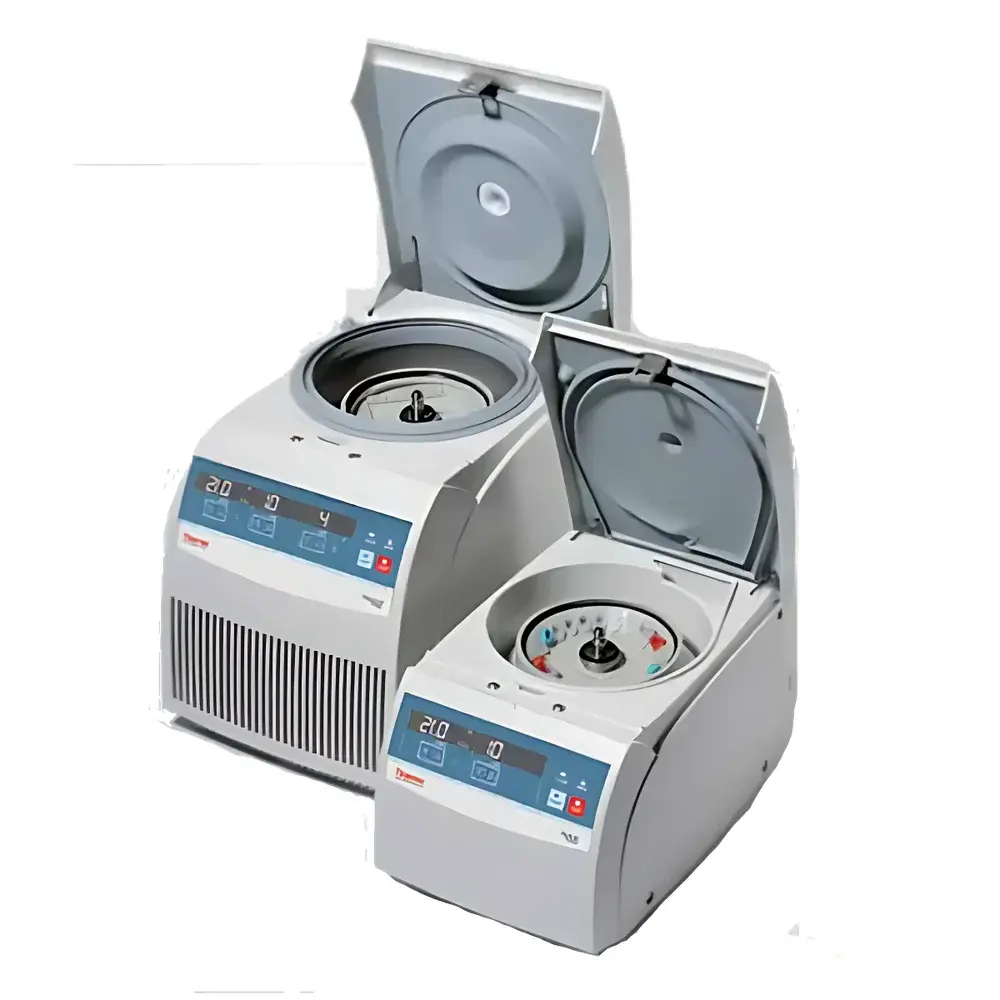
Thermo Scientific Pico & Fresco Microcentrifuges
| Brand | Thermo Fisher Scientific |
|---|---|
| Origin | Shanghai, China |
| Model | Pico & Fresco Microcentrifuge Series (Pico 17 / Pico 21 / Fresco 17 / Fresco 21) |
| Max RCF | 17,000 × g or 21,000 × g |
| Noise Level | <56 dBA (ventilated) / <50 dBA (refrigerated) |
| Motor | Brushless DC |
| Safety Certification | CAMR-validated ClickSeal® biocontainment |
| Rotor Materials | PPSU rotor lids, stainless steel rotors |
| Compliance | ISO 13485 design principles, GLP-compatible operation log |
| Dimensions (W×D×H) | 22.5 × 32.5 × 23.5 cm |
| Weight | ~12 kg |
Overview
The Thermo Scientific™ Pico and Fresco microcentrifuge series are compact, high-performance benchtop centrifuges engineered for precision separation of microliter-volume samples in molecular biology, clinical diagnostics, and biomedical research laboratories. Designed around the fundamental principle of radial acceleration-driven sedimentation, these instruments deliver controlled, reproducible g-forces to separate nucleic acids, proteins, cellular debris, and other biomolecular components from small-volume samples (0.2–2.0 mL). The Pico line operates in ventilated mode for ambient-temperature applications, while the Fresco series integrates a high-efficiency refrigeration system (–9 °C to 40 °C range) to preserve thermolabile analytes during extended or high-speed runs. Both platforms utilize brushless DC motors to eliminate mechanical wear, reduce electromagnetic interference, and ensure silent, vibration-free operation—critical for maintaining sample integrity and minimizing laboratory acoustic load.
Key Features
- Two-tier RCF capability: Select between 17,000 × g (Pico 17 / Fresco 17) for routine DNA/RNA purification and 21,000 × g (Pico 21 / Fresco 21) for accelerated pelleting of viscous lysates or low-abundance targets—reducing run time by up to 20% without compromising recovery yield.
- ClickSeal® biocontainment rotors: Independently validated by the UK’s Centre for Applied Microbiology & Research (CAMR), these self-locking rotor lids provide hermetic sealing against aerosol escape during operation, meeting biosafety Level 2 (BSL-2) containment requirements and supporting compliance with WHO Laboratory Biosafety Manual guidelines.
- Chemically resistant PPSU (polyphenylsulfone) rotor lids: Offering mechanical strength comparable to polycarbonate and stainless steel, plus broad solvent compatibility (including ethanol, isopropanol, and dilute acids/bases), while remaining fully autoclavable at 121 °C for repeated sterilization cycles.
- Intuitive human-centered interface: Backlit LCD display with dedicated speed/RCF/time/temperature keys; real-time parameter feedback; programmable quick-start presets; and audible end-of-run alert with visual indicator.
- Low-noise architecture: Acoustic emission maintained below 56 dBA (Pico) and 50 dBA (Fresco) at maximum speed—enabling continuous use in shared lab spaces without disruption to adjacent instrumentation or personnel concentration.
Sample Compatibility & Compliance
The Pico & Fresco platform supports standardized microvolume containers without adapters: 24-position fixed-angle rotors accommodate all common 1.5 mL and 2.0 mL conical tubes; dual-row rotors simultaneously process 18 × 1.5/2.0 mL + 18 × 0.5 mL tubes; specialized carriers include 36-position 0.5 mL rotors, PCR strip-compatible rotors (for 8-tube strips), and capillary hematocrit rotors. All rotors are balanced to ISO 1940-1 G2.5 grade and certified for continuous operation at rated RCF. Instrument firmware logs rotor ID, cycle count, and maintenance history—supporting traceability under GLP and GMP frameworks. While not FDA 510(k)-cleared as an IVD device, the system conforms to ISO 13485-aligned manufacturing controls and includes documentation packages suitable for internal audit and regulatory inspection readiness.
Software & Data Management
These centrifuges operate via embedded firmware with no external PC dependency. However, optional Thermo Scientific Centri-Log™ data export module (sold separately) enables USB-based transfer of run logs—including timestamp, set parameters, actual RCF, temperature profile (Fresco), rotor serial number, and error codes—to CSV or PDF format. Audit trail functionality records operator-initiated changes and system events with tamper-resistant timestamps, aligning with 21 CFR Part 11 principles for electronic records where local validation protocols are implemented. Firmware updates are delivered via secure USB flash drive with cryptographic signature verification.
Applications
- Routine nucleic acid isolation (plasmid prep, PCR cleanup, column-based RNA extraction)
- Protein precipitation and desalting prior to MS analysis
- Cellular fractionation workflows involving cytoplasmic/nuclear extract preparation
- Microbiological sample concentration (e.g., viral particles, exosomes, bacterial pellets)
- Hematocrit determination using capillary tube rotors in clinical point-of-care settings
- High-throughput library preparation for next-generation sequencing (NGS) workflows
FAQ
What is the difference between Pico and Fresco models?
The Pico series is air-cooled and operates at ambient temperature; the Fresco series features active refrigeration with adjustable setpoints from –9 °C to 40 °C.
Can I use third-party rotors or adapters?
No—only Thermo Scientific–certified rotors are validated for safety and performance. Use of non-OEM components voids warranty and compromises ClickSeal® containment integrity.
Is the instrument compatible with ISO/IEC 17025-accredited labs?
Yes—the design, calibration traceability (NIST-traceable tachometer verification), and operational logging support method validation and equipment qualification per ISO/IEC 17025:2017 Clause 6.4.
How often does the rotor require recalibration or certification?
Rotors do not require recalibration but must undergo periodic visual inspection for stress cracks and corrosion. Thermo recommends annual third-party balance certification for GLP/GMP environments.
Does the centrifuge meet electromagnetic compatibility (EMC) standards?
Yes—it complies with EN 61326-1:2013 for laboratory equipment and meets FCC Part 15 Class B limits for conducted and radiated emissions.



