
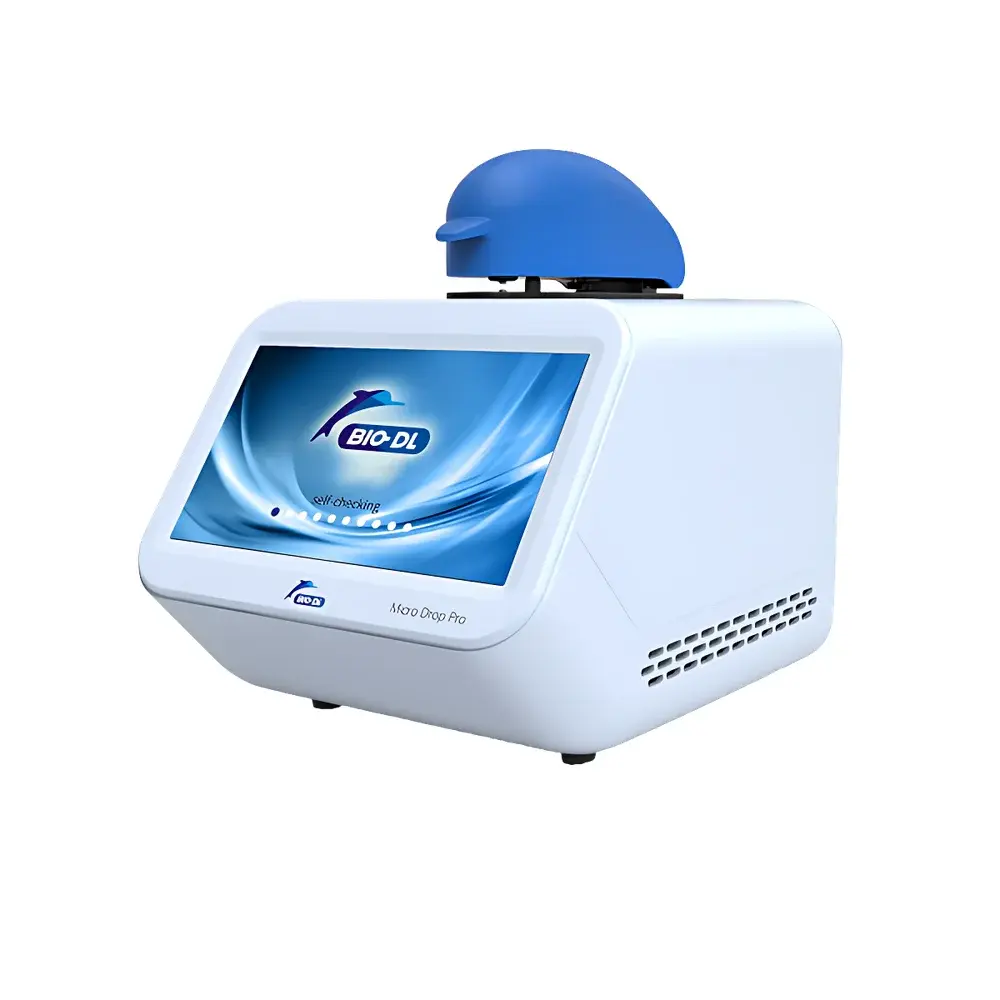
BIO-DL Microdrop Plus Ultra-Micro Spectrophotometer
| Brand | BIO-DL |
|---|---|
| Origin | Shanghai, China |
| Model | Microdrop Plus |
| Wavelength Range | 185–910 nm |
| Sample Volume (Capillary Mode) | 0.5–2 µL |
| Sample Volume (Cuvette Mode) | Standard 10 mm pathlength cuvettes |
| Detection Sensor | 2048-pixel linear CCD array |
| Display | 7-inch high-resolution color touchscreen |
| Internal Storage | High-capacity embedded memory |
| Connectivity | USB and Wi-Fi |
| Temperature Control & Stirring | Available in cuvette mode |
| Optical Path Adjustment | Automatic variable-pathlength technology |
| Compliance | Designed for GLP-compliant workflows |
Overview
The BIO-DL Microdrop Plus Ultra-Micro Spectrophotometer is a benchtop absorption-based analytical instrument engineered for rapid, label-free quantification and spectral characterization of nucleic acids, proteins, and other UV-Vis absorbing biomolecules. It operates on the principle of fixed-wavelength absorbance measurement and full-spectrum scanning (185–910 nm) using a high-stability xenon flash lamp and a precision optical grating monochromator system. Unlike traditional spectrophotometers requiring dilution or large-volume cuvettes, the Microdrop Plus integrates dual-mode sample handling—capillary-based microvolume measurement and standard 10 mm cuvette compatibility—enabling direct analysis of as little as 0.5 µL of undiluted sample. Its optical architecture minimizes stray light and ensures photometric accuracy across the deep UV into the near-infrared region, supporting applications ranging from oligonucleotide purity assessment (A260/A280, A260/A230) to protein concentration determination via Bradford or BCA-compatible absorbance at 595 nm or 562 nm.
Key Features
- 7-inch capacitive color touchscreen interface with intuitive graphical navigation—no external PC required for routine operation
- Automatic variable optical pathlength technology: dynamically adjusts effective pathlength (0.02–1.0 mm) to maintain linearity across wide concentration ranges (e.g., dsDNA: 2–3700 ng/µL), eliminating manual dilution steps
- Dual detection modes: microvolume mode (0.5–2 µL on polished quartz pedestal) and cuvette mode (10 mm pathlength, with optional Peltier-controlled temperature regulation and magnetic stirring)
- High-fidelity spectral acquisition: 2048-element linear CCD detector with <0.5 nm wavelength resolution and photometric accuracy ±0.002 Abs at 1.0 Abs (at 546 nm)
- Onboard data management: internal flash storage retains >10,000 spectra and associated metadata; export via USB or encrypted Wi-Fi to LIMS or ELN systems
- Robust mechanical design: aluminum alloy chassis, vibration-damped optical baseplate, and sealed optical compartment for long-term stability in shared lab environments
Sample Compatibility & Compliance
The Microdrop Plus accommodates diverse biological and chemical sample types without modification: native or fragmented DNA/RNA, purified proteins (including membrane-associated variants), synthetic oligos, dyes (e.g., Cy3/Cy5), nanoparticles, and small-molecule pharmaceuticals. Cuvette mode supports both aqueous and organic solvents (e.g., ethanol, DMSO) within standard quartz or UV-transparent plastic cuvettes. The instrument’s firmware and data export protocols are structured to align with Good Laboratory Practice (GLP) and ISO/IEC 17025 requirements. Audit trails—including user ID, timestamp, method parameters, raw spectra, and calibration logs—are automatically generated and exportable in CSV or XML formats. While not FDA 21 CFR Part 11-certified out-of-the-box, its secure user authentication, electronic signature support (via optional software module), and immutable result archiving enable qualification for regulated QC/QA environments under internal SOP governance.
Software & Data Management
The embedded operating system provides real-time spectral visualization, baseline correction, peak integration, and built-in calculation modules for common assays (e.g., Nanodrop-style nucleic acid ratios, extinction coefficient-based protein quantitation). Raw absorbance data (.spc binary format) and processed reports (.pdf/.csv) are stored with embedded instrument configuration and environmental metadata (ambient temperature, humidity if logged externally). Optional PC software extends functionality: spectral library matching, multi-curve overlay, kinetic time-course analysis (in cuvette mode), and automated report generation compliant with internal quality control templates. All data transfers comply with TLS 1.2 encryption over Wi-Fi and adhere to IEEE 802.11ac standards for interference-resistant connectivity in dense instrumentation environments.
Applications
- Quantitative assessment of extracted genomic DNA, plasmid preps, and RNA integrity prior to NGS library preparation
- Routine verification of protein concentration and aggregation state in purification workflows (e.g., SEC fractions, dialysates)
- Verification of labeling efficiency for fluorescently tagged antibodies or probes
- Monitoring enzymatic reaction progress via NADH/NADPH absorbance at 340 nm
- Characterization of gold nanoparticle size distribution through surface plasmon resonance peak analysis (520–580 nm)
- Quality control of synthetic peptides and modified oligonucleotides in process development labs
FAQ
Does the Microdrop Plus require regular recalibration?
No—factory calibration is traceable to NIST standards and remains stable for 12 months under normal use. Optional annual verification kits (certified neutral density filters and holmium oxide reference) are available for in-house performance checks.
Can the instrument measure turbid or viscous samples accurately?
Microvolume mode is optimized for clear, low-viscosity solutions. For turbid samples (e.g., lysates), cuvette mode with background subtraction and extended integration time is recommended; however, scattering effects may necessitate centrifugation or filtration prior to analysis.
Is method transfer possible between Microdrop and Microdrop Plus instruments?
Yes—method files (.mth) created on legacy Microdrop systems are forward-compatible with Microdrop Plus firmware v3.2+, preserving wavelength sets, calculation formulas, and display layouts.
What maintenance is required for the quartz measurement pedestal?
The pedestal requires only dry lint-free wipe after each sample; no solvents or abrasives. Residue buildup is mitigated by the hydrophobic coating applied during manufacturing—typical service life exceeds 50,000 measurements without degradation in reproducibility.
How does the automatic pathlength adjustment ensure accuracy across concentrations?
The system uses real-time reflectance feedback from the sample surface to determine optimal focal distance and effective pathlength, validated against a proprietary algorithm trained on >10⁴ empirical absorbance–concentration datasets across 20+ biomolecular classes.
Related Products






