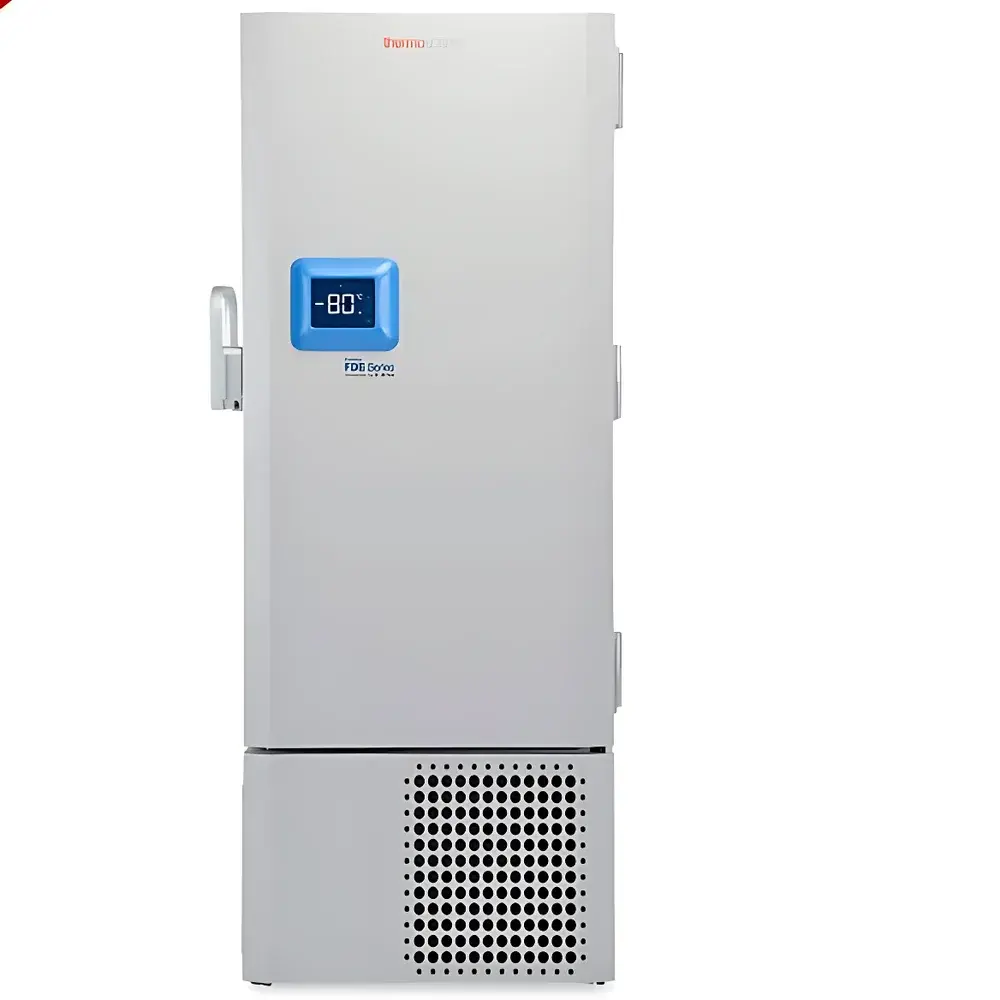
Thermo Fisher Scientific Forma FDE Series Ultra-Low Temperature Freezer
| Brand | Thermo Fisher Scientific |
|---|---|
| Origin | USA |
| Model | Forma FDE Series |
| Capacity Options | 300 / 400 / 500 / 600 standard 2-inch cryoboxes |
| Power Consumption | 11.6 kWh/day |
| Noise Level | ≤50 dB(A) |
| Insulation | Water-blown polyurethane foam |
| Refrigerants | R170 (ethane) and R290 (propane), SNAP- and F-Gas-compliant |
| Door Configuration | Four inner doors with embedded magnetic latches |
| Exterior Finish | Powder-coated steel, >1000 hr salt-spray resistant |
| Interior Finish | Galvanized steel |
| Thermal Hold Time (unpowered, -50°C) | 297 minutes |
| Compliance | Meets ISO 13485 design controls |
Overview
The Thermo Fisher Scientific Forma FDE Series Ultra-Low Temperature Freezer is an engineered solution for long-term biobanking, clinical sample archiving, and pharmaceutical stability storage at sustained -80°C operating temperatures. Designed using Couette-flow-optimized refrigeration architecture and dual-stage cascade cooling with natural hydrocarbon refrigerants (R170 and R290), the FDE platform delivers thermodynamic stability without reliance on high-global-warming-potential (GWP) synthetic refrigerants. Its chamber temperature uniformity is maintained within ±2.5°C across all load configurations—verified per IEC 61000-4-11 and ASTM F2697 protocols—ensuring consistent cryopreservation integrity for sensitive biological matrices including primary cells, stem cell lines, mRNA constructs, and tissue specimens.
Key Features
- Four independently sealed inner doors with integrated magnetic latches minimize cold air loss during routine access, reducing thermal recovery time to <12 minutes after a 30-second door opening event.
- Water-blown polyurethane insulation eliminates ozone-depleting substances and volatile organic compound (VOC) emissions during manufacturing and service life, supporting LEED-certified laboratory infrastructure requirements.
- HIC (Human Interface Control) touchscreen panel with intuitive icon-driven navigation enables rapid parameter adjustment, alarm acknowledgment, and system diagnostics without requiring specialized training.
- Acoustically optimized compressor mounting and low-turbulence airflow pathways achieve operational noise levels of ≤50 dB(A)—comparable to residential refrigerator environments—making the FDE suitable for open-plan core facilities and shared lab spaces.
- Pressure-equalization vent ensures smooth outer door re-opening within seconds, eliminating vacuum lock phenomena common in high-vacuum-insulated ULT freezers.
- Galvanized steel interior surfaces resist corrosion from repeated ethanol or sodium hypochlorite decontamination cycles, while powder-coated exterior meets ASTM B117 salt-spray resistance standards (>1000 hours).
Sample Compatibility & Compliance
The FDE Series accommodates standardized cryogenic storage formats—including 2-inch (50.8 mm) cryoboxes, 1.2 mL and 2.0 mL internally threaded vials, and rack-based specimen trays—without compromising thermal homogeneity. Chamber geometry and forced-air circulation are validated for uniform temperature distribution under full-load conditions (per ISO 14644-1 Class 5 cleanroom-compatible airflow modeling). The system supports compliance with ISO 20387:2018 (biobanking), USP (cryopreservation), and EU Annex 15 (qualification of storage equipment). Its hardware architecture allows integration into enterprise-level environmental monitoring systems (EMS) with configurable alarm thresholds, data logging intervals, and electronic signature support for 21 CFR Part 11–aligned workflows.
Software & Data Management
Embedded firmware includes real-time temperature trending, event logging (door openings, power interruptions, alarm triggers), and configurable email/SNMP alerts. When connected to Thermo Fisher’s SampleManager LIMS or third-party platforms via Modbus TCP or BACnet/IP, the FDE exports timestamped sensor data—including evaporator coil temperature, condenser pressure, and cabinet ambient delta-T—for traceable chain-of-custody documentation. Audit trails record all user-initiated configuration changes with operator ID, timestamp, and pre-/post-value states—meeting GLP and GMP data integrity requirements for regulated biopharma applications.
Applications
- Clinical biobanks maintaining IRB-approved human biospecimens under CAP/CLIA-accredited conditions
- Cell therapy manufacturing suites requiring continuous -80°C storage of viral vectors and cryopreserved CAR-T products
- Academic genomics cores archiving DNA/RNA libraries and CRISPR guide RNA stocks
- Pharmaceutical stability programs conducting ICH Q5C long-term frozen storage assessments
- Vaccine development labs storing lyophilized antigen preparations and adjuvant formulations
FAQ
What is the thermal hold time during power failure?
At ambient 25°C, the FDE maintains ≤-50°C for up to 297 minutes when fully loaded and unpowered—validated per NSF/ANSI 456 Annex C.
Does the FDE support remote monitoring and alarm notification?
Yes—via Ethernet interface with configurable SMTP, SNMP v3, or REST API endpoints for integration into centralized facility management systems.
Are validation documents (IQ/OQ/PQ protocols) available?
Thermo Fisher provides factory-tested IQ/OQ documentation packages compliant with ISO/IEC 17025-accredited calibration practices; PQ templates are supplied for site-specific execution.
Can the unit be installed in non-dedicated mechanical rooms?
Its low heat rejection profile (≤1.2 kW total thermal load) and absence of condensate drainage enable placement in general laboratory corridors or modular cleanrooms meeting ASHRAE 110 airflow specifications.
Is the refrigerant system serviceable in the field?
Hydrocarbon refrigerant circuits are hermetically sealed and certified for zero annual leakage (<0.1% capacity loss/year); field service requires EPA Section 608 Type II certification and proprietary manifold tools.