
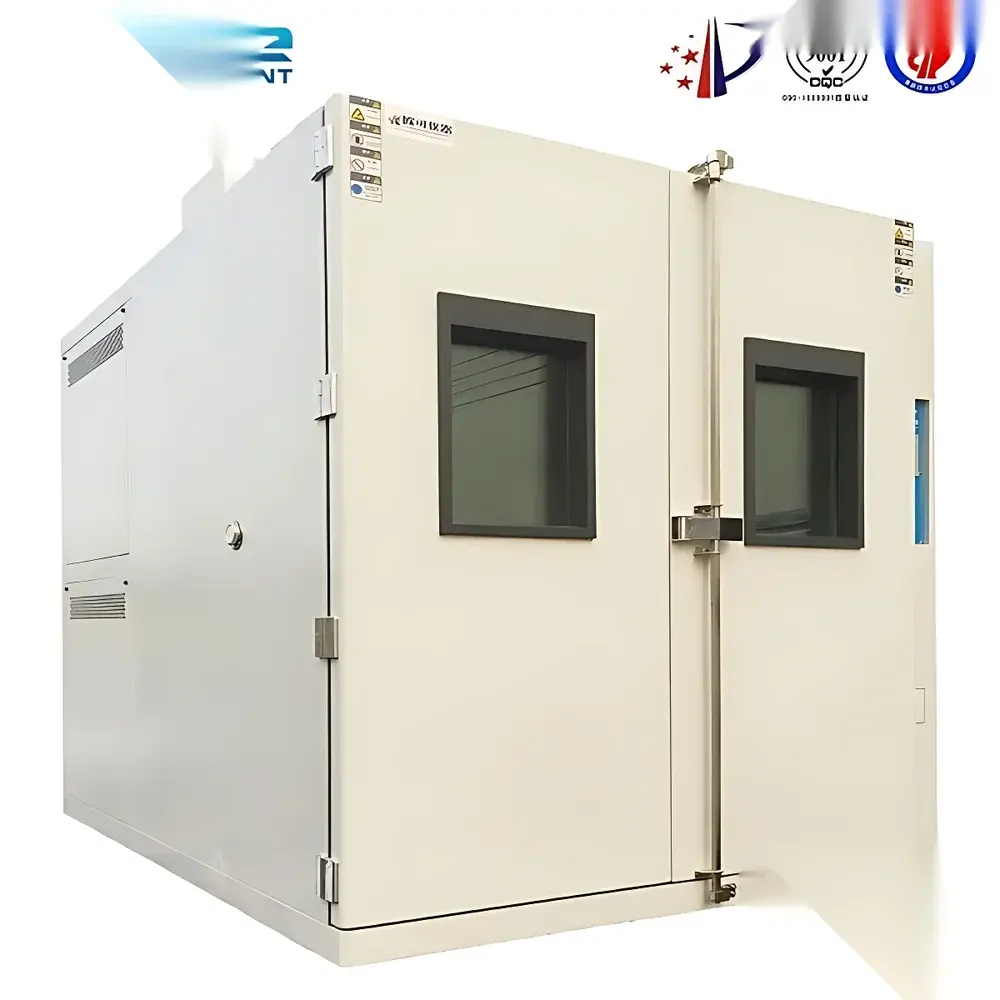
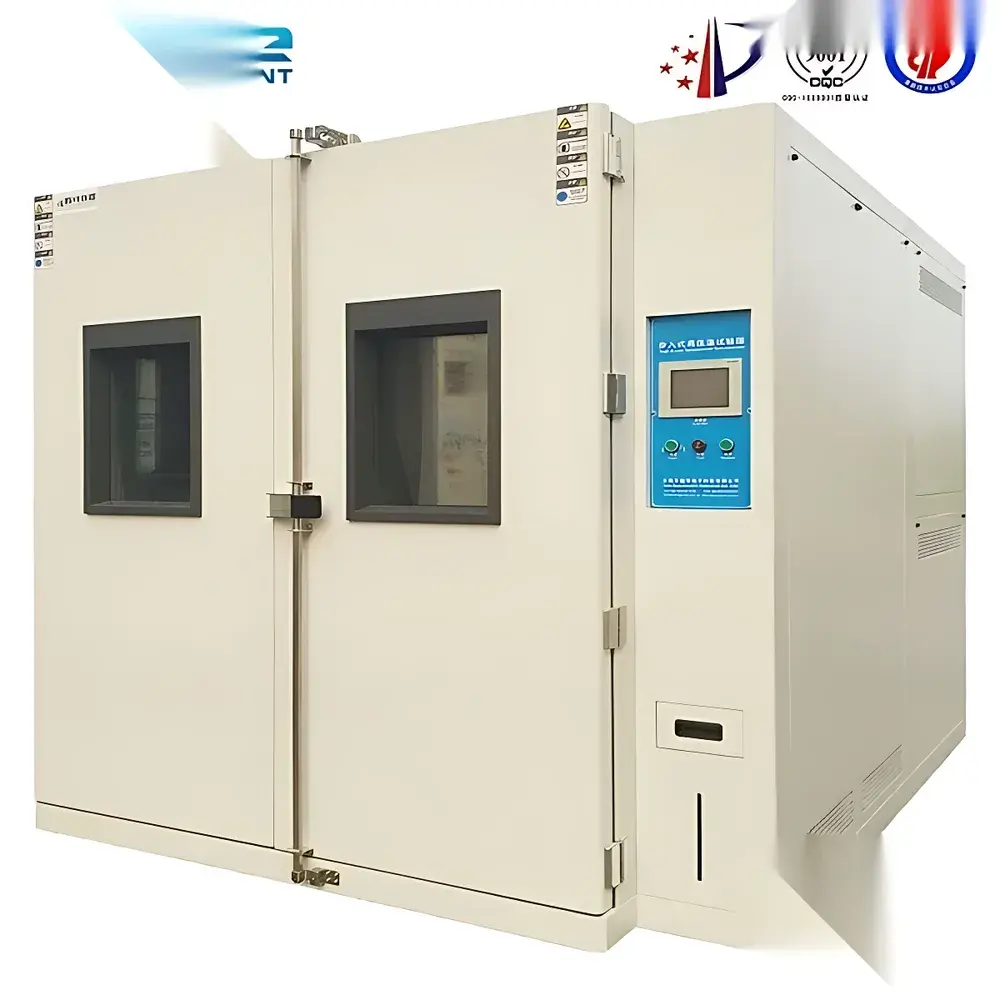
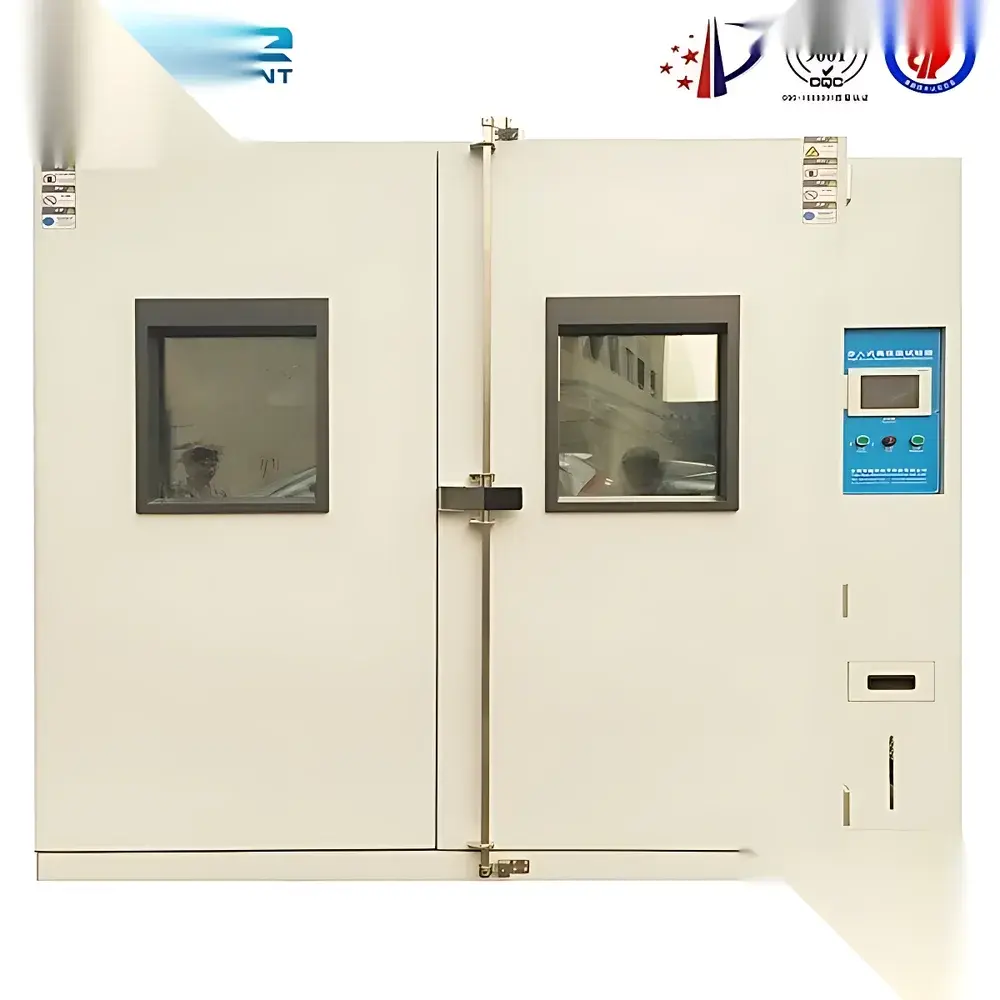
Custom-Built Large-Volume Environmental Test Chamber (Temperature & Humidity Controlled)
| Brand | Other Brands |
|---|---|
| Origin | Imported |
| Manufacturer Type | Authorized Distributor |
| Temperature Range | 0°C to 80°C (Standard) |
| Optional Low-Temp Models | −20°C, −40°C, or −60°C |
| Humidity Range | 20–98% RH (Custom Options: 5–98% RH, 10–98% RH, or 20–98% RH) |
| Control System | Microprocessor-Based PID + SSR + Timer |
| Safety Protections | Compressor Overheat/Overcurrent/High-Pressure Protection, Condenser Fan Overheat, Oil Pressure Monitoring, Phase Sequence & Phase Loss Detection, Earth Leakage Protection, Dry-Heating Prevention, Overload & Short-Circuit Protection, Overtemperature Cut-off, Sample Power Interface: Relay-Controlled AC220V ≤2A |
| Data Logging | PC Connectivity Supported (Optional External Recorder) |
Overview
The Custom-Built Large-Volume Environmental Test Chamber is an engineered solution for long-duration, high-fidelity simulation of temperature and humidity conditions across industrial R&D, quality assurance, and reliability testing environments. Designed around a precision-engineered air distribution system, the chamber ensures uniform thermal and hygric profiles throughout its entire internal volume—critical for validating product behavior under real-world climatic stress. Its operational principle relies on dual-loop microprocessor-controlled regulation: independent PID algorithms govern refrigeration cycle modulation and steam/humidification actuation, while SSR-driven power delivery enables stable, jitter-free setpoint maintenance. The chamber accommodates walk-in configurations with fully customizable footprint and height dimensions, enabling integration into existing facility layouts without structural compromise.
Key Features
- Optimized airflow architecture with laminar flow diffusers and recirculation baffles—validated via ISO 16750-4 thermal mapping protocols—to achieve ±0.5°C temperature uniformity and ±3% RH stability across full load conditions.
- Eco-compliant refrigerant (R-407C or R-134a, per regional regulatory requirements) integrated with high-efficiency scroll compressors and copper-aluminum finned condensers for low GWP operation and extended service life.
- Intuitive LCD interface with multilingual menu navigation (English, German, Japanese), real-time trend graphs, and password-protected parameter locking compliant with ISO/IEC 17025 calibration traceability workflows.
- Comprehensive safety architecture including compressor oil pressure monitoring, phase sequence validation, earth leakage detection (≤30 mA trip threshold), and fail-safe relay-based sample power interruption during fault events.
- Integrated diagnostic logging: all alarm triggers (e.g., “Condenser Fan Overtemp”, “Humidifier Dry-Run”) are timestamped and stored in non-volatile memory, supporting root-cause analysis per IEC 61508 functional safety guidelines.
Sample Compatibility & Compliance
The chamber supports test specimens up to 5 m³ in volume, accommodating full-size automotive ECUs, telecom base station cabinets, medical imaging subsystems, and aerospace avionics enclosures. Internal construction uses stainless steel 304 walls and epoxy-coated aluminum flooring—resistant to corrosion from high-humidity cycling and condensate exposure. All electrical components meet UL 61010-1 and CE EN 61000-6-3 EMC standards. Humidity generation employs stainless steel steam generators with deionized water feed compatibility; optional demineralization kits ensure compliance with ASTM D2247 and IEC 60068-2-78 test methods. Full system documentation—including factory calibration certificates, FAT/SAT reports, and material declarations—is provided to support FDA 21 CFR Part 11 and ISO 13485 audit readiness.
Software & Data Management
PC connectivity is enabled via RS-485 (Modbus RTU) or Ethernet (TCP/IP), allowing seamless integration with LabVIEW, MATLAB, or enterprise MES platforms. Optional data loggers record temperature/humidity at user-defined intervals (1 sec to 60 min resolution) with CSV export and automatic time-stamped file naming. Audit trails include operator ID, parameter changes, alarm acknowledgments, and system startup/shutdown events—fully compliant with GLP/GMP electronic record retention requirements. Remote monitoring capability supports SNMP traps and email alerts for critical faults, configurable via web-based admin portal.
Applications
- Accelerated aging of polymer composites and battery enclosures under cyclic 40°C/93% RH conditions per SAE J2412.
- Pre-conditioning of optical sensors prior to vibration testing, maintaining ±0.3°C stability over 72-hour dwell periods.
- Validation of HVAC control logic in smart building prototypes using programmable ramp-soak profiles.
- Environmental stress screening (ESS) of printed circuit assemblies per IPC-9701, including thermal shock transitions between −40°C and 85°C.
- Long-term reliability assessment of IoT edge devices operating continuously at 60°C/85% RH for >1,000 hours.
FAQ
What is the standard lead time for custom chamber fabrication?
Typical lead time is 12–16 weeks following final dimensional approval and safety specification sign-off.
Can the chamber be configured for rapid thermal cycling?
Yes—optional high-capacity refrigeration packages and auxiliary heating banks enable ramp rates up to 10°C/min within the −40°C to 80°C range.
Is third-party calibration certification included?
Factory calibration with NIST-traceable probes is standard; ISO/IEC 17025-accredited calibration is available as an add-on service.
How is humidity accuracy verified across the full range?
Chambers undergo dual-point verification (25°C/30% RH and 60°C/95% RH) using chilled-mirror hygrometers traceable to PTB standards.
Does the system support automated test sequencing?
Yes—via optional software module supporting up to 99 programmable steps with conditional branching, dwell timers, and external trigger inputs.



