
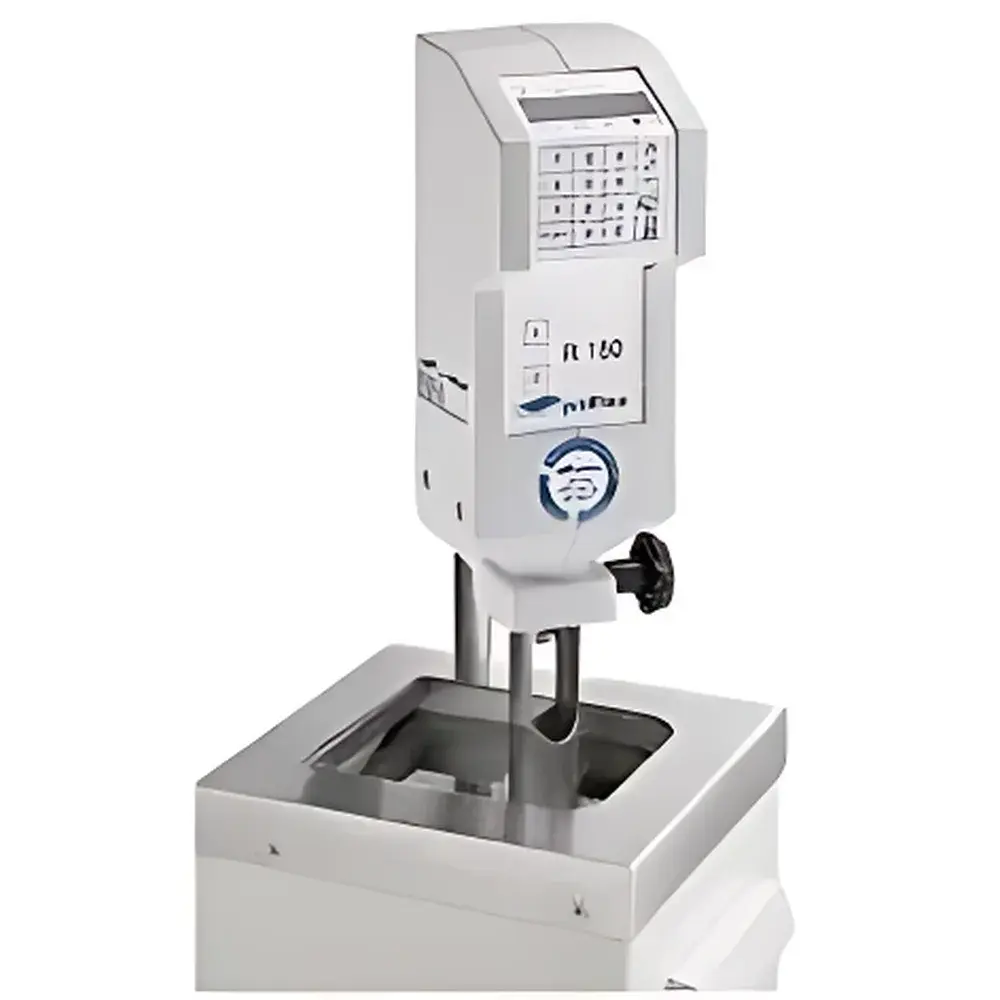
proRheo R140 / R180 Rotational Viscometer
| Brand | proRheo |
|---|---|
| Origin | Germany |
| Model | R140, R180 |
| Instrument Type | Rotational Viscometer |
| Viscosity Range | 2–10,000,000 mPa·s |
| Shear Rate Range | 0.8–3,000 s⁻¹ |
| Torque Range | 0.25–10 mN·m |
| Torque Accuracy | ±0.01 mN·m |
| Rotational Speed Range | 5–1,000 rpm |
| Speed Accuracy | ±1 rpm |
| Temperature Range | −9.9 to 99.9 °C (extendable to 1400 °C with optional accessories) |
| Compliance | DIN 53018, DIN 53019, ISO 2555 |
Overview
The proRheo R140 and R180 are precision-engineered rotational viscometers designed for reliable, repeatable viscosity and basic rheological characterization under controlled shear conditions. Operating on the Couette principle, these instruments measure torque generated when a rotating spindle (rotor) shears a fluid sample confined between the spindle and a stationary outer cup—or, in open-bath configurations, immersed directly in bulk sample. The resulting torque and rotational speed data enable calculation of dynamic viscosity (η = τ/γ̇), shear stress (τ), and shear rate (γ̇), supporting quantification of Newtonian behavior as well as yield point estimation via controlled-shear-rate or controlled-shear-stress protocols. Engineered for laboratory and QC environments, the R180 variant supports both sealed-cup and open-system operation—enabling flexibility across routine quality control and method development workflows without hardware reconfiguration.
Key Features
- High-torque motorized drive system delivering stable rotational speeds from 5 to 1,000 rpm with ±1 rpm accuracy, ensuring consistent shear history across measurements.
- Dual-mode measurement architecture: compatible with standard concentric cylinder (cup-and-bob) geometry for high-precision viscosity determination, and adaptable to standard spindles (e.g., LV, RV, HA types) for open-bath testing per ASTM D2196 and ISO 2555.
- Integrated torque transducer with resolution down to 0.01 mN·m and full-scale range of 0.25–10 mN·m, enabling accurate low-viscosity and high-yield-stress material evaluation.
- Modular temperature control support: base unit operates from −9.9 to 99.9 °C; optional Peltier-cooled jackets, circulating baths, or high-temperature furnace attachments extend operational range up to 1400 °C for ceramic slurries, molten polymers, or metallurgical melts.
- Robust mechanical architecture with vibration-damped base and precision-ground spindle couplings, minimizing mechanical drift during extended runs or low-shear measurements.
Sample Compatibility & Compliance
The R140/R180 series accommodates a broad spectrum of industrial and research-grade samples—including solvent-based paints, aqueous polymer dispersions, non-Newtonian food emulsions, cosmetic gels, ceramic slips, asphalt binders, and thermosetting resins. Its geometric flexibility supports compliance with multiple international test standards: DIN 53018 (viscosity of paints and varnishes), DIN 53019 (rotational viscometry of plastics), and ISO 2555 (determination of apparent viscosity of polymer solutions). When configured with GLP-compliant software modules and audit-trail-enabled hardware logging, the system meets foundational requirements for regulated environments aligned with FDA 21 CFR Part 11 and EU Annex 11 expectations for data integrity.
Software & Data Management
Instrument control and data acquisition are managed via proRheo’s proprietary PC-based software suite, supporting real-time display of viscosity, shear stress, shear rate, torque, and temperature. The software enables programmable multi-step ramp profiles (e.g., shear-rate sweeps, time-dependent thixotropy loops), automatic yield point calculation using Bingham, Casson, or Herschel-Bulkley models, and export of raw datasets in CSV or Excel-compatible formats. All measurement sessions include timestamped metadata (operator ID, instrument serial number, calibration status), and optional configuration allows encrypted storage and electronic signature integration for audit-ready documentation in GMP or ISO 17025-accredited laboratories.
Applications
- Quality assurance of coating formulations: monitoring batch-to-batch consistency of viscosity and flow behavior at application-relevant shear rates.
- Rheological profiling of personal care products: evaluating structural recovery after shear, yield stress thresholds for pump dispensing, and thermal stability across product shelf life.
- Process optimization of ceramic and refractory slurries: correlating green-body strength with low-shear viscosity and thixotropic index measured at 0.1–10 s⁻¹.
- Characterization of edible oils and sauces: detecting oxidative thickening or emulsion breakdown through time-sweep and temperature-ramp experiments.
- Pre-screening of polymer melts and adhesives: assessing molecular weight distribution proxies via zero-shear viscosity extrapolation and melt elasticity indicators.
FAQ
What is the difference between the R140 and R180 models?
The R180 includes dual-mode capability—supporting both sealed cup-and-bob geometry and open-bath spindle measurements—while the R140 is optimized for fixed-geometry cup-based operation only.
Can the instrument perform yield stress measurements?
Yes—via controlled shear-rate ramps or controlled shear-stress tests, with post-processing options for Bingham, Casson, and Herschel-Bulkley model fitting.
Is temperature control integrated or optional?
The base unit includes internal temperature sensing; active temperature control requires optional accessories such as Peltier elements, recirculating chillers, or high-temperature furnaces.
Does the system comply with 21 CFR Part 11 requirements?
When deployed with validated software modules, electronic signatures, and audit-trail logging enabled, the platform supports Part 11 compliance for regulated pharmaceutical and biotech applications.
What calibration standards are recommended?
NIST-traceable silicone oil standards (e.g., Cannon, Brookfield) spanning 1–1,000,000 mPa·s are recommended for routine verification; factory calibration certificates include uncertainty budgets per ISO/IEC 17025 guidelines.



