
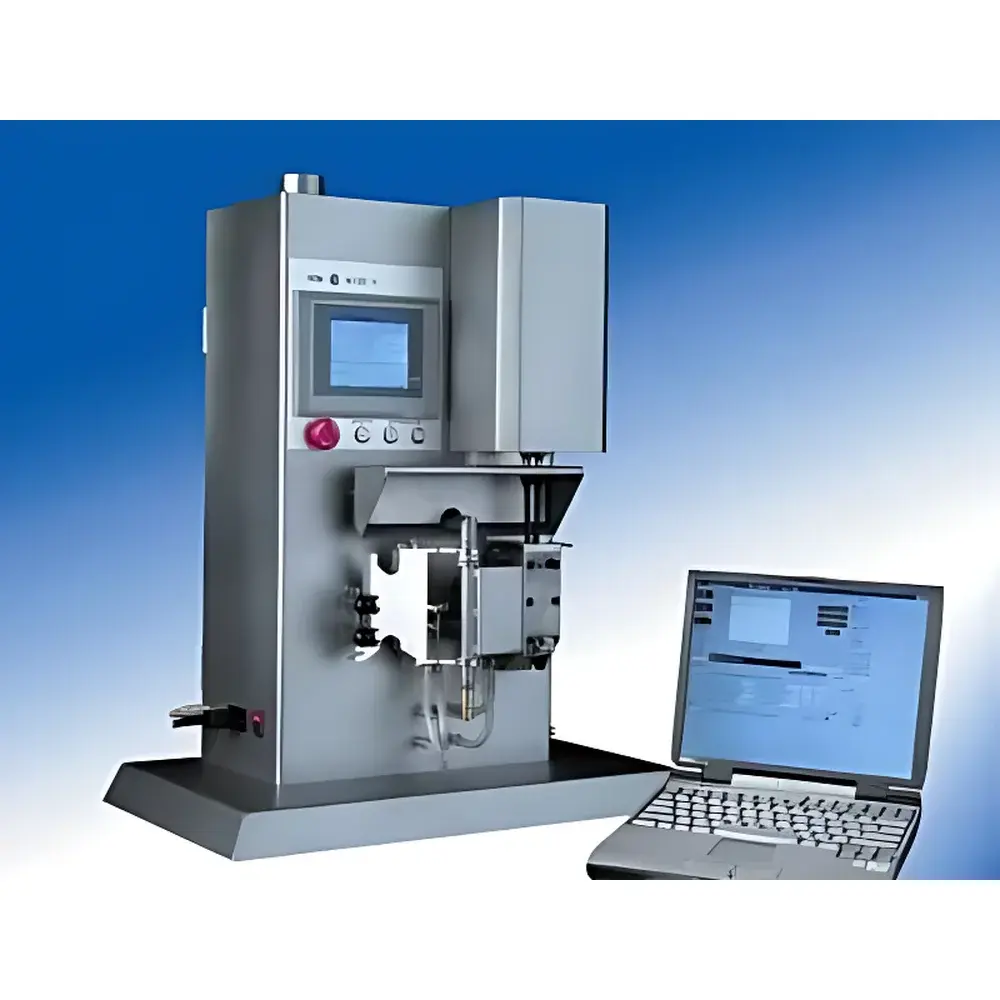
Xplore DSM Micro Twin-Screw Extruder
| Origin | Netherlands |
|---|---|
| Manufacturer Type | Authorized Distributor |
| Origin Category | Imported |
| Model | DSM Xplore |
| Price | €150,000 |
Overview
The Xplore DSM Micro Twin-Screw Extruder is an engineered laboratory-scale compounding system designed for high-fidelity process simulation and material development in polymer science, elastomer formulation, and additive-enabled composites. Operating on the principle of co-rotating intermeshing twin-screw extrusion, it replicates key rheological and thermal histories encountered in industrial-scale extrusion—while reducing material consumption to as little as 3 mL per batch. Its core architecture integrates a split-barrel mixing chamber with precision-machined conical screws, enabling full disassembly for rapid cleaning, geometry verification, and wear monitoring. The system employs Couette-type shear flow under controlled axial force, allowing direct correlation between mechanical load (N), torque (N·m), and melt viscosity (Pa·s)—a critical capability for structure–property relationship studies in R&D labs where sample scarcity or cost restricts conventional trial volumes.
Key Features
- Vari-Batch™ multi-channel configuration supporting discrete batch volumes of 3 mL, 7 mL, and 15 mL—enabling systematic scale-up studies without hardware modification
- Split-barrel design with HRC 65 hardened steel housing and 2000 HV PVD coating, chemically resistant from pH 0–14 and up to 450 °C
- Removable conical screws (HRC 54, 1000 HV coating) with adjustable screw clearance—facilitating geometry-dependent shear profiling
- Six independently controlled heating zones plus nine integrated thermocouples for precise axial temperature gradient control (standard max: 350 °C; optional: 450 °C)
- Digital DC main drive with continuous speed regulation (1–250 rpm) and real-time axial force measurement (up to 5000 N standard; 9500 N in continuous-mode configuration)
- Integrated air/water cooling circuits and nitrogen purging manifold for oxygen-sensitive formulations
- Touchscreen HMI with embedded control logic and audit-trail-capable data logging compliant with GLP and FDA 21 CFR Part 11 requirements
Sample Compatibility & Compliance
The DSM Xplore extruder accommodates thermoplastics (e.g., PP, PE, PA, PC), thermoplastic elastomers (TPEs), filled systems (glass/carbon fiber, nanoclays), reactive formulations (peroxide-cured EPDM, silane-grafted polyolefins), and highly viscous biopolymers (PLA, PHA). Its chemically inert barrel and screw surfaces ensure compatibility with aggressive additives (halogenated flame retardants, acidic catalysts, metal soaps) and solvents used in masterbatch pre-dispersion. All wetted components meet ISO 80000-5 standards for dimensional stability under thermal cycling, and the system supports ASTM D3835 (plastic extrusion characterization) and ISO 1133-2 (melt flow rate correlation via pressure–flow modeling). Mechanical calibration certificates traceable to NIST standards are provided with each unit.
Software & Data Management
The proprietary Xplore Control Suite delivers synchronized acquisition of 32+ real-time parameters—including barrel zone temperatures, screw speed, motor torque, axial thrust, melt pressure (optional transducer), and feed rate—sampled at 10 Hz. Process data are timestamped, encrypted, and stored in .csv and HDF5 formats with metadata tagging (operator ID, recipe version, ambient conditions). Batch reports include rheological profiles (apparent viscosity vs. shear rate), thermal history overlays, and axial force–torque hysteresis loops. Software supports automated method sequencing, alarm-triggered shutdown (e.g., overtemperature, excessive axial load), and export-ready templates aligned with internal SOPs and regulatory submissions (e.g., ICH Q5, Q7).
Applications
- Rapid screening of polymer blends and compatibilizer efficacy under representative residence time distributions
- Development of conductive nanocomposites requiring controlled dispersion without agglomeration
- Thermal stability assessment of heat-sensitive biopolymers during melt processing
- Reactive extrusion optimization (grafting, crosslinking, degradation kinetics) with inline sampling ports
- Correlation of lab-scale extrusion outputs with downstream injection molding performance (via direct coupling to Xplore micro-injection molder)
- Method transfer validation for QC/QA protocols in GMP-regulated medical device polymer manufacturing
FAQ
What is the minimum required sample mass for a valid experiment?
For reproducible rheological output, ≥2.5 g is recommended for 3 mL Vari-Batch™ mode; lower masses (<1.5 g) may be used for qualitative screening but require extended equilibration and yield higher inter-batch variability.
Can the system operate in continuous feed mode?
Yes—when equipped with the pneumatic gravimetric feeder and cooled feed throat, the extruder supports steady-state operation at defined throughput rates (0.1–15 g/min), enabling residence time distribution analysis and pilot-scale parameter mapping.
Is third-party software integration supported?
The system exposes OPC UA and Modbus TCP interfaces for bidirectional communication with LIMS, MES, or custom Python/Matlab environments—enabling closed-loop optimization and digital twin deployment.
How is cleaning validated after processing abrasive fillers?
A stainless-steel brush kit (included) enables non-destructive removal of carbon-black or mineral-filled residues; post-cleaning verification is performed via visual inspection of barrel inner diameter and axial force baseline drift (<±2% over 10 cycles).
Does the system comply with electrical safety standards for EU laboratories?
Yes—it carries CE marking per EN 61000-6-2 (EMC immunity) and EN 61000-6-4 (EMC emissions), and meets IEC 61000-3-12 for harmonic current limits in shared lab power networks.






