
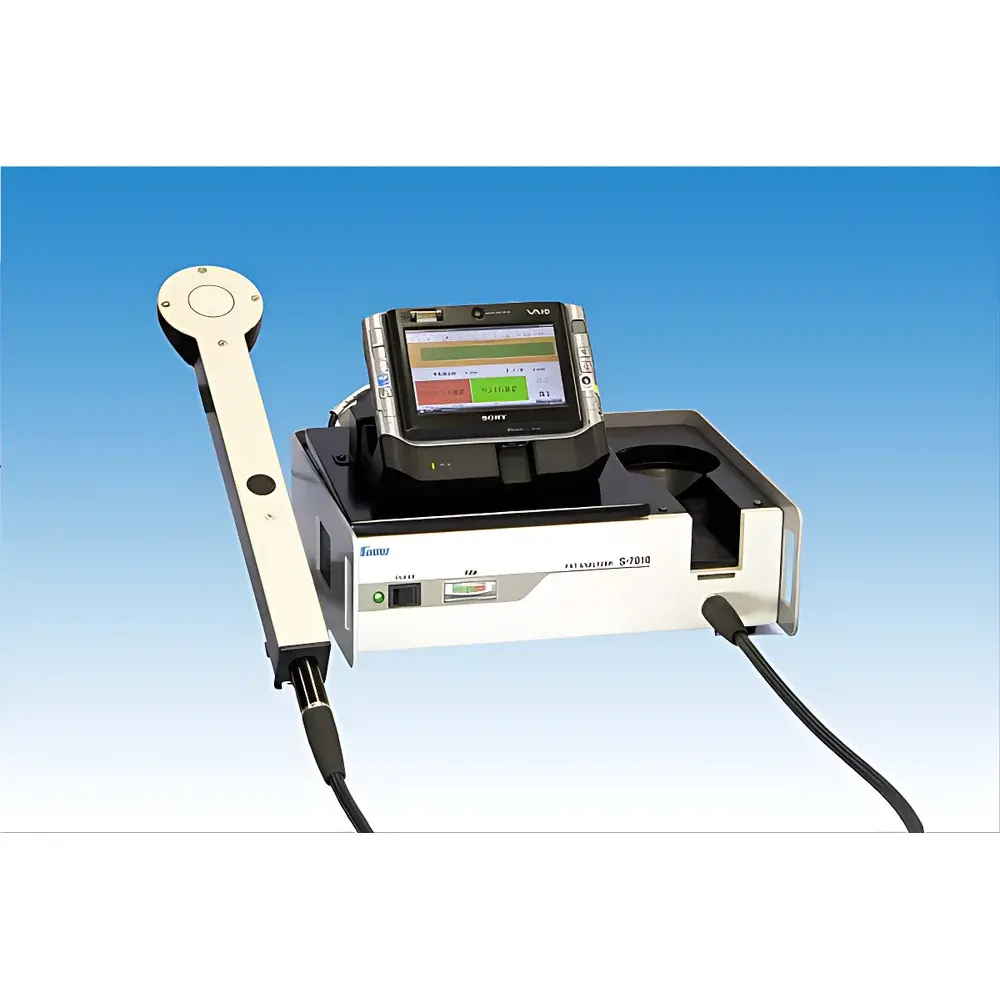
SAMA S-7010 Portable Near-Infrared Spectrometer for Meat Fat Analysis
| Brand | SAMA |
|---|---|
| Origin | Japan |
| Model | S-7010 |
| Instrument Type | Portable |
| Principle | Multi-channel Fourier Transform NIR |
| Wavelength Range | 700–1050 nm |
| Scan Speed | 1 s per spectrum |
| Data Sampling Interval | 3 s |
| Measurement Time | 2–3 s per sample |
| Chemometrics Software | S-7010 Software |
| Light Source | Halogen lamp (avg. lifetime: 40,000 h) |
| Detector | 16-bit ADC |
| Interface | USB 2.0 |
| Power Supply | 6 × rechargeable AA batteries |
| Operating Time | ~1 h |
| Dimensions (W×H×D) | 296 × 98 × 233 mm |
| Weight | 5.3 kg |
| Application Scope | Academic research & QC in meat science, food chemistry, and agricultural laboratories |
Overview
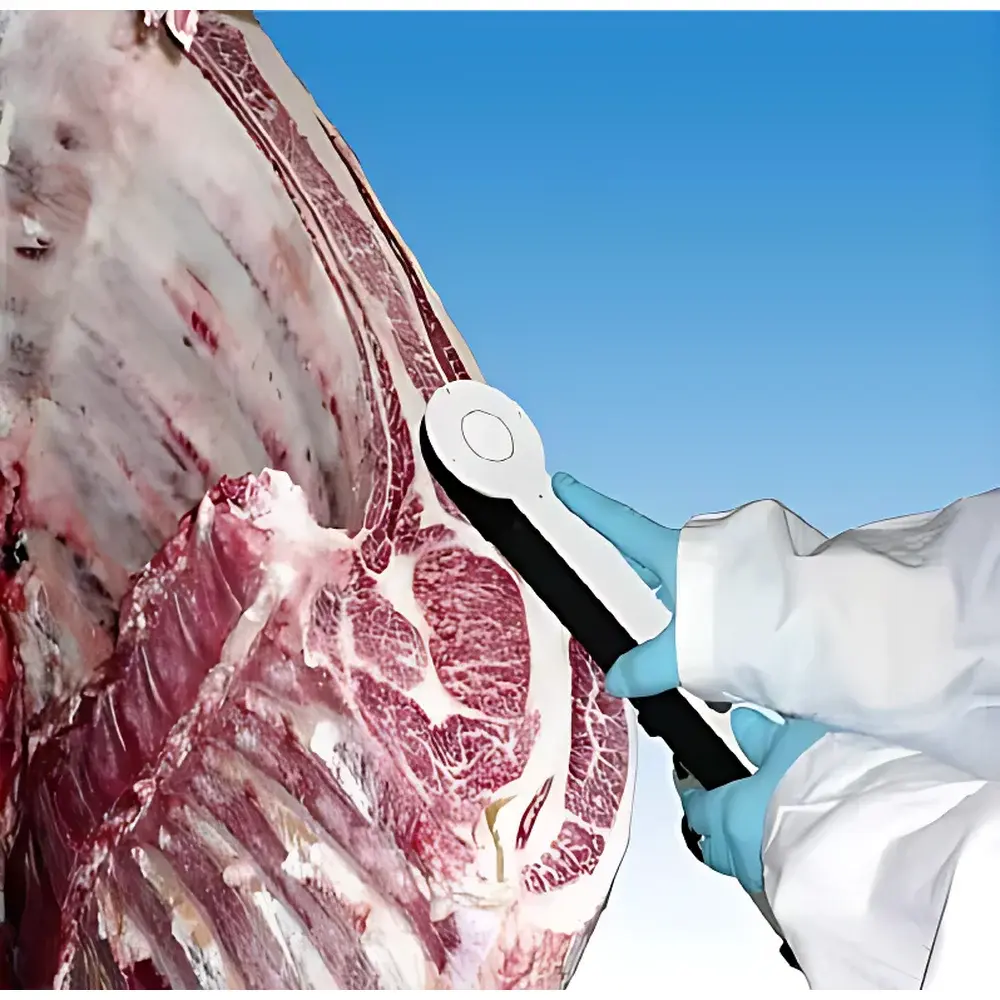
The SAMA S-7010 is a purpose-engineered portable near-infrared (NIR) spectrometer designed for rapid, non-destructive quantification of fat composition in fresh and processed meat samples—specifically pork and beef. Leveraging multi-channel Fourier transform (FT-NIR) architecture, the instrument delivers high signal-to-noise ratio spectra across a robust 700–1050 nm spectral window, optimized for C–H and O–H overtone and combination band absorption features characteristic of fatty acid moieties. Unlike dispersive or filter-based NIR systems, the FT-NIR design ensures inherent wavelength accuracy, long-term photometric stability, and resistance to mechanical drift—critical for field-deployable calibration transfer between instruments and laboratories. The S-7010 operates without sample preparation: direct contact measurement on intact meat surfaces enables real-time assessment of key compositional parameters including oleic acid (C18:1), saturated fatty acids (SFA), and monounsaturated fatty acids (MUFA), supporting breeding evaluation, slaughterhouse grading, and quality assurance workflows.
Key Features
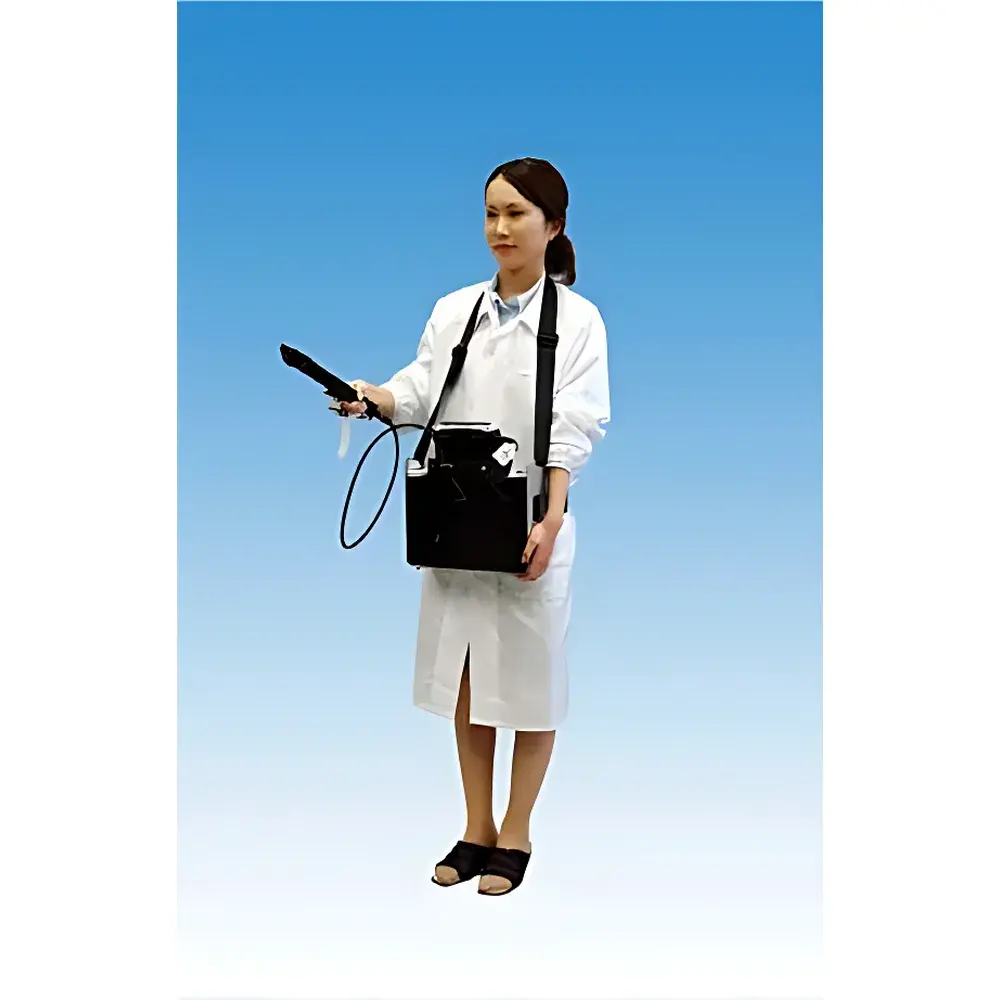
- True portable FT-NIR platform: Compact form factor (296 × 98 × 233 mm) and integrated rechargeable power system enable operation in abattoirs, field stations, or teaching labs without external power or optical tables.
- High-speed acquisition: Full-spectrum capture in ≤1 second; repeat measurements completed in 2–3 seconds—enabling throughput of >20 samples/hour with operator consistency.
- Optimized optical path: 1250-mm fiber-optic probe with halogen illumination (40,000 h rated lifetime) ensures stable intensity output and minimal thermal drift during extended sessions.
- 16-bit analog-to-digital conversion: Provides sufficient dynamic range (>96 dB) to resolve subtle spectral differences among lean/fat ratios and fatty acid profiles across diverse genetic lines.
- USB 2.0 interface with plug-and-play compatibility: Supports direct data streaming to Windows-based host PCs; no proprietary drivers required beyond standard HID-class enumeration.
- Ruggedized mechanical design: Aluminum chassis and shock-absorbing elastomer feet meet IEC 60068-2-64 for operational vibration tolerance in industrial environments.
Sample Compatibility & Compliance
The S-7010 is validated for direct surface measurement on unground, chilled, or frozen pork and beef cuts—including loin, ribeye, and chuck—without homogenization or solvent extraction. Its non-invasive mode preserves sample integrity for downstream histological or sensory analysis. Calibration models are developed using reference methods compliant with AOAC Official Method 996.06 (fatty acid methyl ester GC) and ISO 12966-2:2017 (gas chromatography for lipid classes). While not certified for regulatory submission under FDA 21 CFR Part 11, the instrument supports GLP-aligned workflows via audit-trail-enabled software logging (user ID, timestamp, spectrum hash, calibration version) when used with S-7010 Chemometrics Suite v3.2+. All spectral data files adhere to ASTM E1781-22 (standard format for NIR spectral data exchange).
Software & Data Management
The bundled S-7010 Chemometrics Software provides full spectral preprocessing (Savitzky-Golay smoothing, multiplicative scatter correction, first/second derivative), PLS and PCR model development, cross-validation diagnostics (RMSEC, RMSECV, R²), and real-time prediction reporting. Models are stored as encrypted .mod files with embedded metadata (training set size, reference method, uncertainty estimates). Raw spectra export in JCAMP-DX v5.01 format ensures interoperability with Unscrambler®, MATLAB, or Python-based chemometrics pipelines (e.g., scikit-learn, PyMca). Software logs include operator login, measurement sequence IDs, and automatic backup to user-defined network paths—facilitating traceability in academic publications and internal QA documentation.
Applications
- Meat science research: Correlating NIR-predicted oleic acid content with marbling score, tenderness (Warner-Bratzler shear), and oxidative stability indices.
- Breeding program support: High-throughput phenotyping of live-animal progeny via carcass scans to estimate heritability of favorable fat composition traits.
- University teaching: Hands-on instruction in multivariate calibration, spectral preprocessing, and validation protocols aligned with AOAC and IUPAC guidelines.
- Quality control in processing facilities: On-line verification of fat trimming efficacy or formulation consistency in comminuted products (e.g., sausages, patties).
- Regulatory pre-screening: Rapid triage of suspect batches prior to confirmatory GC-FID analysis—reducing laboratory turnaround time by >60%.
FAQ
Does the S-7010 require annual factory recalibration?
No. The FT-NIR optical path is inherently self-referencing via internal He–Ne laser stabilization; only routine performance verification using NIST-traceable ceramic standards (recommended quarterly) is required.
Can calibration models be transferred between multiple S-7010 units?
Yes—provided all instruments share identical firmware version and probe alignment; model portability is enhanced by built-in wavelength normalization and intensity referencing routines.
Is the software compatible with macOS or Linux?
The S-7010 Chemometrics Suite is Windows-native (Windows 10/11, 64-bit); however, raw JCAMP-DX files are fully cross-platform and can be processed using open-source tools such as R (hyperSpec), Python (SpectroChemPy), or MATLAB.
What is the minimum sample area required for reliable measurement?
A contiguous surface area ≥25 mm² with uniform texture and moisture distribution is recommended; measurements on highly heterogeneous or exudative surfaces should be repeated ≥3 times and median-reported.
How is measurement repeatability quantified for fatty acid predictions?
Based on inter-day reproducibility studies (n=15 pork loins, 5 replicates/day over 3 days), standard deviation for oleic acid prediction is ≤0.42 wt% (CV = 2.1%) at typical concentrations of 15–25 wt%.
Related Products






