
ITACA DKV1/DKV8/PDMK Microwave Dielectric Constant Analyzer
| Brand | ITACA |
|---|---|
| Origin | Spain |
| Model(s) | DKV1, DKV8, PDMK |
| Frequency Range | 1.5–2.6 GHz (nominal, subject to MUT performance) |
| Permittivity (ε′) | < 100 |
| Loss Factor (ε′′) | 0.001–10 |
| Loss Tangent (tan δ) | < 0.1 |
| Measurement Accuracy | ±1–2% for ε′, ±2–5% for ε′′ (range-dependent) |
| RF Power Output | 0 dBm |
| Interface | USB |
| OS Compatibility | Windows 7/8/10 |
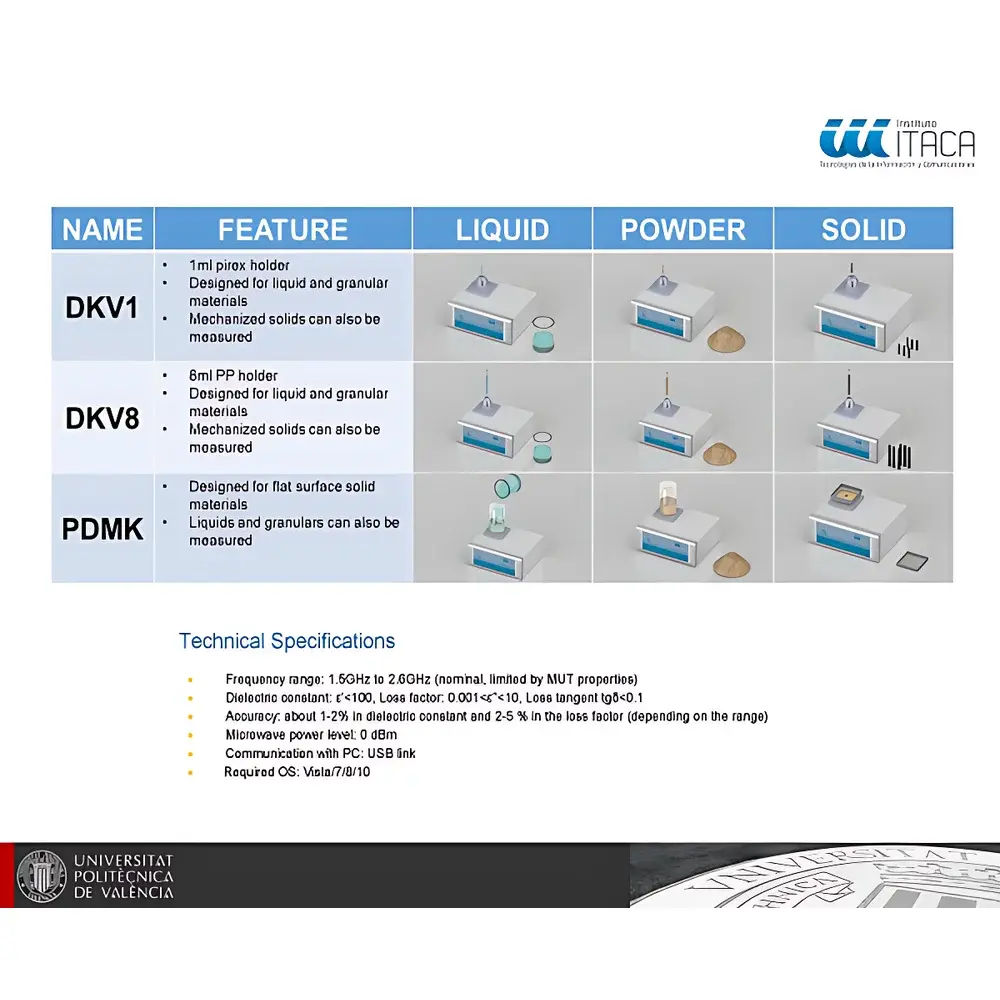
| Sample Types | Solid, Liquid, Powder |
| Compliance | Designed for ASTM D2520, ISO 18563-1, and IEC 60250–compliant workflows |
Overview
The ITACA DKV1, DKV8, and PDMK Microwave Dielectric Constant Analyzers are precision benchtop instruments engineered for non-destructive, contactless characterization of complex permittivity (ε* = ε′ − jε′′) in dielectric materials at microwave frequencies. Operating nominally within the 1.5–2.6 GHz band—with primary calibration and validation centered at the industrial ISM frequency of 2.45 GHz—these analyzers employ resonant cavity perturbation and transmission/reflection (S-parameter) methodologies, depending on configuration and MUT (Material Under Test) geometry. Unlike broadband impedance analyzers or low-frequency LCR meters, this system delivers high signal-to-noise ratio measurements under controlled field distribution conditions, enabling reliable extraction of both real permittivity (ε′) and imaginary loss factor (ε′′), from which tan δ = ε′′/ε′ is derived. The architecture is optimized for laboratory-based R&D and quality assurance environments where traceable, repeatable microwave dielectric data are critical for material selection, process validation, and electromagnetic simulation input.
Key Features
- Multi-model platform: DKV1 (compact cavity-based system for solid slabs and thin films), DKV8 (enhanced dynamic range and extended sample chamber for irregular or larger-volume samples), and PDMK (portable, modular design supporting both reflection-mode and transmission-mode configurations).
- High-resolution RF measurement engine with 0 dBm output power and integrated vector network analyzer (VNA)-compatible signal processing.
- USB-host interface with deterministic latency and driver support for Windows 7/8/10 (64-bit), enabling seamless integration into automated test sequences and lab information management systems (LIMS).
- Robust mechanical design with temperature-stabilized cavity housing, minimizing drift during extended acquisition cycles (typical thermal coefficient < 50 ppm/°C).
- Calibration traceability supported via supplied short-open-load-thru (SOLT) standards and reference dielectric tiles (e.g., fused silica, PTFE, alumina) certified per ISO/IEC 17025-accredited protocols.
Sample Compatibility & Compliance
The DKV series accommodates a broad spectrum of physical forms without requiring metallization or electrode deposition: rigid solids (ceramics, polymers, composites), free-flowing powders (catalysts, battery electrode fillers), and low-conductivity liquids (solvents, precursor solutions, encapsulants). Sample volume requirements range from 100 mm³ (DKV1, slab geometry) to 5 cm³ (DKV8, cylindrical cavity). All models conform to the measurement principles defined in ASTM D2520 (“Standard Test Method for Dielectric Properties of Solid Electrical Insulating Materials at Microwave Frequencies”), ISO 18563-1 (“Non-destructive testing — Characterization of materials by electromagnetic methods — Part 1: General principles”), and IEC 60250 (“Methods of test for determining the dielectric constant and dissipation factor of electrical insulating materials”). Instrument firmware supports audit-ready logging aligned with GLP/GMP documentation requirements, including timestamped calibration records, operator ID fields, and immutable measurement metadata export (CSV/JSON).
Software & Data Management
ITACA’s proprietary DKV Control Suite provides real-time S-parameter visualization (S11/S21), automatic resonance peak detection, and iterative permittivity inversion using quasi-static and full-wave electromagnetic models. The software implements NIST-traceable uncertainty propagation algorithms and generates compliance-ready reports compliant with FDA 21 CFR Part 11 (electronic signatures, audit trails, role-based access control). Raw data exports include complex permittivity spectra, confidence intervals, and raw VNA traces. API support (DLL and REST endpoints) enables integration with MATLAB, Python (via PyVISA), and enterprise MES platforms for closed-loop material qualification workflows.
Applications
- Substrate development for high-speed digital interconnects (e.g., low-Dk laminates for >28 Gbps SerDes channels)
- Qualification of low-loss dielectrics for RF filters, dielectric resonator antennas (DRAs), and 5G/mmWave packaging substrates
- Process monitoring of spin-coated polymer films, ALD-grown oxides, and sol-gel-derived ceramics
- Characterization of semiconductor packaging epoxies, underfills, and mold compounds for thermal-mechanical-electrical co-simulation
- QC screening of copper-clad laminates (CCL) and printed circuit board (PCB) core/prepreg materials per IPC-4101 and IPC-TM-650 2.5.7.1
- Research into emerging dielectrics: MOFs, 2D materials (h-BN, MXenes), and ion-conducting polymers for solid-state batteries
FAQ
What sample preparation is required for accurate measurements?
No surface metallization or electrode attachment is needed. Solids must be cut to fit cavity dimensions; liquids require sealed quartz vials; powders are loaded into standardized cylindrical holders. Minimal surface roughness (< 1 µm Ra) is recommended for slab measurements.
Can the system measure conductive or magnetic materials?
The DKV series is optimized for non-magnetic, low-to-moderate conductivity dielectrics (σ < 1 S/m). Highly conductive or ferromagnetic samples cause excessive field attenuation and resonance suppression—alternative techniques (e.g., eddy current or ferromagnetic resonance spectroscopy) are advised.
Is calibration required before each measurement?
A full SOLT calibration is recommended daily or when ambient temperature shifts exceed ±2°C. Quick “reference material” verification using supplied PTFE or alumina standards can be performed between sample runs.
Does the instrument support automated temperature-controlled measurements?
Yes—optional integration with commercial environmental chambers (−40°C to +150°C) is supported via TTL-triggered acquisition synchronization and external temperature feedback input (0–10 V analog).
How is measurement uncertainty quantified and reported?
Uncertainty budgets are calculated per GUM (JCGM 100:2008) guidelines, incorporating contributions from cavity Q-factor stability, VNA noise floor, sample positioning error, and reference material certification uncertainty. Full uncertainty reports accompany every exported dataset.



