
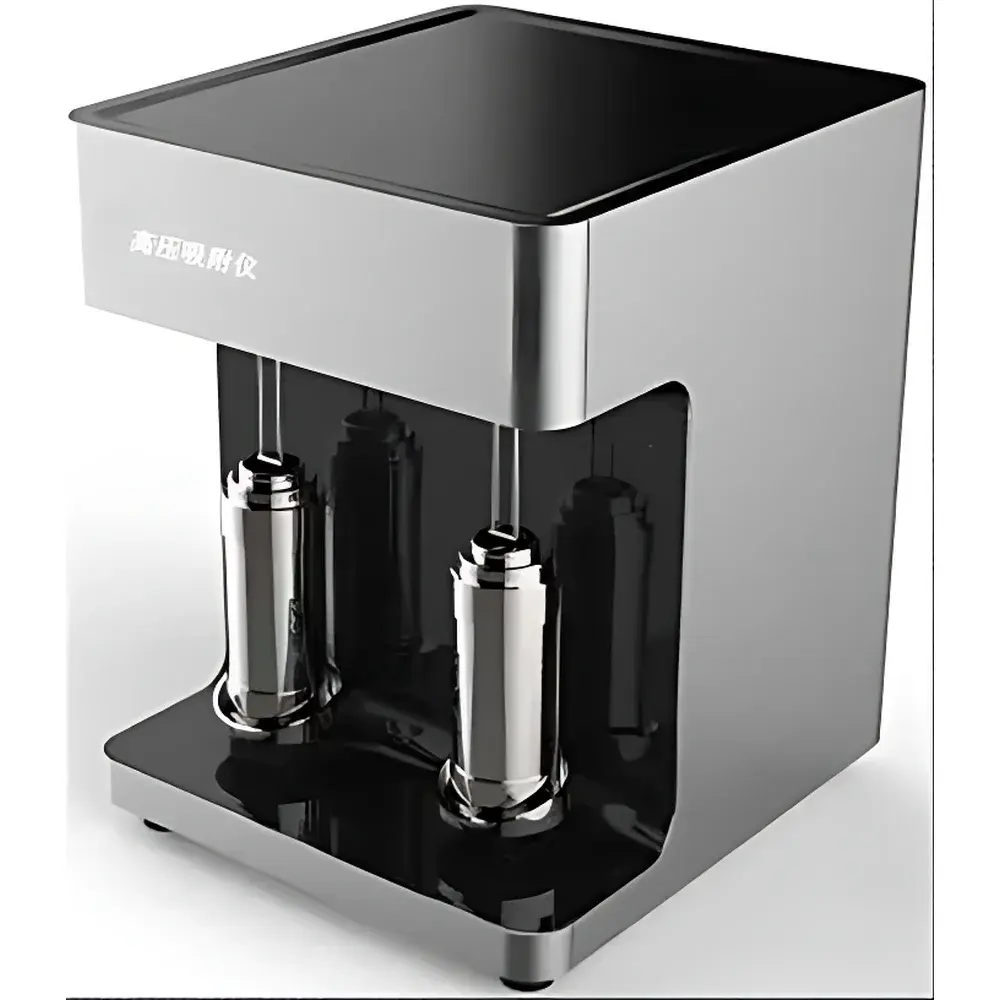
Kyocera JK-B4000 Static Volumetric Specific Surface Area and Pore Size Analyzer
| Brand | Kyocera |
|---|---|
| Origin | Beijing, China |
| Manufacturer Type | Authorized Distributor |
| Product Category | Domestic |
| Model | JK-B4000 |
| Instrument Type | Specific Surface Area and Pore Size Analyzer |
| Number of Analysis Stations | 1–6 |
| Specific Surface Area Range | 0.0001 m²/g (measured with Kr) to unlimited |
| Pore Size Range | 0.35 nm – 500 nm |
| Pressure Range | 0–133 kPa |
| Measurement Principle | Static Volumetric Method |
| Vacuum Base Pressure | ≤1×10⁻⁸ Torr |
| Relative Pressure Resolution (P/P₀) | down to 1×10⁻¹⁰ |
| Adsorption Gas Compatibility | N₂, Ar, Kr, CO₂, NH₃, H₂, CO, O₂, CH₄, C₄H₁₀ (non-corrosive only) |
| Minimum Detectable Pore Volume | 0.0001 cm³/g (N₂ at 77 K) |
| BET Repeatability | < ±1% |
| Analysis Time | ~25 min per BET surface area |
| Data Interface | USB or Ethernet (supports remote control & multi-instrument management) |
| Power Supply | AC 220 V ±10%, 50 Hz, ≤200 W |
Overview
The Kyocera JK-B4000 is a high-precision static volumetric gas adsorption analyzer engineered for comprehensive characterization of specific surface area, microporosity, mesoporosity, and macroporosity in solid materials. It operates on the fundamental principles of physical adsorption—primarily nitrogen (77 K), argon (87 K), or krypton (77 K)—to quantify gas uptake at precisely controlled relative pressures (P/P₀). By measuring equilibrium adsorption and desorption isotherms under ultra-high vacuum conditions (≤1×10⁻⁸ Torr), the instrument enables rigorous application of internationally recognized theoretical models—including BET, Langmuir, BJH, t-plot, αs-plot, MP, DR, HK, SF, and DFT/NLDFT—to extract quantitative microstructural parameters. Its design emphasizes analytical fidelity for microporous-dominant materials such as zeolites, MOFs, activated carbons, battery cathode/anode powders, and catalytic supports—where accurate low-P/P₀ data acquisition (<1×10⁻⁷) and minimal dead volume are critical.
Key Features
- Ultra-high vacuum architecture: Custom-engineered stainless-steel manifold with metal-sealed joints, silver-plated internal surfaces, and dual-layer vacuum shielding to sustain base pressure ≤1×10⁻⁸ Torr and ensure P/P₀ resolution down to 1×10⁻¹⁰.
- Dual-path thermal treatment system: Patented co-located degas-and-analyze station with three-way valve isolation—prevents cross-contamination between degassing byproducts and analysis sensors, eliminating manual sample transfer and atmospheric exposure.
- High-fidelity pressure detection: Imported capacitive absolute pressure transducers (0–10 Torr and 0–1000 Torr ranges), calibrated to ±0.1% full scale, coupled with 24-bit AD acquisition for sub-micropascal stability across >1000 data points per isotherm.
- Independent P₀ reference tube with real-time monitoring ensures thermodynamic consistency and eliminates vapor pressure interpolation errors—critical for accurate micropore modeling.
- Modular station configuration: Scalable from 1 to 6 independent analysis ports, each with dedicated vacuum lines, pressure sensors, and temperature-stabilized sample holders.
- Extended unattended operation: 80-hour liquid nitrogen hold time via large-capacity Dewar; optional auto-refill system enables continuous multi-day runs without intervention.
- No helium dependency: Full N₂-based operation eliminates need for costly, scarce He calibration gas—reducing operational overhead while maintaining traceable P₀ determination.
- Intelligent vacuum management: Adaptive pump cycling minimizes acoustic noise, extends pump service life, and maintains thermal equilibrium during long isotherm acquisitions.
Sample Compatibility & Compliance
The JK-B4000 accommodates powdered, granular, fibrous, and monolithic samples—including battery electrode composites, catalysts, soil fractions, pharmaceutical excipients, carbon nanomaterials, and MOF crystals—within standard 6–12 mm quartz sample tubes. Its vacuum integrity and contamination control meet ASTM D3663, ISO 9277, and IUPAC 2015 guidelines for physisorption measurements. The system supports GLP-compliant workflows through audit-trail-enabled software logging (user actions, parameter changes, calibration events), electronic signature capability, and FDA 21 CFR Part 11–ready data export (PDF/Excel with metadata embedding). All raw isotherm data, intermediate calculations, and final reports are timestamped, version-controlled, and stored in an encrypted local database compliant with ISO/IEC 17025 documentation requirements.
Software & Data Management
The proprietary KyoceraAdsorb™ software provides a unified interface for instrument control, real-time diagnostics, and advanced post-processing. It includes over 30 preconfigured analysis protocols aligned with ASTM, ISO, and USP standards—including single/multi-point BET, Langmuir surface area, t-plot external surface estimation, BJH mesopore distribution, and DFT/NLDFT kernel libraries for slit/cylindrical/helical pore geometries. Users may define custom models, apply batch processing across multiple samples, overlay isotherms or pore distributions for comparative analysis, and generate regulatory-grade reports with embedded uncertainty propagation (e.g., BET C-constant confidence intervals). Data export supports CSV, Excel, PDF, and XML formats; network-enabled deployment allows centralized administration of multi-unit labs via secure Ethernet connection.
Applications
This analyzer serves R&D and QC laboratories in energy storage (Li-ion/Si-anode SSA optimization), heterogeneous catalysis (active site density quantification), environmental science (soil porosity and contaminant adsorption capacity), pharmaceutical development (excipient surface heterogeneity and dissolution kinetics), and advanced materials synthesis (MOF activation verification, carbon scaffold tuning). It delivers essential metrics for process validation—including specific surface area (m²/g), micropore volume (cm³/g), total pore volume (cm³/g), pore size distribution (nm), and average pore diameter (nm)—all traceable to NIST-certified reference materials and validated against interlaboratory round-robin datasets.
FAQ
What gases can be used for analysis besides nitrogen?
N₂, Ar, Kr, CO₂, NH₃, H₂, CO, O₂, CH₄, and C₄H₁₀ are supported—provided they are non-corrosive and compatible with stainless-steel vacuum components.
Is helium required for free space calibration?
No. The JK-B4000 uses an independent, temperature-stabilized P₀ reference tube for direct saturation vapor pressure measurement—eliminating helium dependency and associated supply chain constraints.
Can the system perform DFT/NLDFT analysis out of the box?
DFT/NLDFT modules are available as optional software upgrades, with kernel libraries validated for carbon slit pores, silica cylindrical pores, and alumina surface hydration models.
How is data integrity maintained during power interruption?
The system features automatic state recovery: upon reboot, it resumes isotherm acquisition from the last stable pressure point, preserving all prior data and calibration context.
Does the instrument support remote diagnostics and multi-user access?
Yes—via Ethernet connectivity, administrators can monitor status, initiate tests, retrieve logs, and perform firmware updates remotely across institutional networks.



