
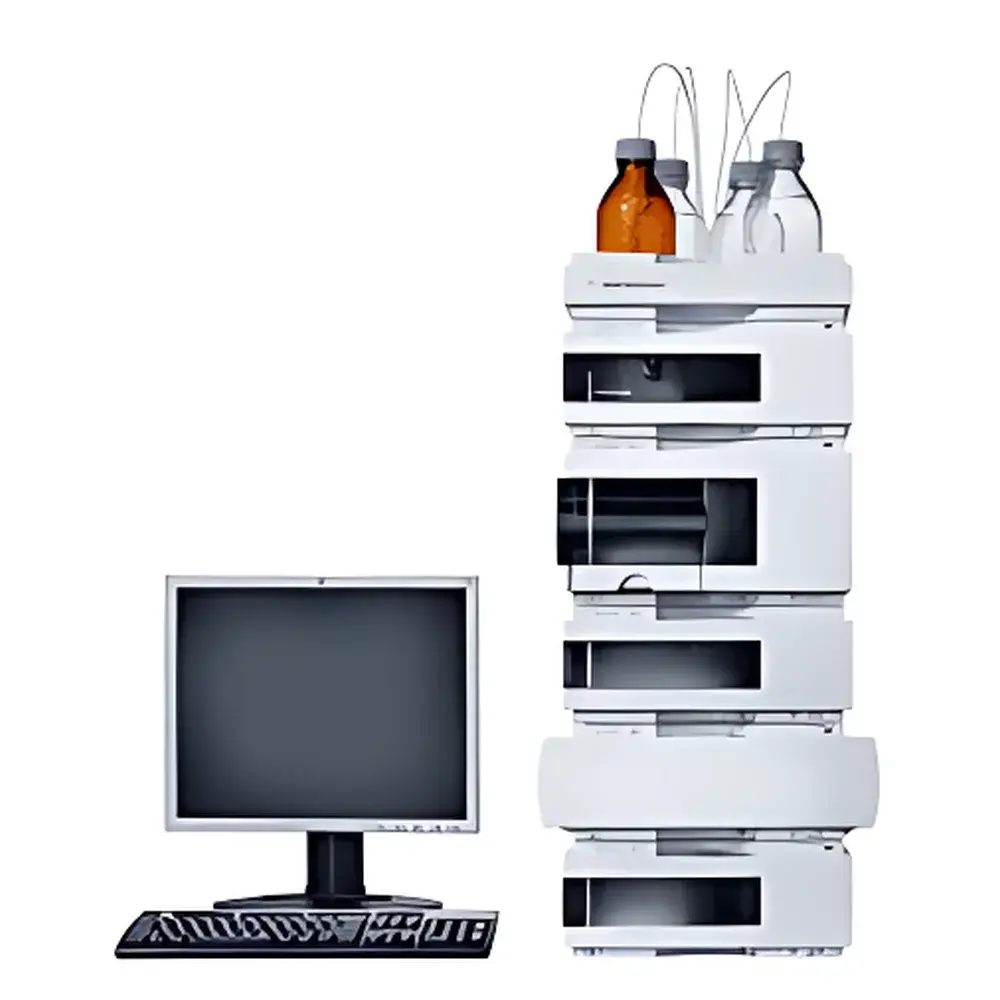
Agilent 1200 Rapid Resolution Liquid Chromatograph
| Brand | Agilent Technologies |
|---|---|
| Origin | Shanghai, China |
| Manufacturer Type | Authorized Distributor |
| Product Category | Domestic (China-manufactured) |
| Model | 1200 |
| Instrument Type | Rapid Liquid Chromatograph |
| Flow Rate Range | 0.001–10 mL/min |
| Maximum Pressure | 600 bar |
| Injection Volume Range | 0.1–100 µL (0.1 µL increments |
| Column Oven Temperature Range | 10 °C below ambient to 80 °C |
| UV Detection Baseline Noise | ≤0.6 µAU/cm |
| Data Acquisition Rate | UV Detector – 80 Hz |
Overview
The Agilent 1200 Rapid Resolution Liquid Chromatograph (RRLC) is a high-performance, modular HPLC system engineered for method development, routine QC/QA, and research applications requiring enhanced speed without compromising resolution, sensitivity, or quantitative precision. Based on conventional high-pressure liquid chromatography principles—employing solvent gradient elution, precise flow control, and column-based analyte separation—the Agilent 1200 platform delivers up to 20× faster analysis compared to standard HPLC systems while maintaining equivalent or improved chromatographic performance. Its architecture supports binary, ternary, and quaternary gradient configurations, enabling broad solvent flexibility for rapid method scouting, robustness testing, and mobile phase optimization. Designed with forward compatibility in mind, the system preserves full backward compatibility with legacy HPLC methods and column chemistries—including fully validated Agilent RRHT (Rapid Resolution High Throughput) columns—ensuring seamless method transfer from conventional HPLC to RRLC workflows.
Key Features
- Modular quaternary pump system with four independent solvent channels, supporting both isocratic and multi-step gradient elution with low dwell volume (configurable: 120 µL for narrow-bore/LC-MS applications; 600–800 µL for standard analytical columns)
- High-pressure capability up to 600 bar, enabling use of sub-2 µm particle-packed columns for superior peak capacity and resolution
- Temperature-controlled autosampler with 0.1–100 µL injection range, programmable in 0.1 µL increments; optional large-volume injection kits available
- Column compartment with precise thermal regulation from 10 °C below ambient to 80 °C, minimizing retention time drift and improving reproducibility
- Integrated vacuum degasser eliminating helium sparging requirements; ensures stable baseline and long-term operational reliability
- Front-access service design for rapid replacement of wear parts (seals, pistons, check valves), minimizing instrument downtime
- Embedded diagnostics, pre-programmed system suitability tests, and Early Maintenance Feedback (EMF) monitoring of pump usage, lamp hours, and detector performance
- Fully upgradeable architecture—compatible with Agilent 1200-series detectors (DAD SL, MWD SL, FLD, RID, VWD), preparative modules, and LC/MS interfaces
Sample Compatibility & Compliance
The Agilent 1200 RRLC accommodates a wide range of sample matrices including pharmaceutical actives, biological fluids, environmental extracts, food additives, and polymer degradation products. It supports reversed-phase, normal-phase, ion-exchange, and size-exclusion chromatography using columns from 1.0 mm to 4.6 mm i.d., including capillary, microbore, and semi-preparative formats. The system meets essential regulatory requirements for GxP environments: it supports audit trails, electronic signatures, and data integrity controls when operated with Agilent OpenLab CDS or ChemStation software compliant with FDA 21 CFR Part 11. All critical parameters—including flow rate, pressure, temperature, and detector response—are logged with timestamps and user attribution. Method validation protocols align with ICH Q2(R2), USP , and ISO/IEC 17025 guidelines for analytical instrument qualification.
Software & Data Management
Control and data acquisition are managed via Agilent ChemStation, OpenLab CDS, or EZChrom Elite software platforms—each offering intuitive sequence setup, real-time monitoring, and automated reporting. The Instant Pilot front-panel interface allows standalone method execution and parameter adjustment without PC dependency. All software versions support GLP/GMP-compliant workflows, including secure user access levels, electronic lab notebook (ELN) integration, and raw data archiving in vendor-neutral formats (e.g., .D format with embedded metadata). System suitability testing (SST) templates can be predefined and automatically executed before each run; results are evaluated against configurable pass/fail criteria and archived with full traceability. Data export supports CSV, PDF, and XML formats for LIMS and enterprise analytics integration.
Applications
The Agilent 1200 RRLC is routinely deployed across pharmaceutical quality control (assay, related substances, dissolution testing), biopharmaceutical characterization (mAb purity, peptide mapping), clinical toxicology (therapeutic drug monitoring), environmental analysis (PAHs, pesticides, PFAS), and food safety (mycotoxins, preservatives, allergens). Its high-speed capability enables throughput of up to 2,000 samples per day in high-volume labs when configured with alternating column regeneration (ACR) modules. For LC/MS coupling, the low-dead-volume configuration minimizes band broadening and maximizes sensitivity—particularly critical for trace-level quantitation in complex biological matrices. Method transfer from HPLC to RRLC is facilitated by Agilent’s Method Translation Software, which calculates equivalent gradient conditions based on column dimensions, particle size, and mobile phase composition.
FAQ
Is the Agilent 1200 system compatible with existing HPLC methods?
Yes—retention times, selectivity, and resolution are preserved when transferring validated HPLC methods to the 1200 RRLC platform using appropriate column scaling and flow rate adjustments.
Does the system support LC/MS coupling?
Yes, especially with low-dwell-volume configurations and narrow-bore columns optimized for mass spectrometry sensitivity and robustness.
What regulatory standards does the Agilent 1200 meet?
When used with compliant software (e.g., OpenLab CDS), the system satisfies FDA 21 CFR Part 11, EU Annex 11, and ISO/IEC 17025 requirements for electronic records and signatures.
Can the 1200 series be upgraded to newer Agilent platforms?
While not directly hardware-upgradable to 1260 or 1290 Infinity II systems, method and data files are interoperable, and many components (e.g., detectors, autosamplers) can be reused in hybrid configurations.
What maintenance intervals are recommended for the quaternary pump?
Pump seal replacement is typically scheduled every 3–6 months depending on solvent aggressiveness and daily usage; EMF alerts notify users when maintenance thresholds are approached.





