
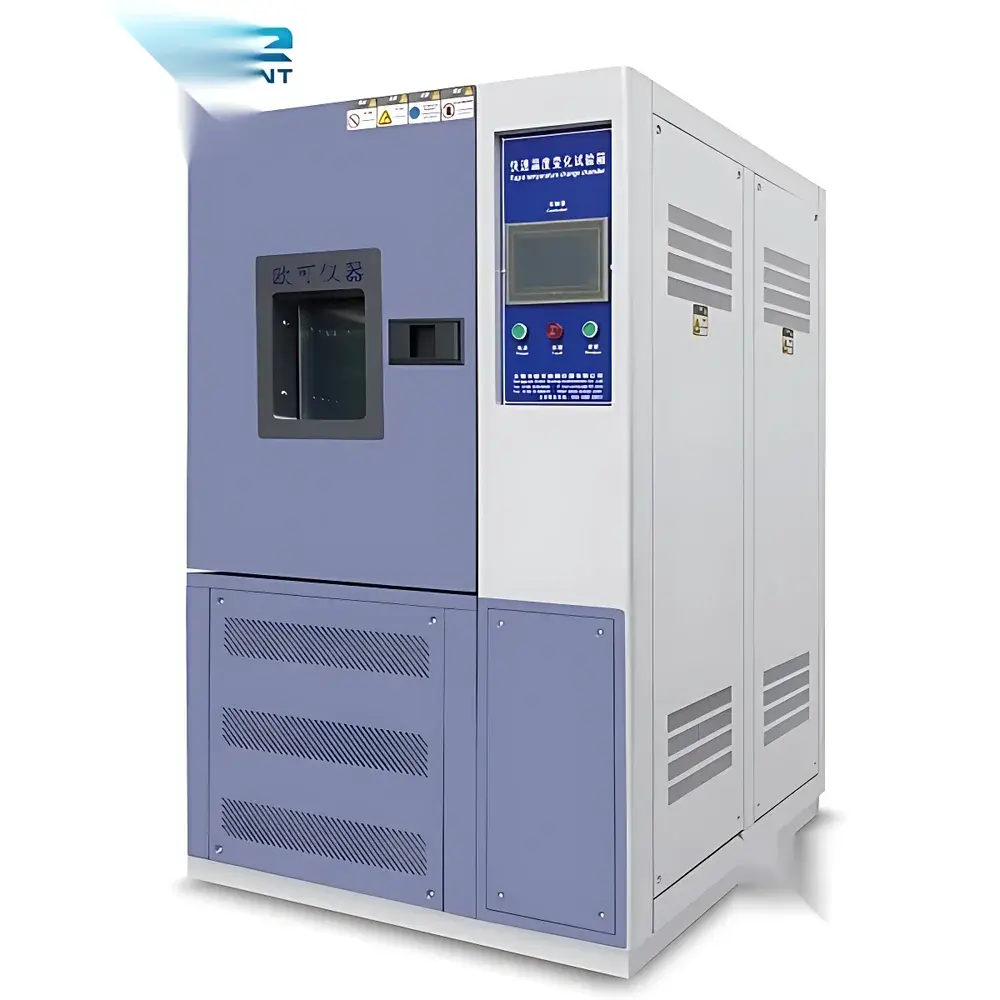
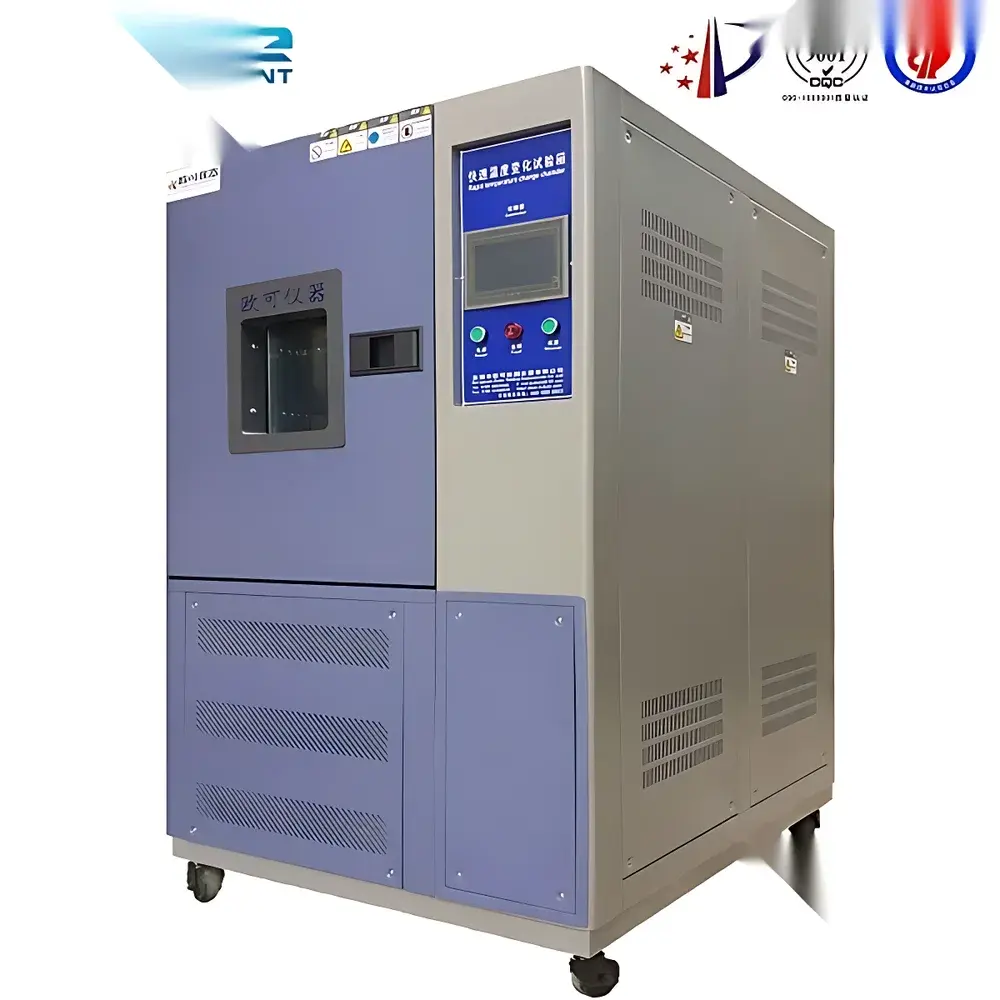
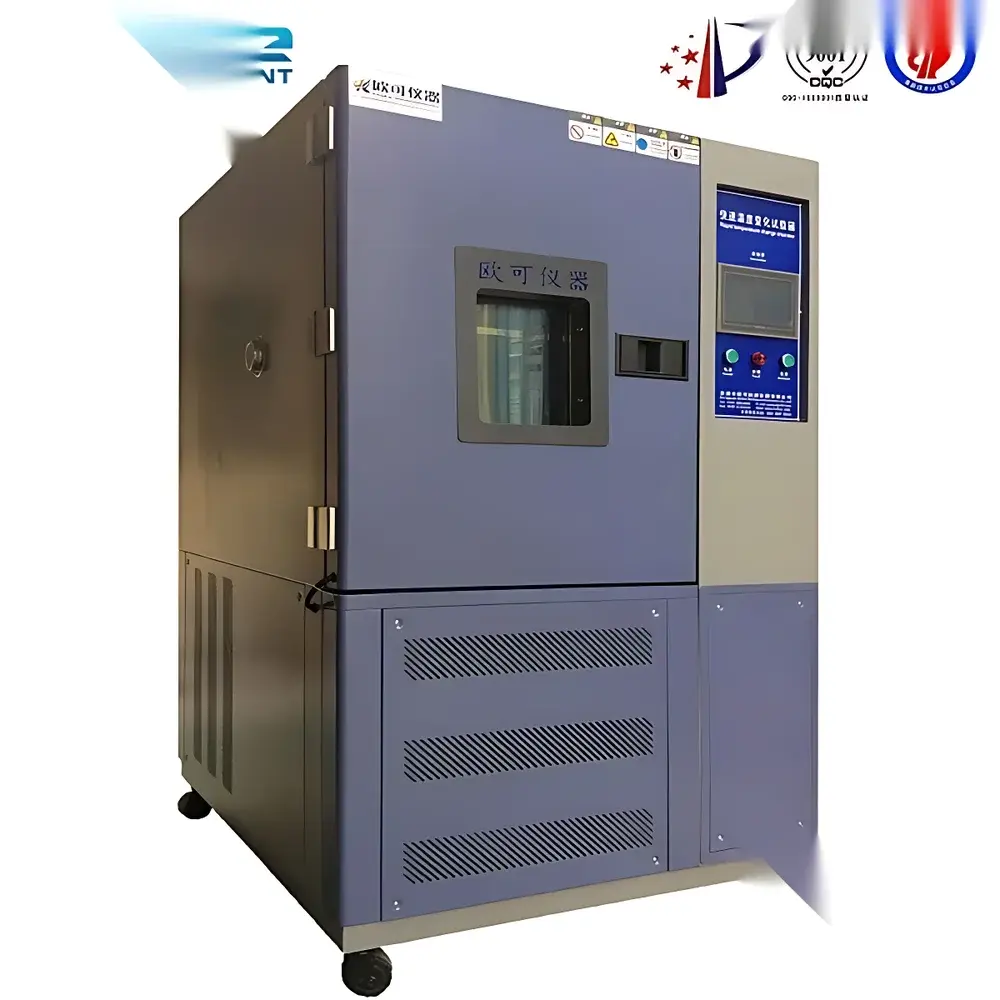
English Product Name
| Brand | OK |
|---|---|
| Origin | China (Manufactured in Huzhou) |
| Manufacturer Type | OEM/ODM Manufacturer |
| Compliance | GB/T 2423, GJB 150, GB 10589, GB 11158, GB 10592 |
| Temperature Range | −70 °C to +150 °C |
| Humidity Range | 20–98 %RH (optional: 5–98 %RH) |
| Rapid TC Range Options | −45 °C to +85 °C or −20 °C to +85 °C |
| Ramp Rates | 5–25 °C/min (user-selectable) |
| Temp. Uniformity | ±2 °C |
| Humidity Uniformity | ±3.0 %RH (at ≥75 %RH) |
| Temp. Stability | ±0.5 °C |
| Humidity Stability | ±2.5 %RH |
| Interior Material | SUS#304 Stainless Steel |
| Refrigeration System | Hermetic Dual-Stage Compressor (R404A/R23) |
| Controller | Touchscreen LCD with English/Chinese UI |
| Power Supply | AC 380 V ±5 %, 50 Hz ±0.5 Hz, 3-phase 5-wire |
Overview
The OK-TH Series Rapid Temperature Change Environmental Test Chamber is an engineered thermal stress screening system designed for accelerated reliability validation of electronic components, automotive modules, aerospace subsystems, and industrial assemblies. It operates on the principle of controlled thermal cycling—inducing repeated expansion and contraction within material interfaces and solder joints through precisely programmed transitions between extreme temperature limits. This thermomechanical stress accelerates the manifestation of latent defects including intermetallic voiding, die attach delamination, PCB microcracking, and conformal coating adhesion failure—enabling early detection prior to field deployment. Unlike standard thermal chambers, the OK-TH series delivers programmable ramp rates up to 25 °C/min across a full operating range of −70 °C to +150 °C, with simultaneous humidity control (20–98 %RH), making it suitable for combined temperature-humidity cycling per IEC 60068-2-14, MIL-STD-810H Method 503.6, and JEDEC JESD22-A104. Its dual-stage refrigeration architecture ensures stable low-temperature hold capability without compressor overload or thermal overshoot.
Key Features
- Programmable ramp rates from 5 °C/min to 25 °C/min—selectable per test segment to match qualification profiles (e.g., MIL-STD-810G, AEC-Q200)
- High-fidelity temperature uniformity (±2 °C) and stability (±0.5 °C) verified per IEC 60068-3-5, supported by calibrated PT100 sensor arrays and PID+ fuzzy logic control
- Humidity control with ±2.5 %RH stability and ±3.0 %RH uniformity (≥75 %RH), achieved via steam generator + solid-state dew point sensor feedback
- SUS#304 stainless steel interior chamber with seamless welding and electro-polished finish—resistant to condensate corrosion and compatible with ISO 14644 cleanroom handling protocols
- Dual-stage hermetic refrigeration system using R404A/R23 blend—compliant with EU F-Gas Regulation (EU) No 517/2014 and EPA SNAP-approved for industrial test environments
- Touchscreen controller with real-time data logging, multi-segment profile programming, USB export, and audit-trail-enabled user authentication (GLP/GMP-ready)
Sample Compatibility & Compliance
The OK-TH chamber accommodates test specimens up to 100 cm × 100 cm × 100 cm (OK-TH-1000 model), with optional internal load racks, cable ports (IP65-rated), and non-magnetic fixtures for EMI-sensitive devices. It meets structural and operational requirements of multiple international standards: GB/T 2423.1 (cold), GB/T 2423.2 (heat), GB/T 2423.22 (temperature change), GJB 150.3–150.5 (military environmental testing), and GB/T 10589/11158/10592 (chamber performance verification). Calibration documentation includes NIST-traceable certificates for temperature and humidity sensors, and optional IQ/OQ/PQ validation packages are available for FDA-regulated medical device manufacturers requiring 21 CFR Part 11 compliance.
Software & Data Management
The embedded controller supports full-cycle data acquisition at configurable intervals (1–60 seconds), storing time-stamped temperature, humidity, setpoint, and alarm status in CSV format. Optional PC-based software enables remote monitoring, statistical process control (SPC) charting, deviation alerting via email/SMS, and automated report generation compliant with ISO/IEC 17025 clause 7.8. All user actions—including parameter edits, profile uploads, and calibration resets—are logged with timestamp, operator ID, and IP address for full traceability. Audit trail files are digitally signed and tamper-evident, satisfying GLP and GMP documentation requirements for regulated industries.
Applications
This chamber is routinely deployed in: accelerated life testing of power electronics (IGBTs, SiC MOSFETs); thermal shock evaluation of MEMS sensors and optical modules; qualification of battery packs under dynamic thermal load; validation of automotive ECUs per ISO 16750-4; reliability screening of avionics enclosures per RTCA DO-160 Section 4; and environmental stress screening (ESS) of PCBAs per IPC-9701. Its rapid transition capability also supports HALT/HASS development phases where high dT/dt exposure reveals design margin weaknesses not evident under steady-state conditions.
FAQ
What is the difference between temperature cycling and thermal shock testing?
Temperature cycling uses controlled ramp rates (e.g., 5–25 °C/min) between defined limits with dwell periods, simulating operational thermal fatigue. Thermal shock employs near-instantaneous transfer between extreme chambers (typically >50 °C/s), inducing brittle fracture mechanisms.
Can the chamber operate at −70 °C while maintaining 98 %RH?
No—humidity control is disabled below 0 °C due to condensation and frost formation. Humidity functionality is active only within +10 °C to +85 °C range.
Is third-party calibration included with purchase?
A factory calibration certificate (traceable to CNAS-accredited lab) is provided. On-site ISO/IEC 17025 calibration and annual re-certification services are available as optional add-ons.
Does the system support integration with MES or SCADA platforms?
Yes—Modbus TCP and Ethernet/IP communication protocols are built-in; OPC UA gateway integration is available upon request for Industry 4.0 factory networks.
What maintenance intervals are recommended for the refrigeration system?
Compressor oil and filter dryer replacement every 24 months; refrigerant leak check and pressure calibration annually; full system performance verification per GB/T 10592 every 12 months.



