
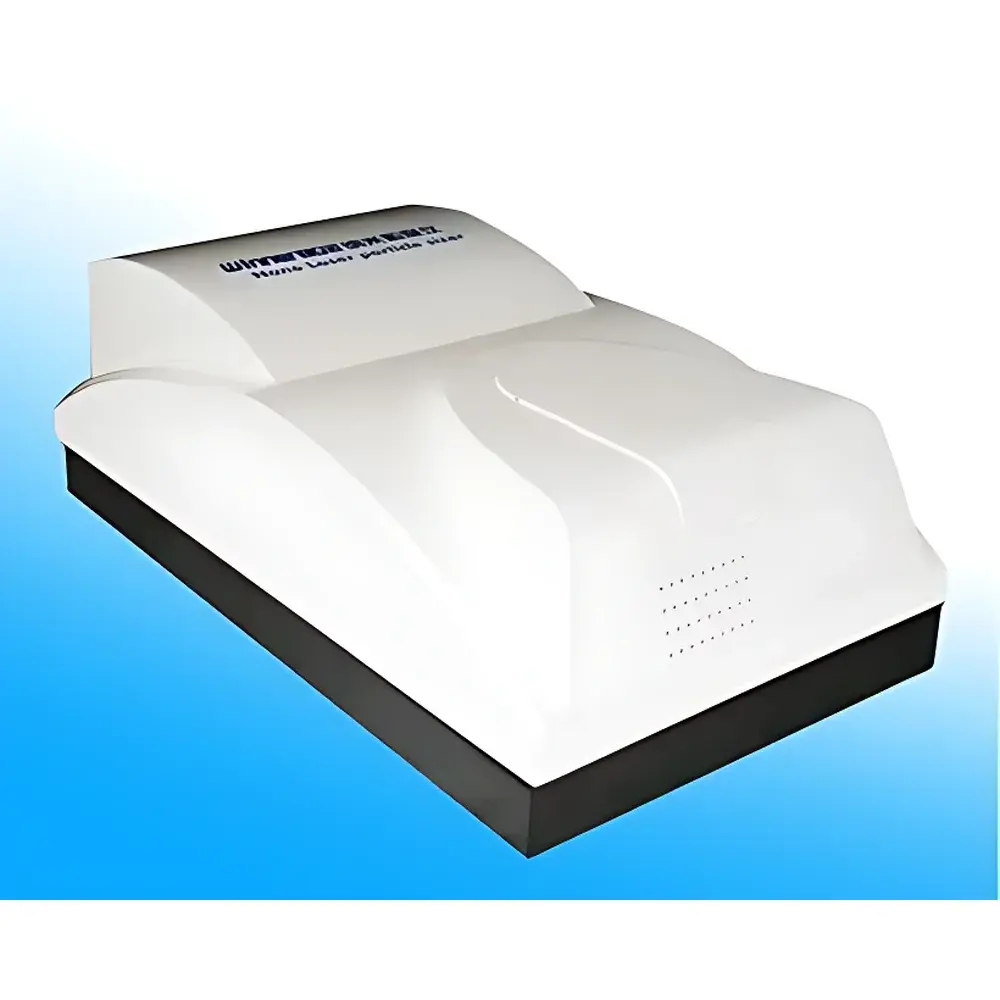
Kyocera JK-JG9000 Photon Correlation Nanoparticle Size Analyzer
| Brand | Kyocera |
|---|---|
| Origin | Beijing, China |
| Manufacturer Type | Authorized Distributor |
| Model | JK-JG9000 |
| Price | USD 22,500 (FOB Beijing) |
| Dispersion Method | Wet Dispersion |
| Measurement Principle | Dynamic Light Scattering (DLS) |
| Measuring Range | 1–10,000 nm |
| Accuracy | <1% (D50, NIST-traceable standard reference material) |
| Repeatability | <1% (D50, same sample, 3 runs) |
| Laser Source | Fiber-coupled semiconductor laser, λ = 532 nm, lifetime >25,000 h |
| Detector | Hamamatsu high-sensitivity photomultiplier tube (PMT) |
| Scattering Angle | 90° |
| Sample Cell Volume | 4 mL |
| Temperature Control Range | 5–40 °C (±0.1 °C stability) |
| Test Duration | <5 min per run |
| Dimensions | 480 × 270 × 170 mm |
| Weight | 12 kg |
Overview
The Kyocera JK-JG9000 Photon Correlation Nanoparticle Size Analyzer is a precision instrument engineered for the characterization of colloidal and nanoscale dispersions using dynamic light scattering (DLS), also known as photon correlation spectroscopy (PCS). It operates on the fundamental physical principle that suspended nanoparticles undergo Brownian motion in liquid media, with diffusion coefficients inversely proportional to hydrodynamic diameter via the Stokes–Einstein equation. By detecting temporal fluctuations in scattered laser intensity at 90°, the system computes the intensity autocorrelation function in real time, enabling robust derivation of particle size distribution (PSD), polydispersity index (PDI), and z-average diameter (Z-Ave). Designed for laboratory environments requiring regulatory-compliant nanoparticle analysis—including pharmaceutical formulation development, nanomaterial synthesis validation, and quality control of liposomal or polymeric drug carriers—the JK-JG9000 delivers non-invasive, label-free, and statistically representative measurements without altering sample integrity.
Key Features
- High-fidelity optical architecture featuring a fiber-coupled 532 nm semiconductor laser with >25,000-hour operational lifetime and minimal beam drift
- Hamamatsu photomultiplier tube (PMT) detector optimized for single-photon sensitivity and low dark current, ensuring superior signal-to-noise ratio across low-concentration samples (0.1–100 mg/mL)
- Proprietary CR256 high-speed digital correlator performing real-time autocorrelation computation at up to 100 million lag channels/sec, supporting resolution down to sub-nanometer increments
- Compact, vibration-damped optical bench built around fused silica fiber optics—reducing alignment sensitivity and enhancing long-term measurement stability
- Integrated Peltier-based thermostatic cell holder with ±0.1 °C temperature regulation over 5–40 °C range, critical for viscosity-dependent DLS accuracy and inter-laboratory reproducibility
- Automated alignment and self-diagnostic routines compliant with ISO 22412:2017 and ASTM E2490-22 guidelines for DLS instrumentation validation
Sample Compatibility & Compliance
The JK-JG9000 accommodates aqueous and organic dispersions, including proteins, exosomes, micelles, polymer nanoparticles, quantum dots, and metal oxides. Its 4 mL quartz cuvette supports both batch-mode and flow-through configurations (with optional accessories). All measurements adhere to internationally recognized standards: ISO 22412:2017 (DLS methodology), ISO 13321:2022 (photon correlation spectroscopy), and USP for particle size distribution of nanosuspensions. Data acquisition and reporting meet GLP/GMP documentation requirements, with full audit trail support, electronic signature capability, and 21 CFR Part 11–compliant software configuration options available upon request.
Software & Data Management
The instrument is controlled via Kyocera Particle Analysis Suite (KPAS) v3.2—a Windows-based application offering intuitive workflow navigation, multi-sample queueing, and automated report generation in PDF/CSV formats. KPAS implements advanced algorithms for regularization (CONTIN), cumulant analysis, and multimodal deconvolution. Raw correlation data are stored in HDF5 format with embedded metadata (timestamp, temperature, laser power, correlation count), ensuring traceability and third-party reanalysis compatibility. Export modules support integration with LIMS platforms and statistical process control (SPC) tools. Optional IQ/OQ/PQ validation packages include protocol templates aligned with FDA and EMA expectations for analytical instrument qualification.
Applications
- Pharmaceutical R&D: Quantitative assessment of liposome size distribution during formulation optimization and stability studies
- Biotechnology: Monitoring aggregation kinetics of monoclonal antibodies and recombinant proteins under thermal or pH stress
- Materials Science: Characterization of synthesized TiO₂, SiO₂, and Fe₃O₄ nanoparticles prior to surface functionalization
- Academic Research: Validation of microfluidic nanoprecipitation processes and comparison against TEM/DLS cross-validation protocols
- Quality Assurance: Release testing of nanomedicine batches per ICH Q5A(R2) and Q5D guidelines
FAQ
What is the minimum detectable concentration for protein samples?
Typical detection threshold is ~0.1 mg/mL for globular proteins (e.g., BSA) in aqueous buffer; lower limits depend on molecular weight, refractive index contrast, and solvent viscosity.
Can the JK-JG9000 measure zeta potential?
No—this model is dedicated to DLS-based size analysis. Zeta potential requires electrophoretic light scattering (ELS); Kyocera offers the JK-ZP series for complementary electrophoretic characterization.
Is the instrument suitable for polydisperse or aggregated samples?
Yes—KPAS v3.2 includes multimodal fitting and residual error diagnostics to identify and quantify subpopulations; however, samples with PDI >0.3 require orthogonal verification (e.g., TEM or AFM).
How is calibration verified?
Certified NIST-traceable polystyrene latex standards (e.g., NIST SRM 1963, 100.3 nm) are recommended for daily performance verification; calibration certificates are provided with each shipment.
Does the system support automated sample changers?
Yes—optional 48-position autosampler (JK-ASC48) enables unattended sequential analysis with programmable rinse cycles and temperature equilibration per sample.



