
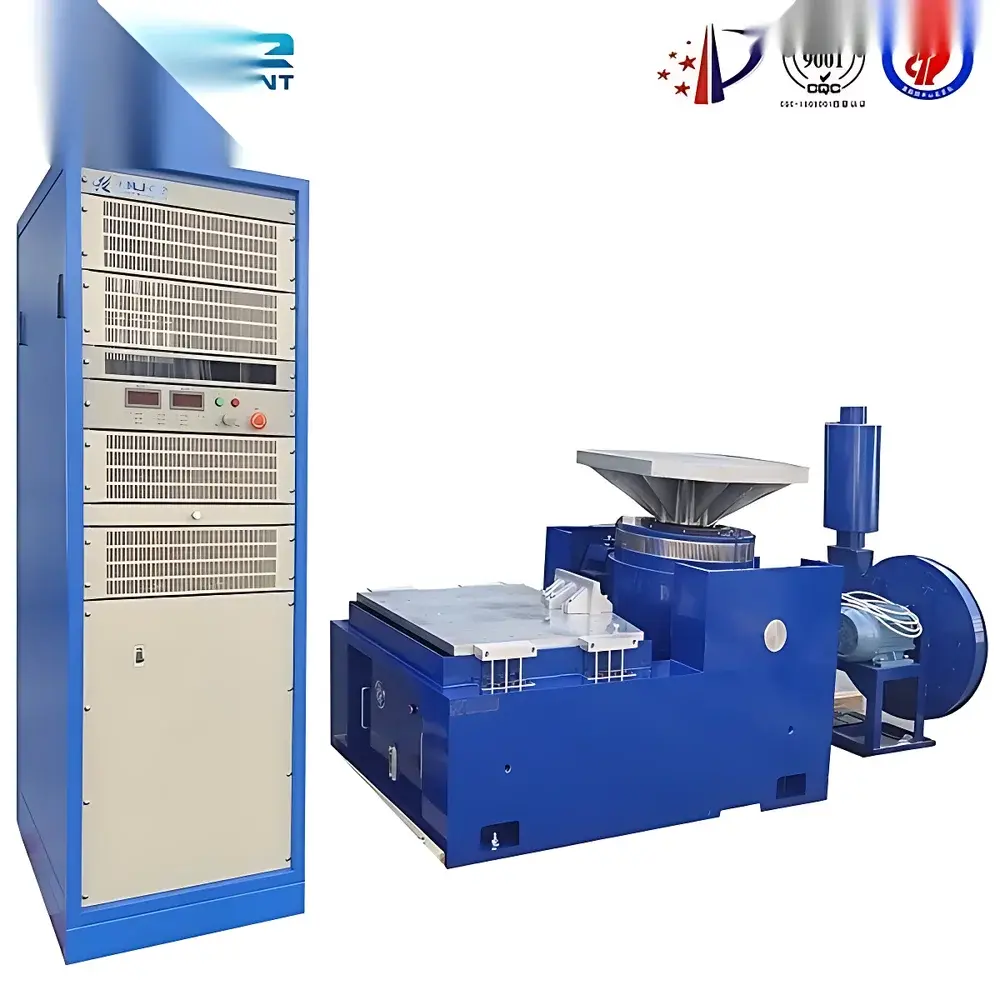
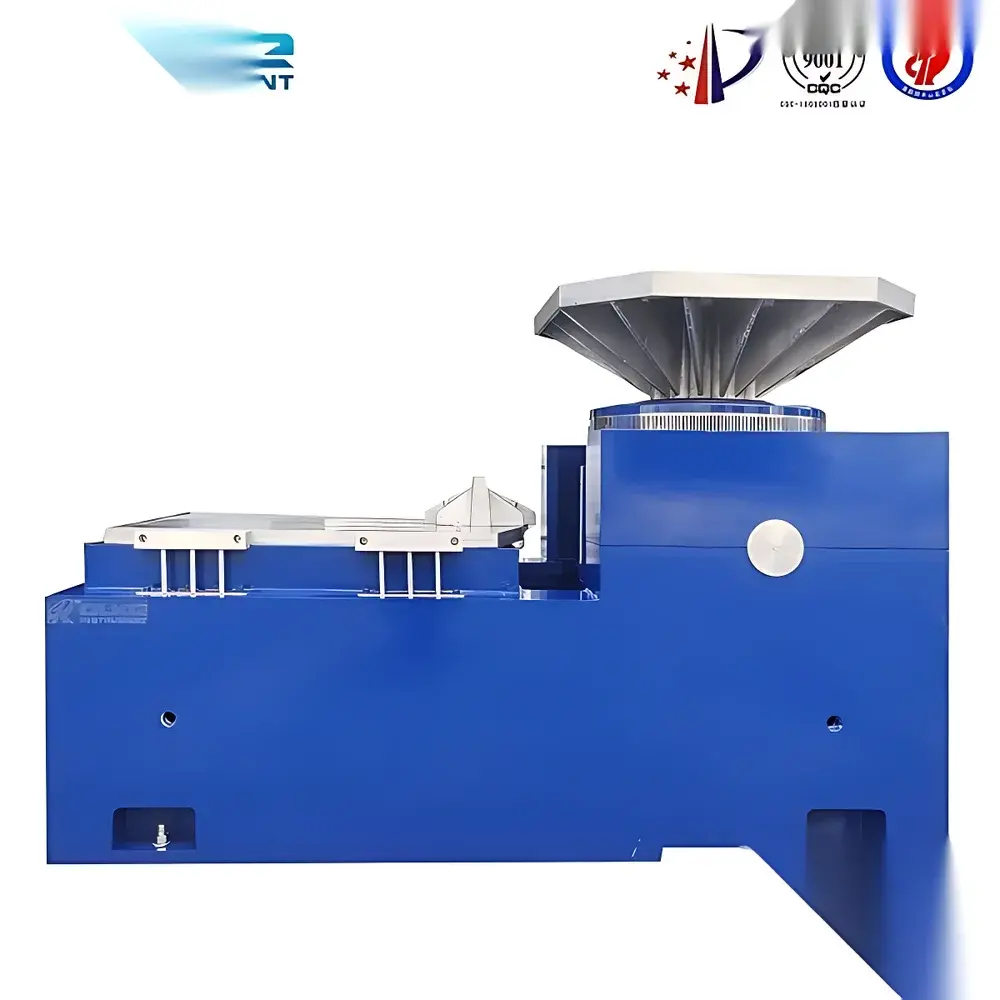
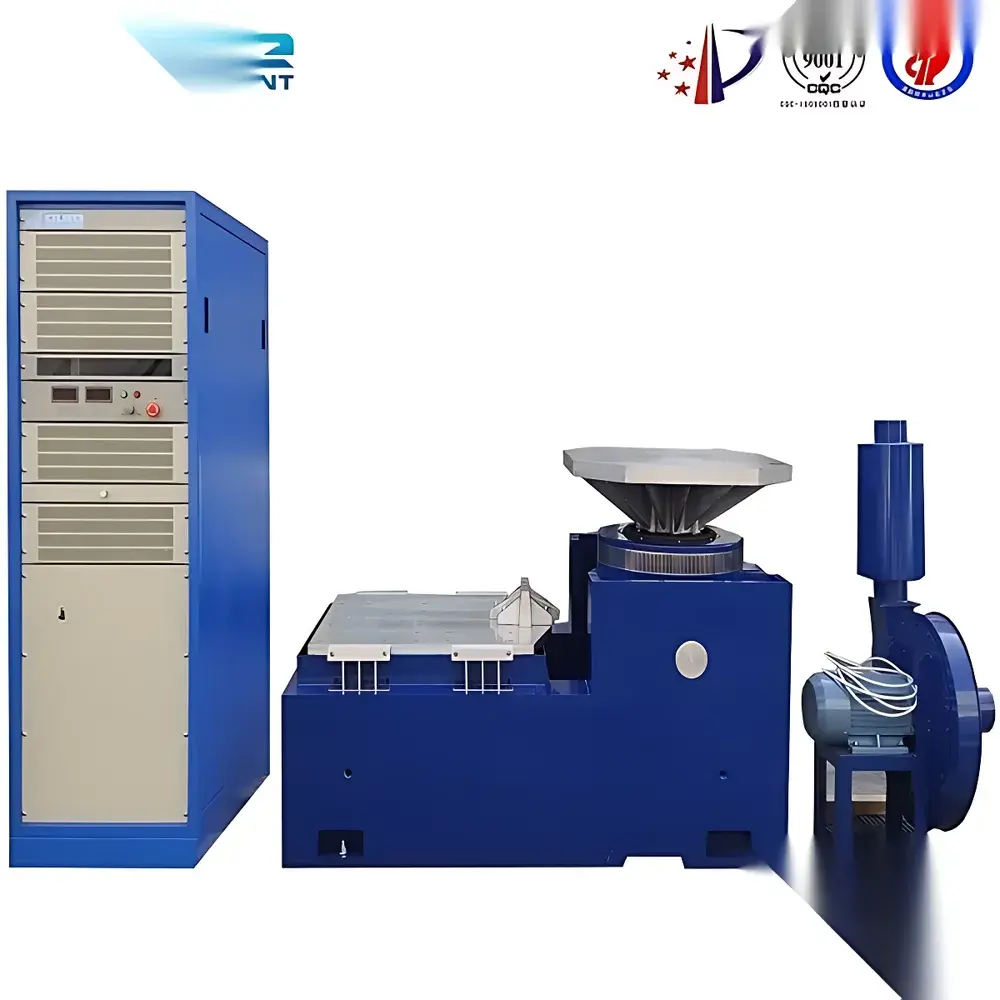
English Product Name
| Brand | OEM/Custom Brand |
|---|---|
| Origin | Imported |
| Supplier Type | Authorized Distributor |
| Price | USD 21,500 (FOB) |
| Max Load Capacity | 50 kg |
| Frequency Range | 2–100 Hz (adjustable) |
| Selectable Amplitude Options | 5, 6, 8, 10, or 15 mm (peak-to-peak) |
| Max Acceleration | 600 g |
| Vibration Axes | Vertical + Horizontal (X/Y) |
| Operating Temperature | 5–35 °C |
| Relative Humidity | ≤85% RH |
| Dimensions (L×W×H) | 60 × 80 × 80 cm |
Overview
The Triaxial Vibration Shaker System is an electromagnetically driven, digitally controlled mechanical excitation platform engineered for environmental stress screening (ESS), structural integrity validation, and early-life failure detection in industrial R&D and production QA environments. Unlike single-axis shakers, this system delivers synchronized, independently controllable vibration inputs along three orthogonal axes—vertical (Z) and dual horizontal (X and Y)—enabling realistic simulation of multi-directional dynamic loading conditions encountered during transportation, operational use, or field deployment. Its design adheres to fundamental principles of forced harmonic excitation and modal response analysis, supporting both sinusoidal sweep (logarithmic or linear) and fixed-frequency testing per ISO 10816, ASTM D999, and IEC 60068-2-64 standards. The system integrates a high-efficiency voice-coil actuator with low-inertia moving mass, enabling rapid frequency response and precise amplitude fidelity across its full operational bandwidth.
Key Features
- Digital PID-controlled frequency generator with real-time feedback loop ensures exceptional stability and repeatability across sweep and dwell modes.
- Integrated electromagnetic interference (EMI) suppression circuitry mitigates signal distortion in high-noise industrial settings, complying with EN 61000-6-3 immunity requirements.
- Programmable test duration timer enables automated, unattended execution of standardized qualification protocols—including MIL-STD-810H Method 514.7 and GR-63-CORE Section 4.5.2.
- Compact monolithic base frame fabricated from high-damping cast aluminum alloy eliminates need for anchoring; achieves sub-0.05 mm lateral drift at resonance.
- Sealed control enclosure with IP54-rated front panel interface provides operator safety and long-term reliability in laboratory and factory-floor deployments.
- Modular mounting plate with T-slots (M6 spacing) accommodates fixtures up to 50 kg without recalibration; supports quick-change tooling for high-throughput line inspection.
Sample Compatibility & Compliance
This shaker system is validated for testing rigid and semi-rigid assemblies including PCB modules, automotive ECUs, consumer electronics enclosures, medical device housings, and packaged goods. It supports specimens ranging from small SMT components (≥10 g) to full subassemblies (≤50 kg). All mechanical and electrical performance specifications conform to GLP-compliant calibration traceability per ISO/IEC 17025. Test reports generated via optional software include timestamped metadata, audit trails, and configurable pass/fail thresholds aligned with internal QA procedures and external regulatory expectations—including FDA 21 CFR Part 11 when paired with compliant data acquisition modules.
Software & Data Management
The embedded controller supports USB and RS-232 connectivity for integration with third-party DAQ systems (e.g., National Instruments PXI, Dewesoft X). Optional PC-based software provides waveform visualization, spectral analysis (FFT up to 1024 lines), and automated report generation in PDF/CSV formats. All test logs retain digital signatures, user authentication records, and version-controlled configuration files—ensuring full compliance with GMP documentation requirements for regulated manufacturing sectors.
Applications
- Early fault detection in electronic assemblies prior to burn-in or final packaging
- Structural fatigue assessment of solder joints, connectors, and adhesive bonds
- Verification of packaging integrity under simulated shipping vibration profiles (ASTM D4728)
- Modal survey support for finite element model correlation in automotive NVH labs
- In-line end-of-line (EOL) functional screening on high-volume production lines
- Qualification testing of aerospace avionics per DO-160 Section 8
FAQ
Does the system support random vibration testing?
No—this model is optimized for deterministic sinusoidal excitation (sweep and fixed-frequency modes) only. Random vibration capability requires upgrade to the optional VCS-RT module with dedicated power amplifier and spectrum controller.
Is calibration certification included with shipment?
Yes—a NIST-traceable calibration certificate covering frequency accuracy (±0.1 Hz), acceleration amplitude (±2% full scale), and displacement linearity (±1.5% FS) is provided with each unit.
Can the shaker operate continuously for extended durations?
Rated for continuous operation up to 8 hours at ≤70% of maximum acceleration output; thermal management includes forced-air cooling with redundant overtemperature cutoff.
What mounting interfaces are available for custom fixtures?
Standard T-slot pattern (M6, 50 mm pitch) on top plate; optional adapter plates with threaded inserts (¼”-20, M8) or vacuum chuck interfaces available upon request.
Is remote monitoring supported via Ethernet or Wi-Fi?
Ethernet (TCP/IP) remote command interface is standard; Wi-Fi connectivity requires external industrial-grade bridge and must be configured per site-specific IT security policy.



