
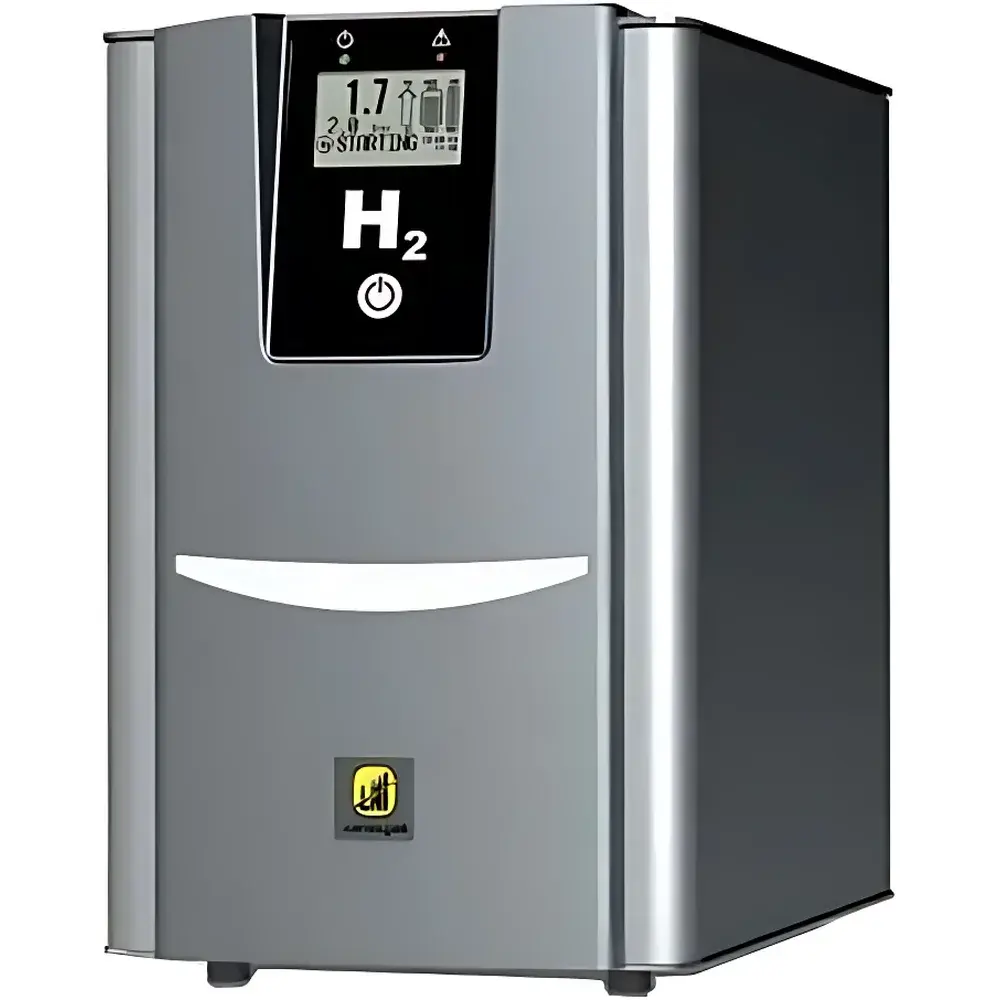
JKRDA CH2-260 Ultra-High-Purity Hydrogen Generator
| Brand | JKRDA |
|---|---|
| Origin | USA |
| Model | CH2-260 |
| Hydrogen Generation Principle | Pure Water Electrolysis |
| Output Flow Rate | 260 mL/min |
| Output Pressure | 11.9 bar |
| Hydrogen Purity | 99.999995% |
| Certifications | CSA, UL, IEC 61010, CE |
| Dimensions | 40 × 40 × 45 cm |
| Weight | 23 kg |
| Power Supply | 220 V, 50 Hz |
Overview
The JKRDA CH2-260 Ultra-High-Purity Hydrogen Generator is an engineered solution for continuous, on-demand production of research-grade hydrogen gas in analytical and synthetic laboratories. It employs membrane-separated alkaline electrolysis of deionized water—requiring no caustic electrolytes, compressed gas cylinders, or external purification stages. The core process involves electrochemical dissociation of H2O at a nickel-based anode and cathode, followed by selective permeation of nascent hydrogen through a palladium-silver alloy diffusion membrane. This proprietary barrier allows only molecular hydrogen (and isotopic variants) to pass while rejecting oxygen, moisture, nitrogen, argon, hydrocarbons, and metal ions—delivering certified purity of 99.999995% (6.7 N) at the point of use. Unlike pressure-swing adsorption (PSA) or catalytic purifiers, this architecture eliminates baseline drift, memory effects, and consumable-dependent degradation. Designed for uninterrupted 24/7 operation, the CH2-260 meets stringent safety thresholds defined under OSHA 1910.103 and NFPA 50A, with integrated leak detection, over-pressure shutoff, and real-time gas composition monitoring.
Key Features
- Zero-cylinder dependency: Eliminates logistical risk, regulatory burden, and downtime associated with high-pressure H2 cylinder handling and changeovers
- True ultra-high-purity output: 99.999995% H2 (≤5 ppb total impurities), validated per ASTM D7165 and ISO 8573-1 Class 1 solid particle / Class 1 water / Class 1 oil specifications
- Stable flow-pressure control: Precisely regulated output from 0–260 mL/min at up to 11.9 bar (173 psi), supporting both GC carrier gas and CVD process feed requirements
- Intelligent water management: Auto-refill system maintains optimal electrolyte level using conductivity-sensed ultrapure water reservoir; compatible with Type I water (≥18.2 MΩ·cm resistivity)
- Embedded diagnostics: LED status interface displays real-time metrics including cell voltage, membrane temperature, flow rate, pressure, and system health flags
- Compact footprint: Benchtop design (40 × 40 × 45 cm) occupies ≤0.1 m², suitable for fume hoods, GC rooms, and mobile lab configurations
- Certified safety compliance: Fully compliant with CSA C22.2 No. 61010-1, UL 61010-1, IEC 61010-1, and CE marking for laboratory environments
Sample Compatibility & Compliance
The CH2-260 is qualified for direct integration with gas chromatography systems requiring ultra-trace-level inertness—including flame ionization detectors (FID), thermal conductivity detectors (TCD), and pulsed discharge helium ionization detectors (PDD). Its output meets USP and requirements for pharmaceutical residual solvent analysis, as well as EPA Method 8260D and 8021B specifications for volatile organic compound (VOC) profiling. For semiconductor manufacturing applications, it satisfies SEMI F57-0218 purity criteria for hydrogen used in epitaxial growth and annealing processes. All internal wetted materials—including 316L stainless steel manifolds, PTFE diaphragms, and palladium-silver membranes—are electropolished and passivated to prevent metallic leaching or catalytic decomposition. No routine maintenance is required beyond periodic reservoir cleaning and annual verification of membrane integrity per manufacturer-recommended protocol.
Software & Data Management
While the CH2-260 operates as a standalone instrument without mandatory software, optional RS-232 or USB-C digital interfaces enable remote monitoring and logging via third-party LIMS or SCADA platforms. Event-driven data capture includes timestamped records of start/stop cycles, pressure excursions, low-water alerts, and automatic shutdown triggers. Audit trails comply with FDA 21 CFR Part 11 requirements when paired with validated electronic signature modules. Raw sensor outputs (e.g., differential pressure across membrane, cell current draw) are accessible for predictive maintenance modeling and root-cause analysis during GLP/GMP audits. Firmware updates are delivered via secure HTTPS endpoint and require dual-authentication approval prior to installation.
Applications
- Carrier gas for capillary GC and fast-GC methods demanding retention time stability and minimal detector noise
- Fuel gas for FID in environmental air monitoring, petrochemical QA/QC, and forensic toxicology workflows
- Reaction gas in catalytic hydrogenation, hydrosilylation, and asymmetric synthesis under controlled atmosphere gloveboxes
- Process gas in low-pressure chemical vapor deposition (CVD) and atomic layer deposition (ALD) tools for thin-film fabrication
- Calibration and zero-gas generation for FTIR, cavity ring-down spectroscopy (CRDS), and laser absorption analyzers
- Economic helium replacement in GC-MS where H2 offers comparable separation efficiency with enhanced sensitivity for early-eluting compounds
FAQ
Does the CH2-260 require KOH or other liquid electrolytes?
No—it uses only deionized water as the sole consumable. The electrolytic cell employs a solid polymer electrolyte (SPE) membrane with immobilized catalyst layers, eliminating corrosive alkali solutions.
Can it be integrated into a GC oven or enclosed cabinet?
Yes, provided ambient temperature remains between 15–35°C and ventilation exceeds 5 air changes per hour. Internal thermal management ensures stable operation under continuous load.
What water quality is required for optimal performance?
Type I ultrapure water (ASTM D1193, ≥18.2 MΩ·cm at 25°C, TOC <5 ppb) is mandatory. Use of lower-grade water will accelerate membrane fouling and reduce service life.
Is hydrogen purity verified at the outlet port or downstream of connected instruments?
Certification applies to gas measured directly at the generator’s stainless-steel outlet fitting, using calibrated gas chromatography with thermal conductivity detection (GC-TCD) per ISO 14687-2 Annex B.
How often must the palladium-silver membrane be replaced?
Under normal operating conditions and proper water quality, the membrane is rated for ≥10,000 hours of continuous use (≈1.14 years at 24/7 duty cycle) with no scheduled replacement interval specified in the maintenance manual.



