
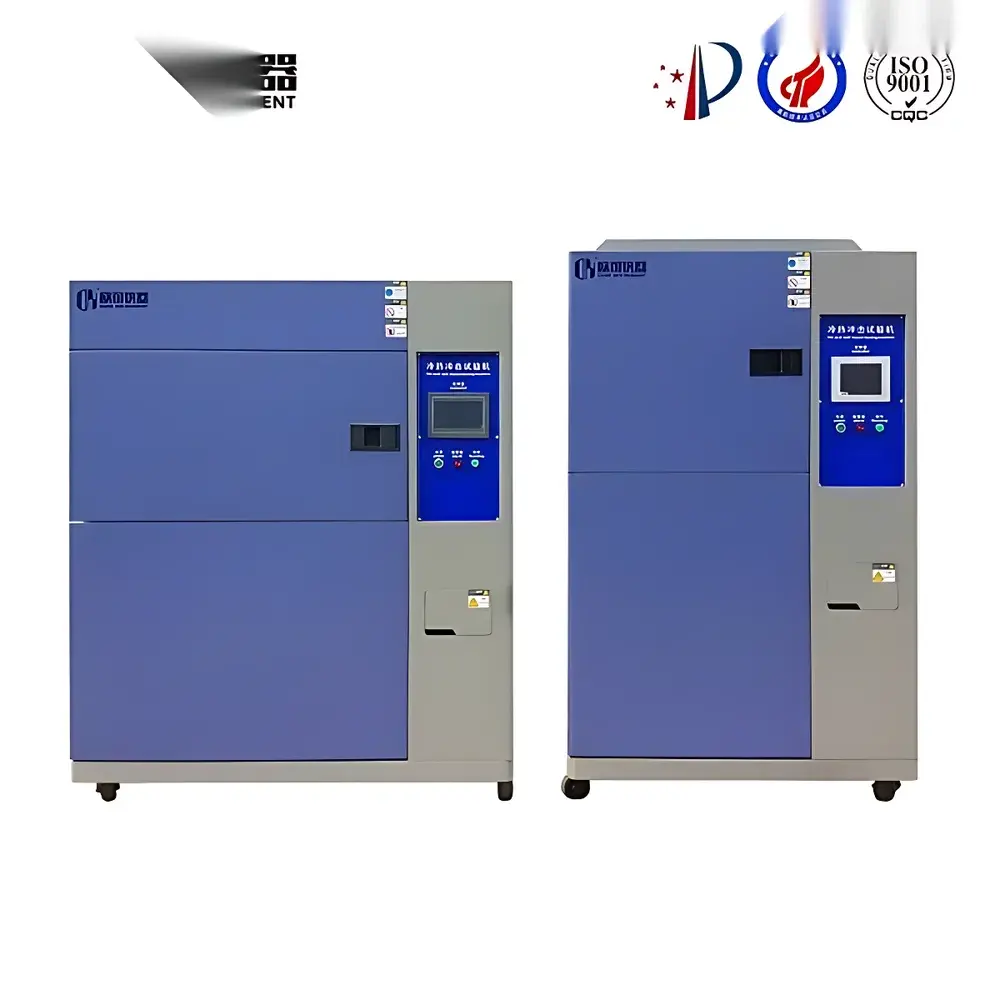
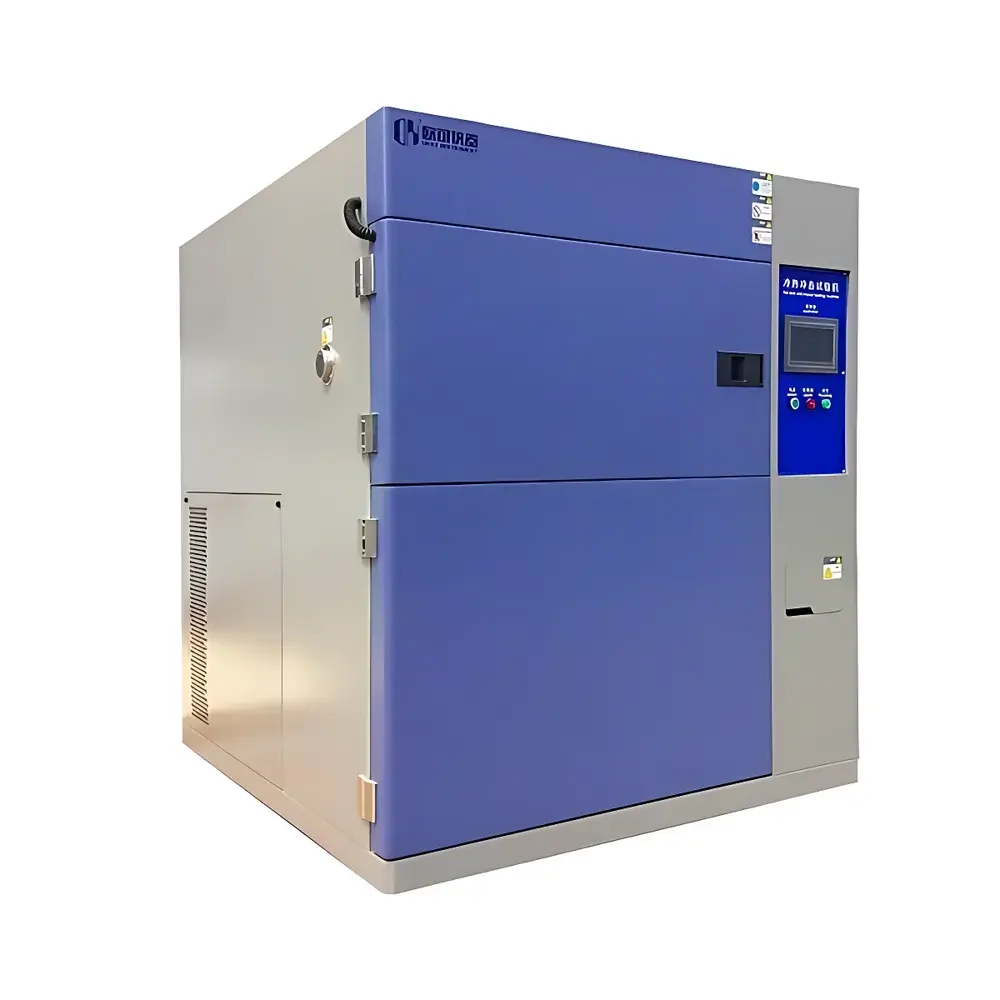
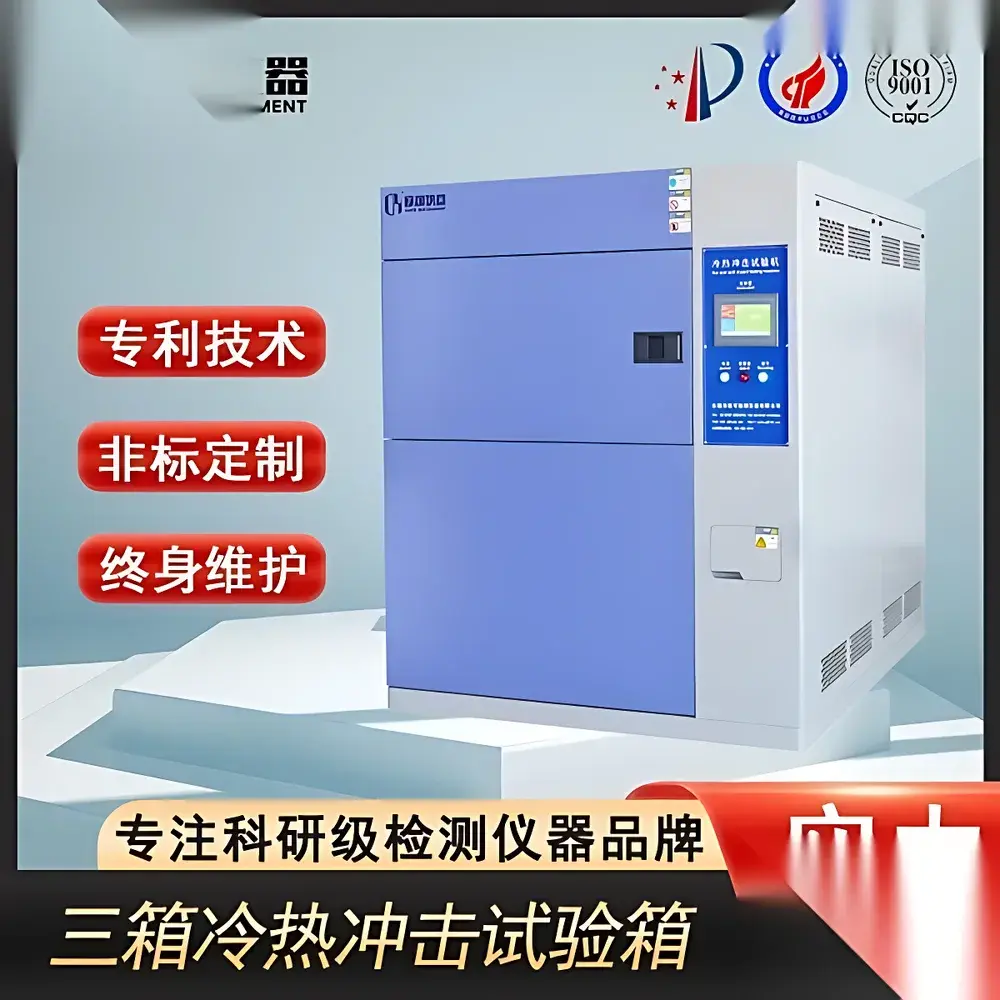
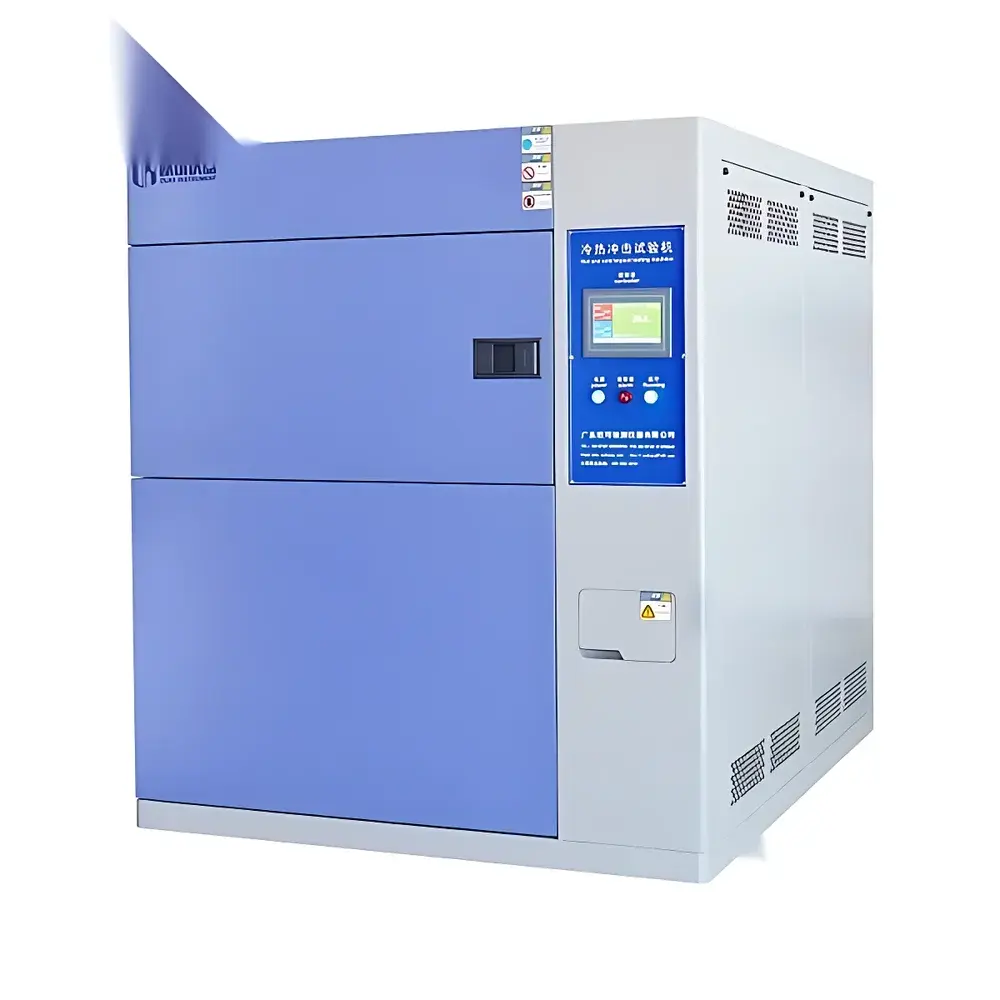
Thermal Shock Test Chamber – Dual-Zone Extreme Temperature Cycling Chamber with BTSC Control System
| Brand | OEM / Custom Brand |
|---|---|
| Origin | Imported |
| Manufacturer Type | Authorized Distributor |
| Price | USD 11,200 (FOB) |
| Controller Options | TEMI880 Color Touchscreen (EN/CN Switchable) or TEMI300 Membrane Keypad (English Only) |
| Temperature Range | −70 °C to +180 °C (Dual-Zone Independent Control) |
| Humidity Range | 20–98% RH (Optional Humidification) |
| Cooling System | Twin-Stage Cascade Refrigeration with Original Tecumseh (France) Hermetic Compressor |
| Insulation | Polyurethane Rigid Foam (150 mm) + Ultra-Fine Glass Fiber Blanket |
| Interior Material | SUS304 Stainless Steel |
| Exterior Finish | Electrostatic Powder-Coated Cold-Rolled Steel or Optional Brushed SUS304 |
| Airflow | Wide-Band Forced Convection via Centrifugal Blower (Top-Out / Bottom-In) |
| Compliance | Meets ASTM D5229, IEC 60068-2-14, MIL-STD-810H Method 503.7 |
Overview
The Thermal Shock Test Chamber is an engineered environmental simulation system designed for rapid, repeatable thermal cycling between extreme high- and low-temperature zones. Utilizing a dual-chamber (hot/cold) architecture with independent temperature control, it subjects test specimens to abrupt transitions—typically within 10–15 seconds—enabling accelerated evaluation of material integrity, solder joint reliability, coating adhesion, and electronic component failure modes under thermal stress. The chamber implements Balanced Temperature and Humidity Control (BTSC), a closed-loop proportional-integral-derivative (PID) regulation strategy that maintains setpoint stability ±0.5 °C and humidity accuracy ±2.5% RH (when equipped with humidification). Its forced-air circulation system—driven by a multi-wing centrifugal blower—ensures uniform thermal distribution across the working volume (per ISO 16750-4 Annex B and IEC 60068-3-5), minimizing spatial gradients to <±1.0 °C at steady state. Designed for integration into GLP-compliant validation workflows, the chamber supports full audit trail logging and meets structural requirements for Class II cleanroom-compatible installation.
Key Features
- Dual-zone independent refrigeration and heating circuits, enabling simultaneous hot (up to +180 °C) and cold (down to −70 °C) zone operation
- Original Tecumseh (France) hermetically sealed compressors with cascade refrigeration architecture for extended service life and reduced maintenance frequency
- TEMi880 7-inch color touchscreen controller with real-time graphing, programmable profiles (up to 99 segments), and EN/CN language toggle; optional TEMi300 membrane keypad variant for simplified operation
- Comprehensive safety interlocks: compressor overheat/overcurrent/overpressure protection, dry-run prevention for heaters and humidifiers, chamber over-temperature cutoff, and automatic water-level monitoring
- High-efficiency insulation stack: 150 mm rigid polyurethane foam core + ultra-fine glass fiber blanket, achieving thermal conductivity ≤0.022 W/m·K
- Double-layer tempered safety glass observation window with anti-fog heating element; 50 mm diameter test port (left-side mounted) with silicone gasket and blanking plug
- Adjustable stainless-steel sample racks (2 sets), integrated fluorescent interior lighting, and four swivel casters with locking brakes
Sample Compatibility & Compliance
The chamber accommodates standard test specimens up to 500 mm × 500 mm × 500 mm (W×D×H) and supports mounting fixtures for PCBs, automotive ECUs, aerospace composites, medical device housings, and polymer packaging. All internal wetted surfaces are fabricated from electropolished SUS304 stainless steel to prevent corrosion and facilitate cleaning validation. The system complies with key international standards including ASTM D5229 (low-temperature impact resistance), IEC 60068-2-14 (change of temperature), MIL-STD-810H Method 503.7 (temperature shock), and ISO 16750-4 (road vehicles—electrical disturbances). Optional calibration certificates traceable to NIST or PTB are available upon request. For regulated environments, firmware supports 21 CFR Part 11–compliant user access control, electronic signatures, and immutable data export in CSV or PDF format.
Software & Data Management
The included PC-based control software enables remote monitoring, profile editing, real-time data visualization (temperature/humidity vs. time), and automated report generation. Data logging resolution is configurable from 1 second to 60 minutes, with storage capacity exceeding 1 million data points per session. All operational events—including door openings, alarm triggers, and setpoint changes—are timestamped and archived with operator ID. Audit trail records are write-protected and exportable for QA review. The RS485/RS232 interface supports Modbus RTU protocol for integration into MES or SCADA platforms. Firmware updates are performed via USB or Ethernet without requiring factory service.
Applications
This chamber serves critical roles in reliability engineering labs, automotive Tier-1 supplier QC departments, semiconductor packaging validation, and aerospace component qualification. Typical use cases include: accelerated life testing of conformal coatings on printed circuit assemblies; validation of thermal expansion coefficient mismatches in MEMS sensors; screening of adhesive bond strength in battery module enclosures; and qualification of optical lens mounts under cyclic thermal load. It is routinely deployed in accordance with AEC-Q200 stress testing protocols and JEDEC JESD22-A104 for temperature cycling reliability assessment.
FAQ
What is the typical transition time between temperature extremes?
Standard models achieve ≤15-second transfer time between −65 °C and +150 °C zones, verified per IEC 60068-2-14 Clause 6.2.
Can the chamber operate in humidity-controlled thermal shock mode?
Yes—optional surface-evaporation humidification extends operational range to 20–98% RH at temperatures ≥+10 °C, with dew point control down to −40 °C.
Is third-party calibration support available?
Certified calibration services with NIST-traceable probes and ISO/IEC 17025–accredited documentation are offered as an add-on.
What power supply requirements apply?
Three-phase 380 V ±10%, 50/60 Hz, with dedicated grounding (TN-S system); total connected load ranges from 18–32 kVA depending on configuration.
How is data integrity ensured during long-duration tests?
Non-volatile memory retains all logged data and active profiles during power interruption; auto-resume functionality restores pre-failure conditions upon recovery.



