
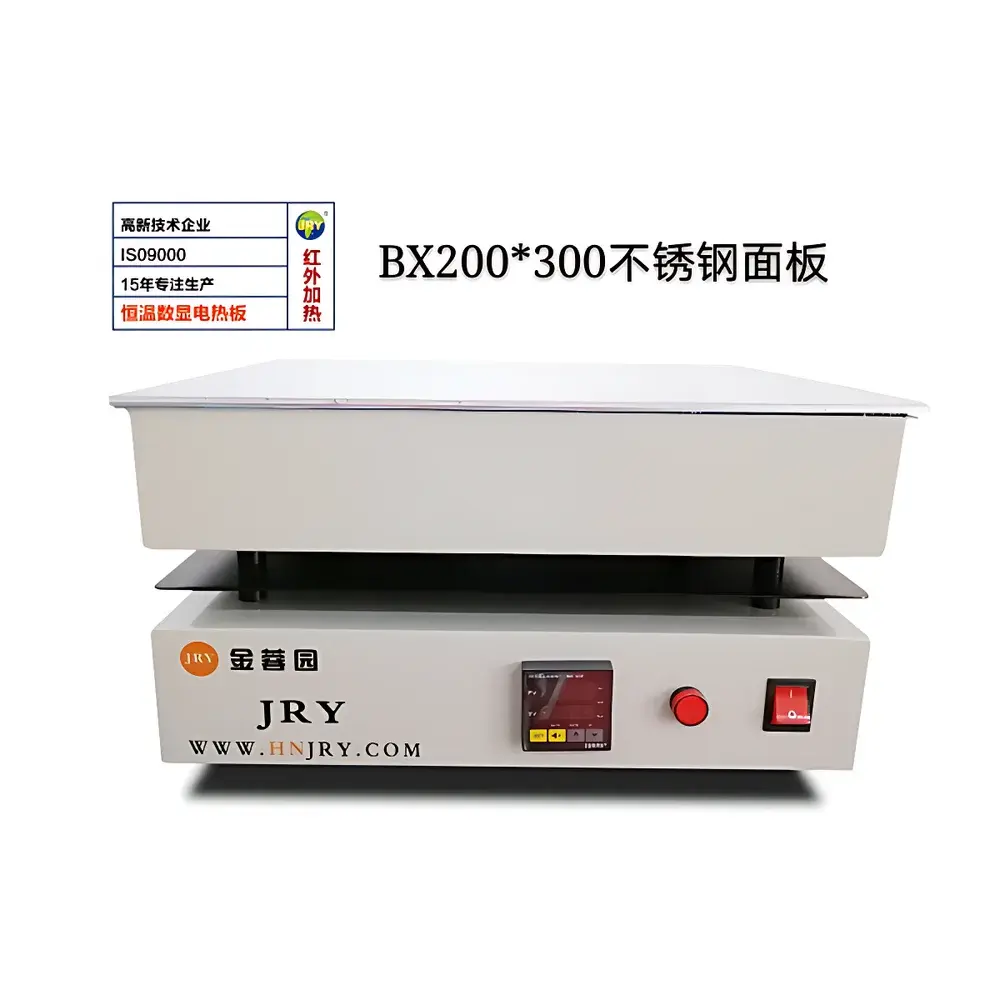
JRY JRYSM Graphite Electric Heating Plate with PID Digital Temperature Control
| Brand | JRY |
|---|---|
| Origin | Hunan, China |
| Manufacturer Type | Direct Manufacturer |
| Product Category | Domestic |
| Model | JRYSM |
| Heating Power | 2 kW |
| Temperature Controller | PID Digital Display Controller |
| Maximum Operating Temperature | 450 °C |
| Temperature Uniformity | ±0.1 °C |
| Heating Surface Dimensions | 200 × 300 mm |
| Display Type | LED Digital Display |
Overview
The JRY JRYSM Graphite Electric Heating Plate is a precision-engineered laboratory heating platform designed for consistent, contamination-free thermal treatment of samples during digestion, evaporation, concentration, and sample preparation workflows. Built around a high-purity graphite heating surface—selected for its exceptional thermal conductivity, chemical inertness, and resistance to thermal shock—the unit delivers uniform heat distribution across the entire 200 × 300 mm active zone. Unlike traditional metal-surface hotplates, graphite minimizes localized hot spots and eliminates leaching risks associated with stainless steel or aluminum plates when exposed to aggressive acids (e.g., HNO₃, HF, HCl) commonly used in EPA Method 3050B, 3051A, and ISO 11466 sample digestion protocols. The system operates on a robust 2 kW resistive heating architecture, regulated by a closed-loop PID digital temperature controller that maintains setpoint stability within ±0.1 °C under steady-state conditions—a critical performance threshold for method-compliant trace-metal analysis and GLP-regulated environmental testing laboratories.
Key Features
- Graphite heating surface engineered for acid resistance, low outgassing, and long-term dimensional stability at temperatures up to 450 °C
- PID digital temperature controller with real-time LED display, adjustable ramp/soak profiles, and auto-tuning capability for optimal thermal response
- Uniform heating zone precisely matched to the physical dimensions (200 × 300 mm), eliminating edge cooling effects common in oversized or undersized platforms
- Stainless steel housing with reinforced structural integrity for benchtop durability and compatibility with fume hood integration
- Over-temperature protection circuit with independent safety cutoff (adjustable limit up to 480 °C) compliant with IEC 61000-6-3 electromagnetic immunity requirements
- No moving parts or consumables—designed for >10,000 hours of continuous operation with minimal maintenance
Sample Compatibility & Compliance
The JRYSM heating plate supports a wide range of sample vessels including borosilicate glass beakers (50–1000 mL), PTFE and quartz digestion tubes, and ceramic crucibles. Its inert graphite surface ensures no catalytic interference during open-vessel acid digestions or solvent-based evaporation steps. The unit meets fundamental safety and performance criteria outlined in ASTM D5630 (Standard Test Method for Ash Content of Plastics), ISO 11466 (Soil quality — Extraction of trace elements for subsequent analysis), and USP (Evaporation Residue). While not certified as a Class I Division 1 device, it conforms to EN 61326-1 for electrical equipment used in laboratory environments and includes documentation traceable to manufacturer’s QC records per ISO 9001:2015 quality management system standards.
Software & Data Management
The JRYSM operates as a standalone analog-digital hybrid instrument without embedded firmware or network connectivity. All temperature settings, dwell times, and operational logs are manually recorded by the user. For laboratories requiring electronic data capture and audit trails, the unit is compatible with external USB or RS-232 data loggers (e.g., Omega OM-DAQPRO-5300 series) via optional analog output (0–5 V or 4–20 mA) when interfaced through third-party signal conditioning modules. No proprietary software is provided; however, raw temperature readings can be imported into LIMS or ELN platforms (e.g., LabWare, Benchling) following CSV or Excel-compatible formatting conventions. The design intentionally omits cloud connectivity to preserve data sovereignty and align with FDA 21 CFR Part 11 requirements where electronic signatures and audit trail validation are managed at the enterprise system level—not at the instrument layer.
Applications
- Open-beaker acid digestion of soils, sediments, and biological tissues prior to ICP-MS or AAS analysis
- Controlled evaporation of organic extracts in pesticide residue testing (AOAC 2007.01, EN 15662)
- Drying and ashing of filter papers in gravimetric particulate matter analysis (EPA Method 201A)
- Pre-heating and temperature equilibration of reagent solutions in wet chemistry calibration workflows
- Support heating for reflux condensers and distillation assemblies in organic synthesis labs
- Thermal conditioning of calibration standards in environmental monitoring QA/QC programs
FAQ
What materials are compatible with the graphite surface?
Glass, quartz, PTFE, PFA, and ceramic vessels are fully compatible. Avoid direct contact with molten metals, strong alkalis above pH 13, or concentrated perchloric acid unless used within certified fume hoods and with appropriate explosion-proof safeguards.
Is the temperature uniformity specification verified per ASTM E220?
No—ASTM E220 applies to thermocouple calibration. Uniformity is validated internally using a 9-point NIST-traceable PT100 probe array per manufacturer’s SOP-HP-007, with results documented in the Certificate of Conformance shipped with each unit.
Can this unit be integrated into an automated sample prep line?
Not natively. It lacks digital I/O or Modbus support. Integration requires external relay control and third-party PLC coordination for start/stop and temperature setpoint modulation.
Does the unit include a calibration certificate?
A factory calibration report (covering zero offset, span accuracy, and uniformity at 100 °C, 250 °C, and 400 °C) is included. ISO/IEC 17025-accredited calibration services are available through authorized regional partners upon request.
What is the expected service life under daily 8-hour operation?
Based on accelerated life testing per IEC 60068-2-2, the graphite plate retains ≥95% thermal efficiency after 12,000 operating hours; the PID controller electronics are rated for 50,000 hours MTBF.



