
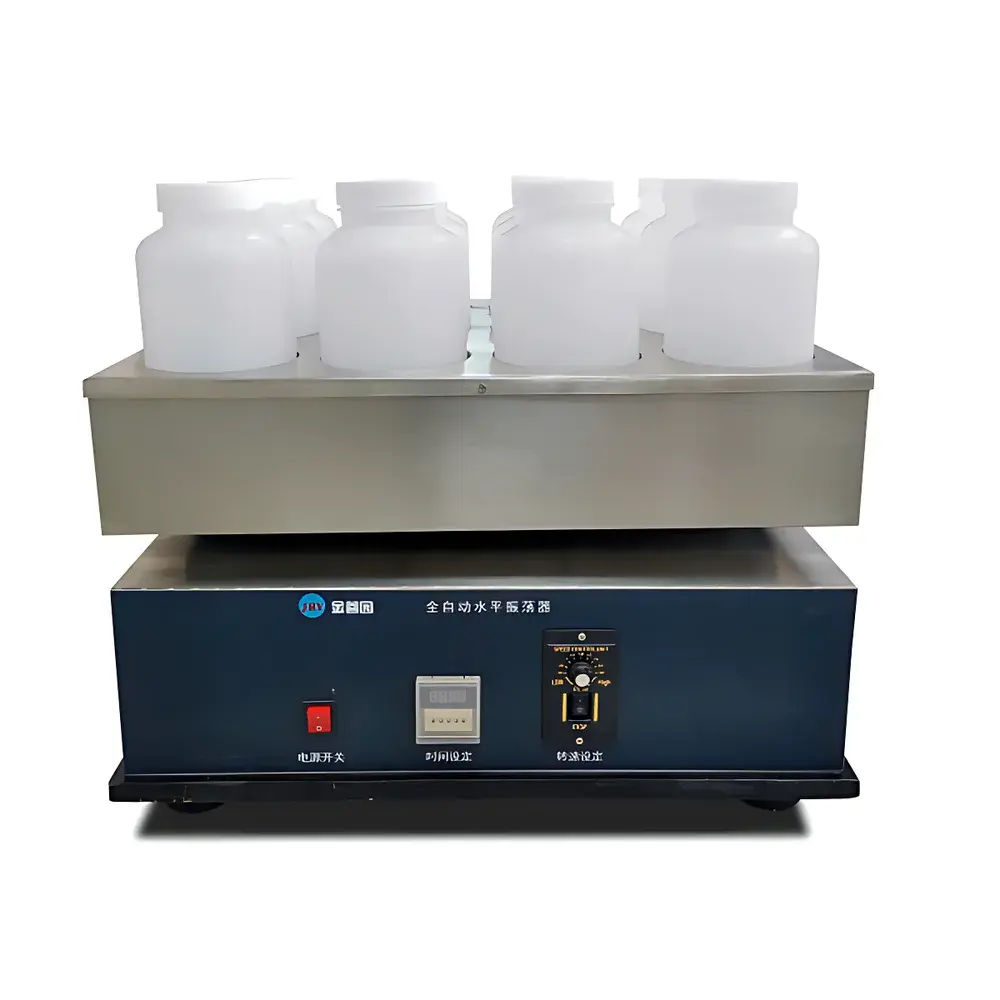
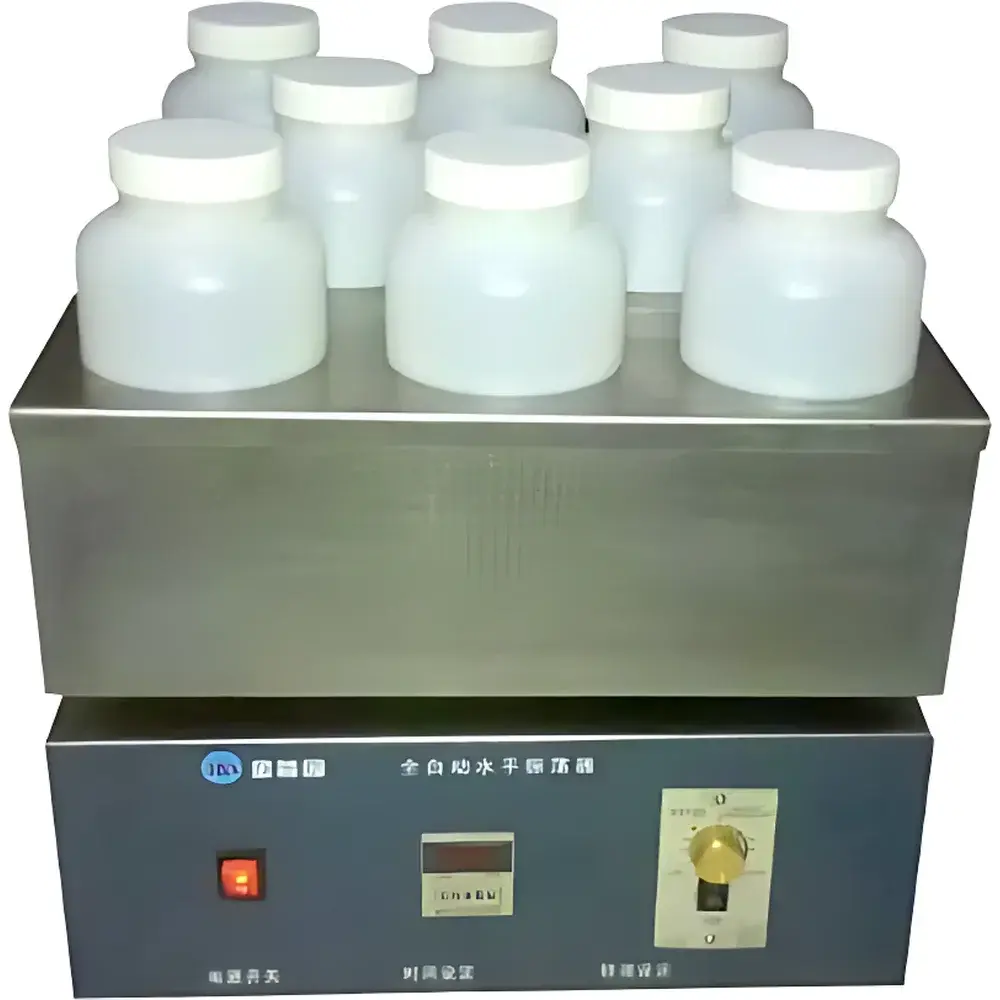
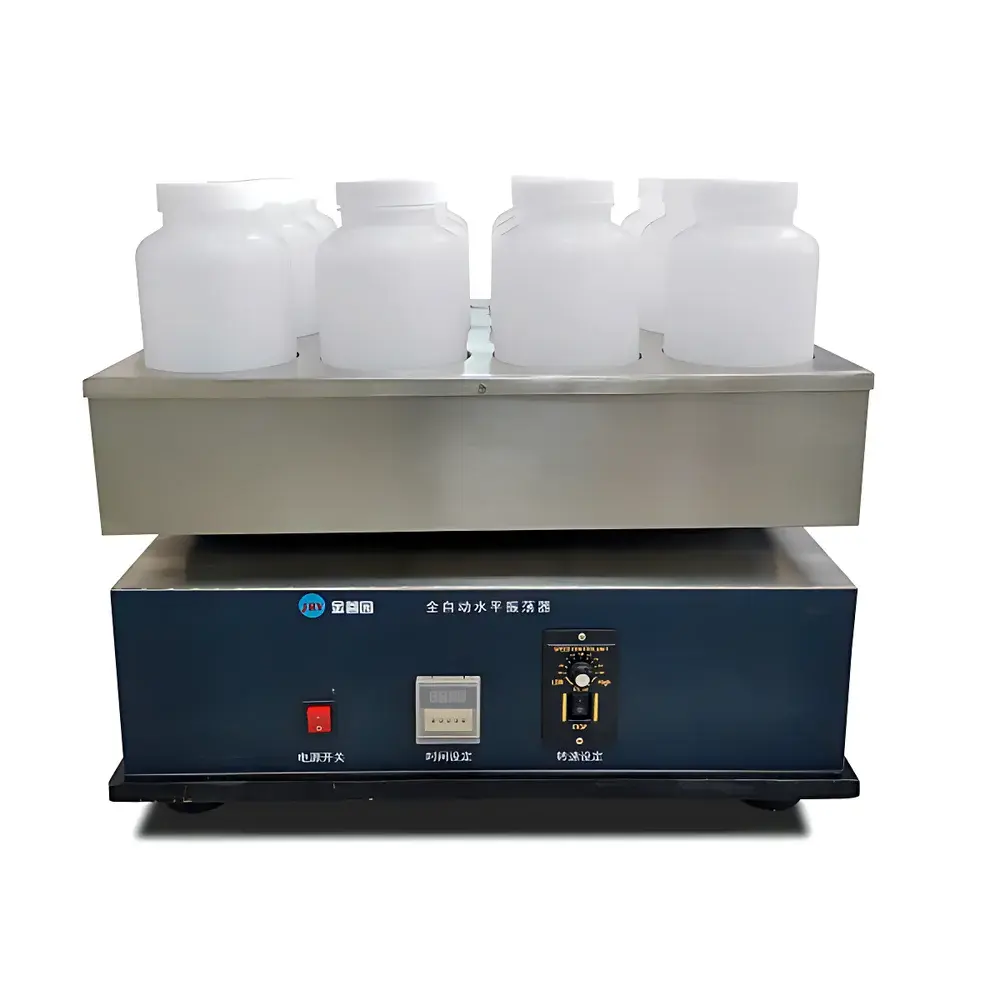
JRY-S08 Horizontal Shaker for Solid Waste Leaching Extraction
| Brand | JRY |
|---|---|
| Model | S08 |
| Origin | Hunan, China |
| Manufacturer Type | Direct Manufacturer |
| Country of Origin | China |
| Speed Range | 0–150 cycles/min (adjustable) |
| Oscillation Mode | Linear reciprocating |
| Amplitude | 4.5 mm / 6 mm (selectable) |
| Display | Analog scale |
| Power Supply | 220 V, 50 Hz |
| Motor Power | 140 W |
| Sample Capacity | 8 × 2 L bottles |
| Dimensions (L×W×H) | 450 × 290 × 290 mm |
| Net Weight | 10 kg |
| Housing Material | Full stainless steel (AISI 304) |
| Timer Range | 0–99 h |
| Compliance | HJ 557–2009, GB/T 10288–2003 |
| Quality System | ISO 9001 certified |
| Patent No. | ZL2011 3 0225454.6 |
Overview
The JRY-S08 Horizontal Shaker is a precision-engineered laboratory instrument specifically designed to meet the rigorous mechanical and regulatory requirements of solid waste leaching toxicity testing. It operates on the principle of controlled linear reciprocating oscillation—mimicking natural percolation and leaching processes that occur when hazardous or potentially hazardous solid waste interacts with aqueous media under landfill or storage conditions. As defined in the Chinese Environmental Protection Standard HJ 557–2009 (“Leaching Toxicity Test Method for Solid Waste – Horizontal Oscillation Method”), this shaker delivers reproducible, standardized motion to ensure consistent extraction kinetics across sample batches. Its mechanical architecture—featuring a balanced eccentric drive mechanism, low-inertia stainless-steel platform, and vibration-damped base—is optimized for long-duration, high-load operation without drift or thermal instability. Unlike orbital or rotary shakers, the horizontal reciprocating motion ensures uniform shear distribution along the entire liquid–solid interface, minimizing particle settling and enhancing solute mass transfer efficiency—critical for accurate quantification of extractable heavy metals, organic pollutants, and other regulated contaminants.
Key Features
- Full AISI 304 stainless-steel housing and platform for corrosion resistance, chemical compatibility, and compliance with GLP laboratory hygiene standards.
- Linear reciprocating oscillation with dual-amplitude selection (4.5 mm and 6 mm), enabling method-specific tuning per HJ 557–2009 or internal SOPs.
- Analog speed scale calibrated to 0–150 cycles per minute, offering stable, non-digitally modulated motion ideal for regulatory traceability and audit readiness.
- Integrated mechanical timer (0–99 hours) supporting unattended, extended-duration leaching protocols—including 18-hr and 24-hr standard extractions.
- Modular bottle tray accommodating eight 2 L containers—compatible with borosilicate glass, HDPE, and PTFE-lined bottles per EPA SW-846 Method 1311 and HJ 557–2009 material specifications.
- 140 W high-torque induction motor with reinforced bearing assembly, rated for continuous duty at full load (≤16 kg total payload) with noise level <55 dB(A).
- ISO 9001-certified design, manufacturing, and service workflow—ensuring documented process control, calibration traceability, and post-installation technical support.
Sample Compatibility & Compliance
The JRY-S08 is validated for use with standard leaching vessels conforming to HJ 557–2009 dimensional and sealing requirements, including 2 L wide-mouth glass jars (DIN 11851 thread), PE containers meeting ASTM D4929 specifications, and fluoropolymer-coated bottles for aggressive matrices (e.g., acidic or alkaline leachates). It satisfies mechanical performance criteria outlined in both HJ 557–2009 and GB/T 10288–2003 (Feather and Down Testing Methods), making it suitable for cross-sector applications in environmental monitoring, waste characterization, pharmaceutical excipient testing, and raw material quality control. While not FDA 21 CFR Part 11–compliant out-of-the-box (as it lacks electronic audit trail functionality), its analog control system provides inherent data integrity for paper-based GLP recordkeeping. The device supports full traceability when paired with laboratory notebooks, calibrated stopwatch verification, and periodic amplitude/speed validation using ISO 5347-compliant vibration analyzers.
Software & Data Management
The JRY-S08 operates as a standalone hardware platform with no embedded firmware or digital interface. All operational parameters—including oscillation frequency, amplitude setting, and elapsed time—are manually configured and visually verified via analog indicators. This architecture eliminates software validation burdens associated with computerized systems under ISO/IEC 17025 or EU Annex 11, while ensuring deterministic behavior across power cycles and environmental fluctuations. For laboratories requiring digital integration, third-party data loggers (e.g., Omega OM-DAQPRO-5300 series) may be mounted adjacent to the shaker to capture real-time acceleration profiles via triaxial MEMS sensors—enabling post-hoc correlation of mechanical input with analytical output (e.g., ICP-MS metal concentrations). Calibration certificates for amplitude and cycle rate are issued upon request and traceable to CNAS-accredited metrology labs.
Applications
- Regulatory leaching tests for hazardous waste classification under China’s “Technical Specifications for Identification of Hazardous Wastes” (HJ 298–2019).
- Pre-disposal screening of municipal solid waste incineration ash, contaminated soils, and construction/demolition debris.
- Research-scale simulation of contaminant release kinetics in landfill leachate generation studies.
- Extraction of residual solvents or catalyst residues from pharmaceutical intermediates per ICH Q5C guidelines.
- Standardized agitation in method development for EPA Method 1311 (TCLP), Method 1312 (SPLP), and ISO 16620–2 (plastics leaching).
- Quality assurance of industrial absorbents, activated carbons, and ion-exchange resins used in wastewater treatment.
FAQ
Is the JRY-S08 compliant with international standards such as ASTM or ISO?
Yes—it fulfills the mechanical performance requirements of HJ 557–2009, which aligns closely with ISO 16620–2 and ASTM D5233 for horizontal shaking parameters. While not formally certified to ASTM standards, its amplitude, frequency range, and load capacity meet or exceed those specified in ASTM D5233–22 Annex A1.
Can the shaker accommodate bottles larger than 2 L?
The standard tray is engineered for eight 2 L bottles. Custom trays supporting up to four 5 L containers are available under OEM agreement (lead time: 6–8 weeks; requires structural reinforcement and motor recalibration).
What maintenance is required for long-term reliability?
Biannual inspection of drive belt tension, lubrication of linear guide rails (with ISO VG 68 synthetic grease), and verification of amplitude consistency using a dial indicator are recommended. No firmware updates or sensor recalibration are necessary due to the analog control architecture.
Does the device include documentation for audit purposes?
Each unit ships with a Factory Calibration Report (amplitude ±0.2 mm, frequency ±2 cycles/min), ISO 9001 Certificate of Conformance, HJ 557–2009 Application Note, and full mechanical schematic—suitable for inclusion in laboratory validation protocols and regulatory submissions.



