
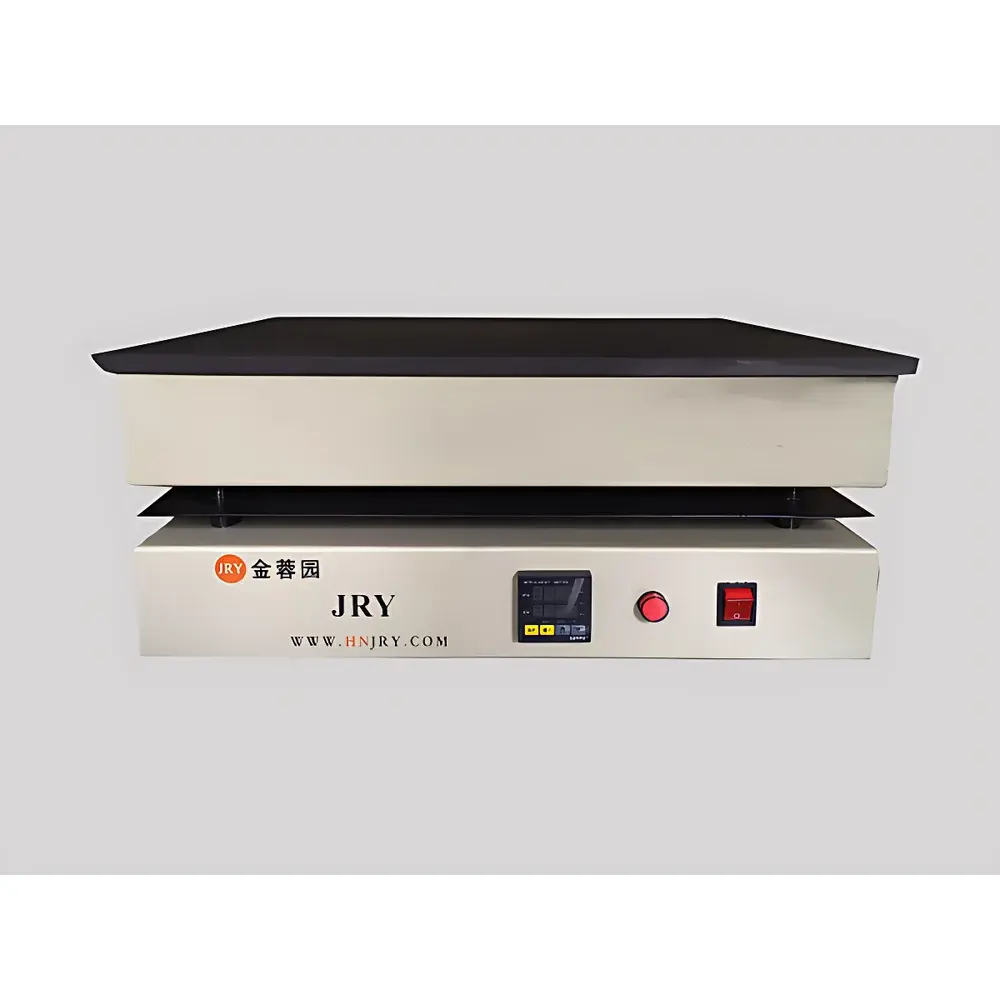
JRY JRY-D350-A Graphite Platen Heater
| Brand | JRY |
|---|---|
| Origin | Hunan, China |
| Manufacturer Type | Direct Manufacturer |
| Product Category | Domestic |
| Model | JRY-D350-A |
| Temperature Range | Ambient to 350 °C |
| Temperature Accuracy | ±1 °C |
| Display | Digital LED |
| Input Voltage | 220 V ±10%, 50 Hz |
| Power Rating | 4000 W |
| Dimensions (W×D×H) | 400 × 300 × 240 mm |
| Weight | 15 kg |
| Control Mode | PID Digital Temperature Controller |
| Compliance | Designed for GLP-compliant laboratory environments |
| Surface Material | High-Purity Isostatic Graphite |
| Max Continuous Operation | 40 h at rated temperature |
Overview
The JRY JRY-D350-A Graphite Platen Heater is a precision-engineered laboratory heating platform designed for applications requiring uniform, contamination-free, and chemically inert thermal treatment of samples. Unlike conventional metal-sheathed or ceramic plate heaters, this unit employs a monolithic high-purity isostatic graphite platen — engineered for exceptional thermal conductivity, dimensional stability up to 350 °C, and intrinsic resistance to strong acids, alkalis, and organic solvents. Its operating principle relies on resistive Joule heating embedded within the graphite matrix, enabling rapid thermal response (<15 min to reach 300 °C from ambient) and spatial temperature uniformity of ≤±2 °C across the active surface area (400 × 300 mm). The heater is not a furnace enclosure but a flat, open-format conductive heating surface—ideal for controlled evaporation, solvent removal, sample pre-drying, catalyst activation, and gravimetric analysis workflows where sample integrity and surface cleanliness are critical.
Key Features
- High-purity isostatic graphite platen: Non-porous, corrosion-resistant, and non-reactive—eliminates metallic leaching and surface residue buildup during repeated use with aggressive reagents.
- PID digital temperature controller with real-time LED display: Enables precise setpoint regulation (ambient to 350 °C) with accuracy of ±1 °C and repeatability <±0.8 °C over 40-hour continuous operation.
- Optimized thermal architecture: Uniform heat distribution achieved via calibrated resistive element layout and graphite’s inherent lateral thermal conductivity (>120 W/m·K), minimizing radial gradients.
- Robust mechanical design: Stainless steel housing with integrated ventilation slots and thermal insulation layer ensures stable external casing temperature (<60 °C at full load) and long-term structural integrity.
- Ergonomic usability: Front-panel controls with tactile buttons, clear digitized readout, and intuitive parameter navigation—designed for glove-compatible operation in fume hood or benchtop settings.
- Compliance-ready operation: Supports audit trails when paired with optional data logging modules; compatible with standard lab documentation protocols under ISO/IEC 17025 and GLP frameworks.
Sample Compatibility & Compliance
The JRY-D350-A accommodates a wide range of sample formats including crucibles (porcelain, quartz, Pt), Petri dishes, watch glasses, aluminum pans, and custom stainless-steel trays. Its inert graphite surface prevents catalytic side reactions and enables direct heating of pH-sensitive or trace-metal analysis samples without cross-contamination risk. The device meets general safety requirements per IEC 61010-1:2010 for laboratory electrical equipment and incorporates over-temperature cut-off protection (independent of main controller) at 380 °C. While not certified to UL or CE for export markets out-of-the-box, its electrical architecture and material selection align with baseline requirements for FDA-regulated QC labs performing USP drying procedures or ASTM E145-22 gravimetric moisture determination.
Software & Data Management
The base model operates via standalone hardware control; however, an optional RS-485 interface (Modbus RTU protocol) enables integration with LabView, MATLAB, or LIMS platforms for remote monitoring and automated temperature ramping. When used with JRY’s companion software suite (v2.1+), users can configure multi-step thermal profiles, export timestamped temperature logs (.CSV), and generate calibration reports compliant with ISO/IEC 17025 clause 6.4.2. All recorded data include operator ID, session start/end time, setpoint history, and deviation alerts—supporting 21 CFR Part 11–aligned electronic record retention when deployed with validated user access controls.
Applications
- Gravimetric moisture and ash content analysis per AOAC 925.09, ASTM D2974, and ISO 5982.
- Pre-concentration of environmental water extracts prior to ICP-MS or HPLC analysis.
- Drying of pharmaceutical excipients and active ingredients under controlled thermal stress (ICH Q1A).
- Activation of silica gel or molecular sieve desiccants in analytical prep labs.
- Controlled thermal treatment of geological core samples for XRF fusion preparation.
- Low-oxygen thermal conditioning of battery electrode slurries in R&D settings.
FAQ
Is the graphite platen susceptible to oxidation at 350 °C?
No—under ambient air conditions, isostatic graphite exhibits negligible oxidation below 450 °C. Long-term stability at 350 °C is confirmed by accelerated aging tests per ASTM C781.
Can the heater be used inside a nitrogen-purged glovebox?
Yes. Its sealed electronics and absence of outgassing materials (e.g., no epoxy potting or PVC wiring) make it suitable for inert-atmosphere applications.
What maintenance is required to sustain temperature accuracy?
Annual verification using NIST-traceable PT100 probe is recommended; graphite surface requires only IPA wipe-down—no lubrication or recalibration needed under normal use.
Does the unit support programmable ramp-and-soak cycles?
Not in standard configuration; ramp/soak functionality requires the optional digital controller upgrade kit (JRY-DCU-PRO v3.0).
How does it compare to ceramic plate heaters in terms of thermal recovery after sample loading?
Graphite’s higher specific heat capacity (710 J/kg·K) and thermal diffusivity yield ~40% faster recovery vs. equivalent-area alumina plates, particularly with high-mass or high-thermal-capacity samples.



