
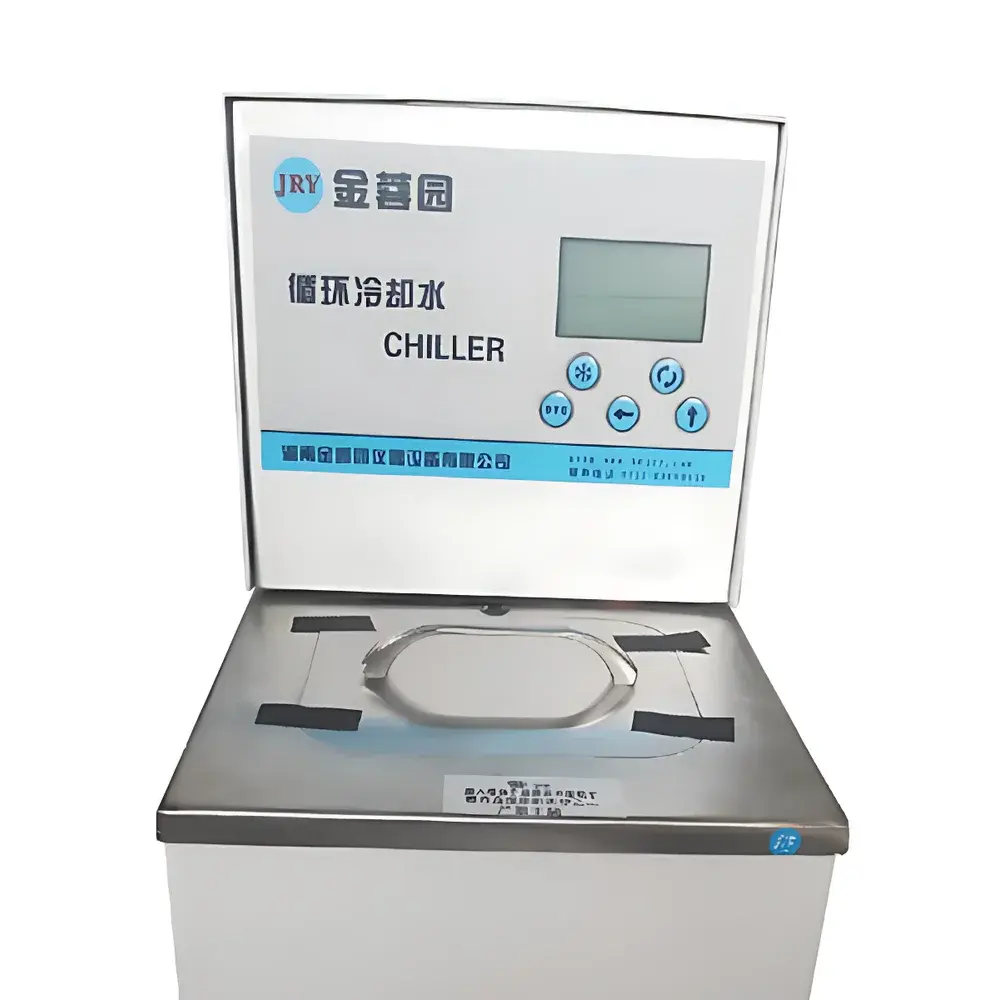
JRY JRY-05-A Integrated Circulating Chiller
| Brand | JRY |
|---|---|
| Origin | Hunan, China |
| Manufacturer Type | Direct Manufacturer |
| Instrument Type | Integrated Unit |
| Cooling Method | Water-Cooled |
| Temperature Range | 0–99.99 °C |
| Temperature Stability | ±0.1 °C |
| Refrigeration Capacity | 1000 W |
| Circulation Pump Pressure | 1.0 bar |
| Circulation Flow Rate | 6 L/min |
| Reservoir Volume | 6 L |
| Operation Mode | Continuous Duty |
Overview
The JRY JRY-05-A Integrated Circulating Chiller is a precision temperature control system engineered for stable, continuous thermal management of laboratory instrumentation requiring active heat dissipation or precise bath temperature maintenance. It operates on a closed-loop refrigeration cycle with water-cooled condensation, enabling reliable operation in ambient environments where air-cooled units may face capacity derating or condensate management challenges. The chiller employs a hermetic compressor, high-efficiency plate heat exchanger, and PID-controlled digital thermostat to maintain setpoint accuracy within ±0.1 °C across its full 0–99.99 °C operating range — a specification validated under steady-state load conditions per ISO 17025-aligned internal calibration protocols. Its integrated architecture eliminates external coolant reservoirs or auxiliary plumbing, reducing footprint and installation complexity while preserving hydraulic integrity and minimizing evaporation loss.
Key Features
- Integrated design with built-in 6-liter stainless-steel reservoir, circulation pump, refrigeration circuit, and digital controller — no external components required.
- Water-cooled condenser enables consistent performance in elevated ambient temperatures (up to 35 °C) without airflow dependency or acoustic noise typical of air-cooled compressors.
- PID-driven temperature regulation with real-time feedback from dual Pt100 sensors (bath and outlet) ensures dynamic compensation for load transients and long-term drift stability.
- High-flow, low-pulsation circulation pump delivering 6 L/min at 1.0 bar maximum head pressure — sufficient for multi-port distribution manifolds or instruments with moderate backpressure (e.g., ICP torch cooling jackets).
- Continuous-duty rated motor-compressor assembly with thermal overload protection and refrigerant leak detection circuitry compliant with IEC 61000-6-3 EMC standards.
- Front-panel interface with 4-digit LED display, keypad navigation, and configurable alarm thresholds for high/low temperature, low flow, and reservoir level.
Sample Compatibility & Compliance
The JRY-05-A supports both internal recirculation (for standalone bath applications) and external loop configurations via standardized 1/2″ BSP threaded ports. It is routinely deployed with analytical instruments including atomic absorption spectrometers (AAS), inductively coupled plasma optical emission spectrometers (ICP-OES), CO₂ lasers, rotary evaporators, Kjeldahl digesters, Soxhlet extractors, and electrophoresis systems requiring isoelectric focusing (IEF) temperature stabilization. All wetted materials — reservoir, pump housing, and heat exchanger plates — are constructed from 316 stainless steel or EPDM-certified elastomers, ensuring compatibility with deionized water, 30% ethylene glycol solutions, and mild aqueous buffers. The unit conforms to CE marking requirements (2014/30/EU EMC Directive and 2014/35/EU LVD Directive) and meets the mechanical safety provisions of EN 61010-1 for laboratory electrical equipment.
Software & Data Management
While the JRY-05-A operates as a stand-alone instrument, it features an RS-485 serial interface (Modbus RTU protocol) for integration into centralized lab monitoring networks. Optional OEM firmware upgrades support time-stamped logging of temperature setpoint, actual bath temperature, pump status, and compressor run hours to external SCADA or LIMS platforms. Audit trail functionality — including user login timestamps, parameter modification history, and alarm event logs — can be enabled to satisfy GLP and FDA 21 CFR Part 11 requirements when paired with validated third-party data acquisition software. No proprietary cloud service or vendor-hosted platform is required or embedded.
Applications
- Thermal stabilization of plasma sources in ICP instrumentation to prevent torch thermal drift and improve spectral reproducibility.
- Cooling of high-power laser diodes and solid-state gain media where junction temperature must remain within ±0.5 °C for wavelength stability.
- Condenser temperature control in rotary evaporation systems to optimize solvent recovery efficiency and prevent bumping during low-boiling-point fractionation.
- Temperature-regulated jacketing of reaction vessels in synthetic chemistry workflows requiring exotherm management or cryogenic initiation.
- Support of electrophoretic separation techniques such as isoelectric focusing, where gel matrix temperature directly impacts protein migration resolution and band sharpness.
FAQ
What is the maximum allowable coolant viscosity for continuous operation?
The system is optimized for aqueous solutions and glycol-water mixtures up to 30% v/v ethylene glycol (dynamic viscosity ≤ 3.5 mPa·s at 20 °C). Higher viscosities require flow rate derating and are not covered under warranty.
Can the chiller operate unattended for extended periods?
Yes — the unit includes automatic restart after power interruption, reservoir level sensing with dry-run prevention, and overtemperature cutout. For >72-hour unattended runs, periodic verification of coolant level and conductivity is recommended.
Is external pressure regulation required for connection to sensitive instruments?
No — the integrated pressure relief valve and adjustable bypass flow path allow direct coupling to instruments with inlet pressure specifications between 0.3–1.0 bar without additional regulators.
Does the chiller support remote setpoint adjustment via analog signal?
Not natively — only digital communication via Modbus RTU is supported. Analog 0–10 V or 4–20 mA setpoint input requires an external signal converter compatible with the RS-485 interface.
What maintenance intervals are specified for laboratory-grade operation?
Compressor oil and refrigerant charge require inspection every 24 months; condenser water filter (if installed upstream) must be cleaned quarterly; reservoir descaling with 5% citric acid solution is advised every 6 months under hard-water conditions.



