
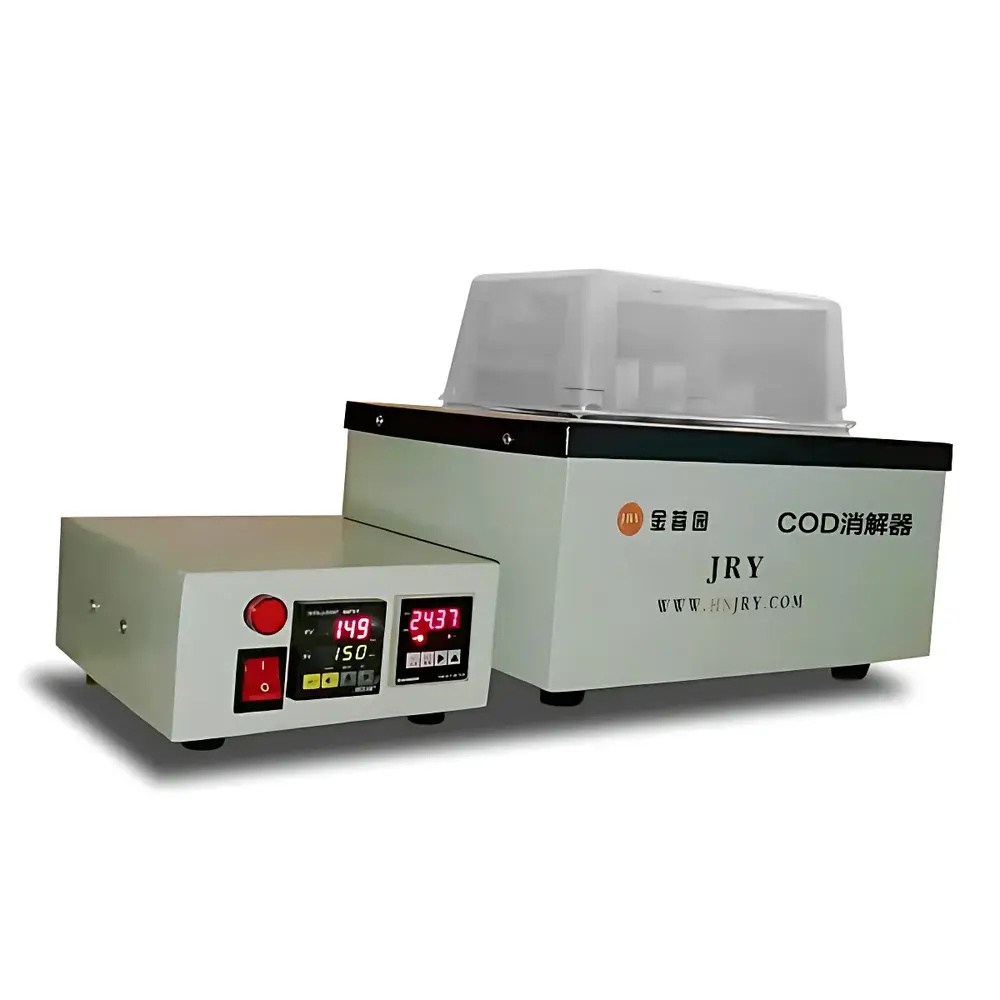
JRY-F-COD Advanced Multi-Analyte Rapid Digestion System for COD, Total Nitrogen & Total Phosphorus in Water and Wastewater
| Brand | JRY |
|---|---|
| Origin | Hunan, China |
| Manufacturer Type | Direct Manufacturer |
| Product Category | Domestic |
| Model | JRY-F-COD |
| Digestion Method | Rapid Closed-Vessel Catalytic Digestion |
| Heating Modules | Dual Independent Aluminum Block Heaters |
| Batch Capacity | 60 Samples |
| Temperature Range | Ambient to 350 °C |
| Temperature Accuracy | ±1 °C |
| Temperature Uniformity Across Block | ±1 °C |
| Digestion Vessel Capacity | 1–10 mL (compatible with standard 16 mm OD × 60 mm depth tubes) |
| Timer Range | 0–999 min |
| Timing Resolution | 1 s |
| Power Supply | 220 V AC, 50/60 Hz |
| Rated Power | 1500 W |
| Warm-up Time to 160 °C | <10 min |
| Net Weight | 8 kg |
| Compliance | Designed to meet USEPA Method 410.4 requirements for COD determination |
Overview
The JRY-F-COD Advanced Multi-Analyte Rapid Digestion System is a laboratory-grade, dual-block thermal digestion platform engineered for high-throughput, standardized oxidative digestion of water and wastewater samples prior to spectrophotometric quantification of chemical oxygen demand (COD), total nitrogen (TN), and total phosphorus (TP). It operates on the principle of closed-vessel catalytic digestion—where samples are heated under controlled acidic conditions (typically K₂Cr₂O₇/H₂SO₄ for COD; persulfate/acid for TN and TP) to mineralize organic carbon, nitrogenous compounds, and orthophosphate-bound phosphorus into measurable inorganic forms. The system supports both rapid (15-min) and extended digestion protocols, fully aligned with USEPA Method 410.4 for COD and harmonized with ISO 6060 (COD), ISO 11905-1 (TN), and ISO 6878 (TP). Its dual independent heating blocks enable parallel processing of two sample batches under distinct temperature/time profiles—critical for laboratories performing multi-parameter analysis across heterogeneous sample matrices.
Key Features
- Dual independent aluminum heating blocks with PID-controlled thermal regulation ensure precise, repeatable temperature maintenance (±1 °C accuracy, ±1 °C uniformity across all 60 positions)
- 60-position batch capacity optimized for standard 16 mm OD × 60 mm deep digestion tubes (1–10 mL volume range), compatible with 50 mL sealed glass vials per HJ 828–2017 and USEPA-compliant protocols
- Wide programmable temperature range (ambient to 350 °C) and timer (0–999 min, 1-second resolution) support method flexibility—including rapid 165 °C/15 min COD digestion and 120 °C/30 min persulfate oxidation for TN/TP
- Rapid thermal response: achieves 160 °C in under 10 minutes from ambient, minimizing turnaround time without compromising digestion completeness
- Robust industrial-grade construction: corrosion-resistant anodized aluminum housing, integrated safety cut-off, and over-temperature protection compliant with IEC 61010-1
- Front-panel digital interface with intuitive keypad navigation and real-time display of setpoint, actual temperature, and remaining time
Sample Compatibility & Compliance
The JRY-F-COD accommodates diverse aqueous matrices including surface water, domestic sewage, industrial effluents, and pretreated leachate. It is validated for use with chloride-tolerant digestion chemistries (e.g., mercury sulfate masking for Cl⁻ ≤ 1000 mg/L after dilution), as specified in USEPA 410.4 and HJ 828–2017. All digestion protocols are traceable to internationally recognized standards: ISO 6060 for COD, ISO 11905-1 for TN, and ISO 6878 for TP. While the instrument itself does not perform analysis, its thermal performance profile ensures full compliance with the digestion step requirements of GLP- and ISO/IEC 17025-accredited laboratories. No internal data storage or electronic records are generated—users maintain full chain-of-custody control via external lab notebooks or LIMS-integrated workflows.
Software & Data Management
The JRY-F-COD is a standalone hardware platform with no embedded software, cloud connectivity, or proprietary firmware. Operation relies exclusively on its front-panel interface; no drivers, OS compatibility, or installation is required. This architecture eliminates cybersecurity vulnerabilities, ensures long-term operational stability, and simplifies audit readiness—particularly under FDA 21 CFR Part 11 or EU Annex 11 environments where instrument qualification focuses solely on thermal verification (IQ/OQ/PQ). Users perform routine calibration using NIST-traceable PT100 reference probes, documenting temperature deviation and timing accuracy in accordance with ISO/IEC 17025 clause 6.4.2. All method parameters (temperature, duration, ramp rate) are manually entered and verified pre-run—supporting full procedural transparency and analyst accountability.
Applications
- Routine COD monitoring in municipal wastewater treatment plants (WWTPs) and industrial discharge compliance reporting
- Simultaneous TN and TP digestion for eutrophication assessment in freshwater and estuarine systems
- Method validation and interlaboratory comparison studies requiring strict adherence to USEPA 410.4 and ISO 6060
- Research applications involving kinetic digestion profiling (e.g., temperature-dependent oxidation efficiency studies)
- Teaching laboratories conducting APHA Standard Methods 5220D (COD), 4500-Nitrogen D (TN), and 4500-P E (TP) experiments
FAQ
Does the JRY-F-COD include digestion reagents or consumables?
No. Reagents (e.g., potassium dichromate solution, sulfuric acid, catalyst mixtures) and certified digestion tubes must be sourced separately per applicable method requirements.
Can it be used for heavy metal digestion (e.g., EPA 3015A)?
Not recommended. The system lacks pressure-rated vessels and automated pressure relief mechanisms required for microwave-assisted or high-pressure acid digestion protocols.
Is calibration certificate included with shipment?
A factory calibration report (temperature accuracy at 100 °C, 165 °C, and 300 °C) is provided. Full IQ/OQ documentation kits are available upon request for regulated environments.
What tube dimensions are supported?
Standard 16 mm outer diameter × 60 mm depth digestion tubes; compatible with 50 mL borosilicate glass vials meeting ASTM E2934 specifications.
How is cooling managed post-digestion?
Passive air cooling is standard. For accelerated cooldown, users may transfer tubes to a dedicated water bath or ambient-air rack—consistent with USEPA 410.4 Step 8 cooling guidance.
Related Products







