
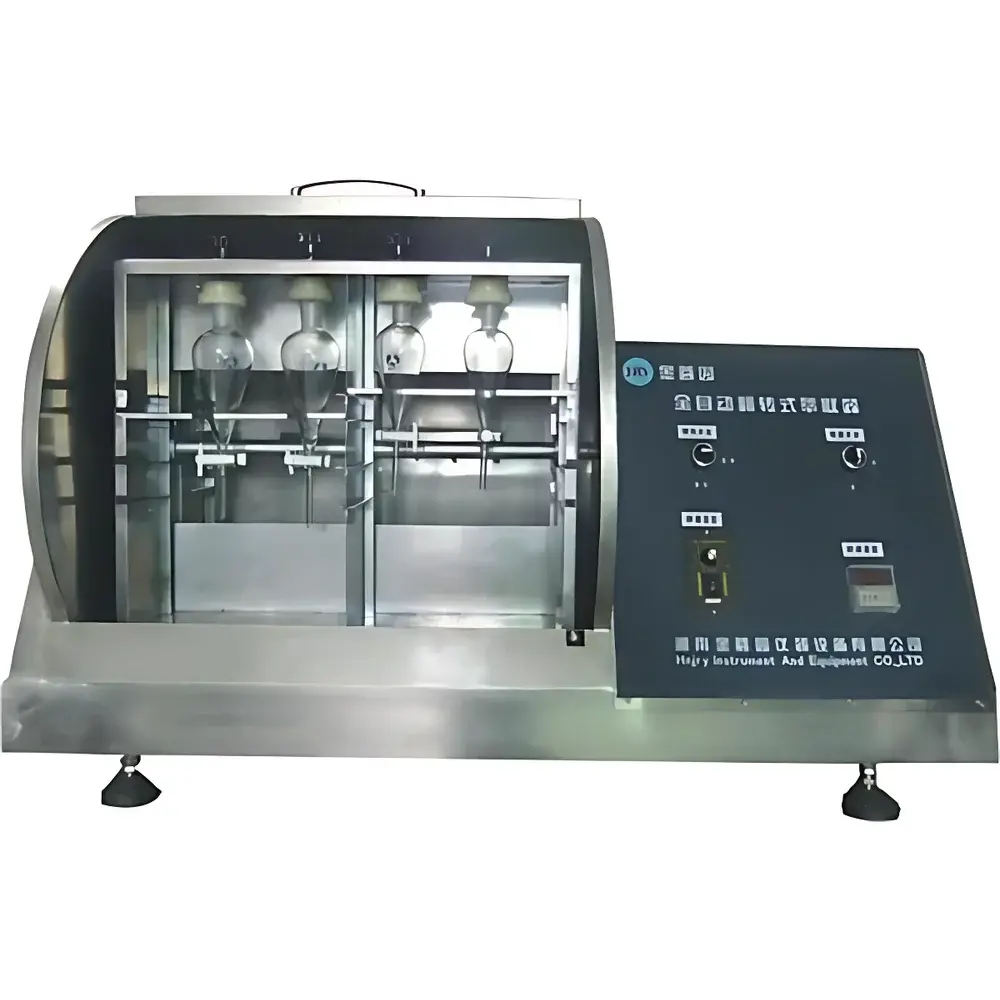
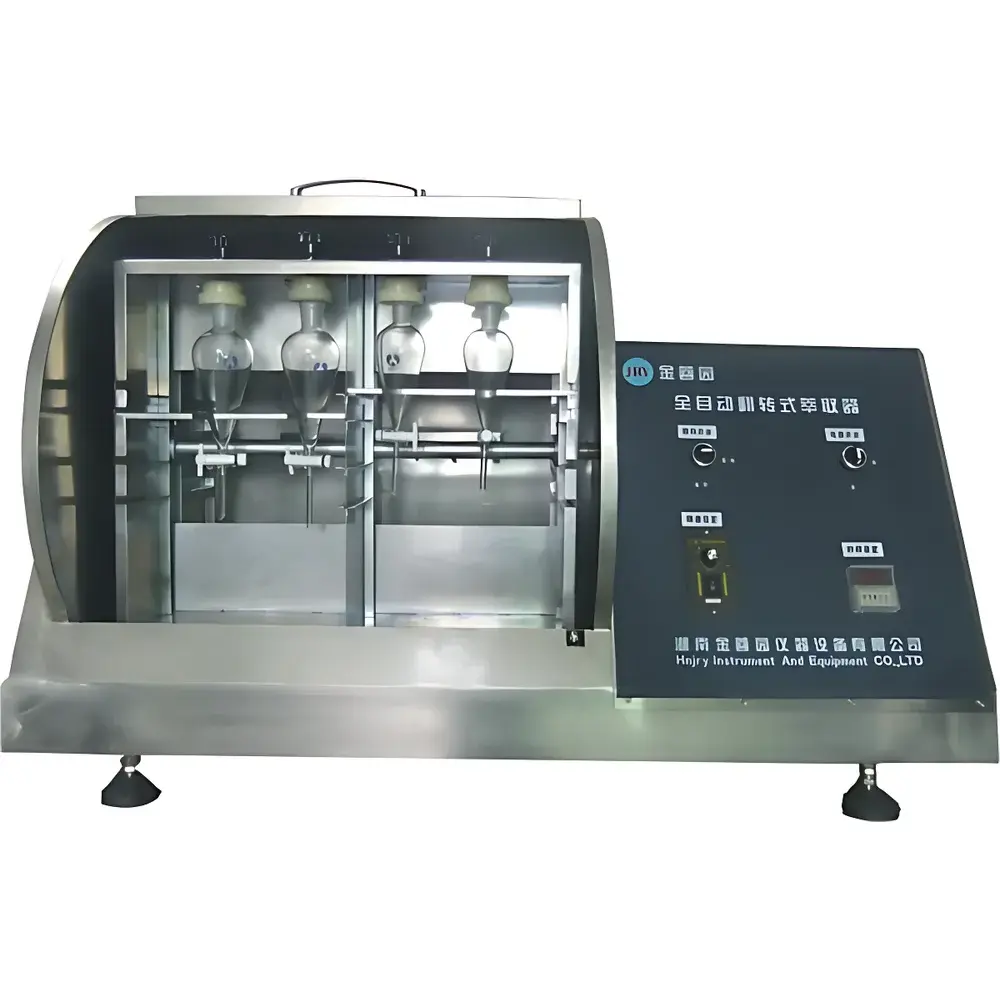
JRY FC06 Automated Inversion Extractor
| Brand | JRY |
|---|---|
| Origin | Hunan, China |
| Manufacturer Type | Direct Manufacturer |
| Product Category | Domestic |
| Models | JRY-FC06 / FC08 / FC10 / FC12 |
| Instrument Type | Solid-Liquid Extraction |
| Temperature Range | Stable operation at 4°C ambient (long-term cold-room compatible) |
| Pressure Rating | >50 psi |
| Extraction Vessel Capacity | 50 mL / 125 mL / 250 mL / 500 mL / 1000 mL |
| Extraction Cycle Time | ≤15 min per batch |
| Dimensions (W×D×H) | 800 × 550 × 700 mm |
| Sample Positions | 6 |
| Motor Power | 90 W |
| Speed Range | 0–60 rpm (adjustable) |
| Timer Range | 0.5–24 h (0.5-h increments) |
| Rotation Modes | Unidirectional, Bidirectional (customizable on/off timing), Oscillatory inversion |
| Safety Features | Interlocked transparent guard door, overload protection, leakage current protection, auto-shutoff upon lid opening |
| Housing Material | Full 304 stainless steel |
| Viewing Window | Tempered acrylic |
| Compliance | ISO 9001 certified design, manufacturing, and service |
Overview
The JRY FC06 Automated Inversion Extractor is an engineered solid-liquid extraction system designed for reproducible, closed-vessel sample preparation in regulated and research-intensive laboratory environments. It operates on the principle of controlled mechanical inversion—precisely rotating sealed extraction vessels through a defined arc to induce vigorous yet gentle mixing between solid matrices and solvent phases. Unlike vortexing or shaking methods that generate shear-induced particle fragmentation or emulsification, inversion-based extraction preserves sample integrity while maximizing interfacial contact area and mass transfer kinetics. The system is optimized for applications requiring high recovery consistency (≥95% typical recovery for target analytes under validated conditions), minimal solvent exposure, and full operator safety compliance. Its structural architecture supports long-term operation in refrigerated environments (e.g., 4°C cold rooms), enabling low-temperature extraction protocols critical for thermolabile compounds or volatile organic analysis.
Key Features
- Closed-system extraction: Eliminates solvent vapor release during operation, meeting OSHA and EU Directive 2004/37/EC occupational exposure limits for hazardous solvents.
- Programmable bidirectional inversion: Independent control over forward rotation duration, reverse rotation duration, and pause intervals—enabling method development for heterogeneous matrices (e.g., sludge, soil, activated carbon).
- Full stainless-steel enclosure (AISI 304): Corrosion-resistant housing with IP54-rated ingress protection; surface-finished for easy decontamination and GLP-compliant cleaning validation.
- Interlocked acrylic viewing window: Provides real-time visual monitoring without compromising containment integrity or triggering safety shutdowns.
- Integrated motor protection suite: Thermal overload cutoff, ground-fault circuit interruption (GFCI), and automatic power disengagement when the protective guard door is opened.
- Modular vessel compatibility: Accommodates standard glass or PTFE-lined separatory funnels (50–1000 mL) via precision-machined, adjustable clamping fixtures—no tool required for reconfiguration.
- Low-noise, high-torque DC motor drive: Rated for continuous duty cycles exceeding 10,000 hours; speed stability ±1 rpm across full 0–60 rpm range.
Sample Compatibility & Compliance
The FC06 accommodates a broad spectrum of solid-phase samples—including soils, sediments, biological tissues, polymer composites, and industrial filter cakes—when paired with appropriate solvent systems (e.g., dichloromethane, acetone, ethyl acetate, or EPA Method 3541-compatible mixtures). All extraction vessels remain fully sealed throughout the process, satisfying containment requirements outlined in EPA SW-846 Method 3541 and ISO 11464:2021 for preparative sample handling. The instrument’s mechanical design conforms to IEC 61000-6-2 (immunity) and IEC 61000-6-4 (emissions) standards. Manufacturing and quality assurance processes are certified to ISO 9001:2015, with full traceability of raw materials, calibration records, and final inspection reports provided with each unit.
Software & Data Management
While the FC06 operates via intuitive front-panel controls (rotary encoder + LCD interface), optional RS-232/USB connectivity enables integration into LIMS or ELN platforms. Time-stamped extraction logs—including start time, total runtime, rotation mode, speed setpoint, and cycle completion status—are exportable as CSV files. For laboratories operating under FDA 21 CFR Part 11 or EU Annex 11 requirements, the optional JRY-FC-MF variant supports user-level access control, electronic signatures, and audit-trail-enabled parameter locking—ensuring data integrity and regulatory readiness without third-party middleware.
Applications
- Environmental testing labs performing EPA Methods 3541 (inversion extraction), 3550C (Sonication), and ASTM D7699 (soil/sediment PAH analysis).
- Pharmaceutical QC units extracting residual solvents from active pharmaceutical ingredients (APIs) per ICH Q5C guidelines.
- Food safety laboratories quantifying pesticide residues in cereals, spices, and dried botanicals per EN 15662:2018.
- Materials science R&D groups isolating leachables from packaging polymers or battery electrode coatings.
- Academic teaching labs demonstrating fundamental extraction thermodynamics and mass transfer principles under controlled, repeatable conditions.
FAQ
What solvent compatibility does the FC06 support?
The system is compatible with all common organic solvents (e.g., hexane, chloroform, methanol) and aqueous mixtures, provided vessels are chemically rated for the selected medium. Glass and PTFE-lined funnels are recommended for aggressive solvents.
Can the FC06 be used in walk-in cold rooms?
Yes—the electronics and motor assembly are rated for stable operation at 4°C ambient temperature with relative humidity ≤80% non-condensing.
Is method validation documentation available?
JRY provides a comprehensive Validation Support Package including IQ/OQ templates, performance qualification test protocols, and blank interference studies aligned with ISO/IEC 17025:2017 clause 7.2.2.
How is maintenance performed?
Routine maintenance is limited to periodic lubrication of pivot bearings (every 12 months) and verification of clamp torque (M6 fasteners, 5.5 N·m). No internal calibration is required; factory calibration certificates are supplied with initial delivery.



