
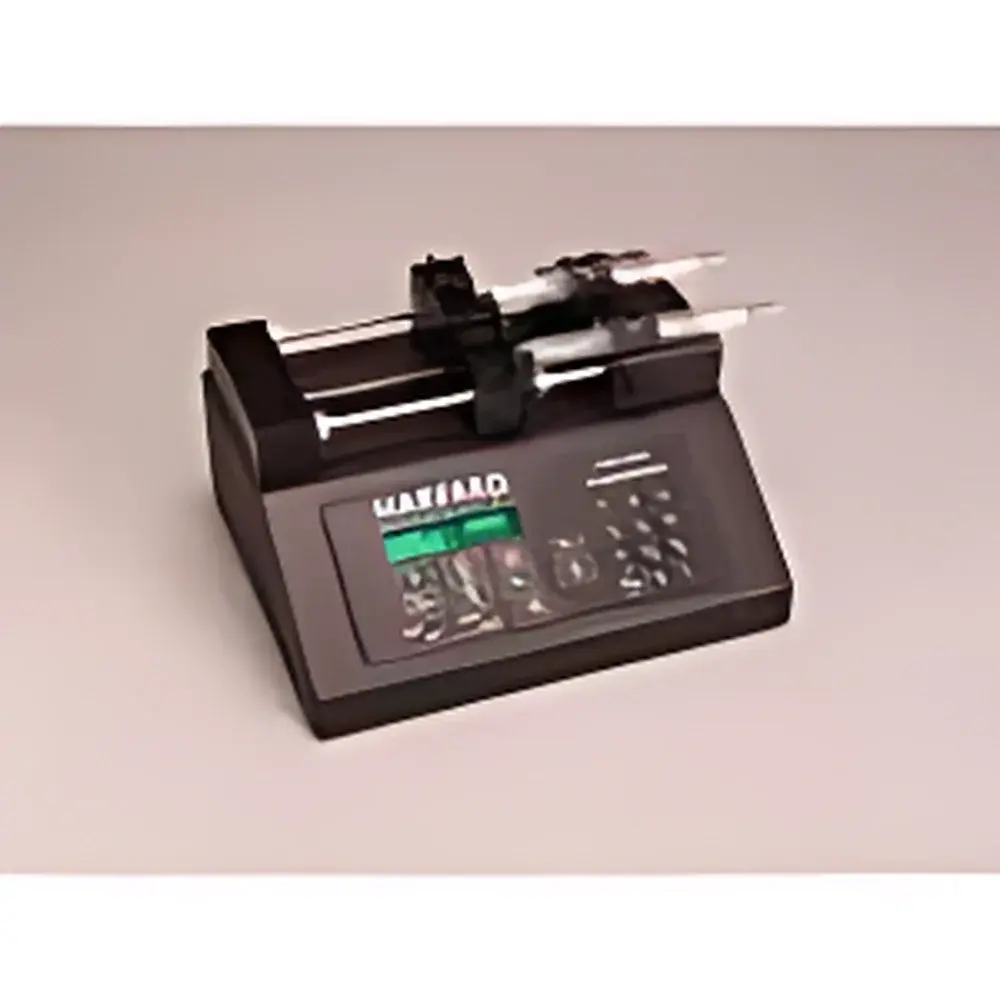
Harvard Apparatus PHD 22/2000 Microprocessor-Driven Syringe Pump
| Brand | Harvard Apparatus |
|---|---|
| Origin | USA |
| Model | PHD 22/2000 |
| Stability Accuracy | ±0.35% |
| Reproducibility Accuracy | ±0.05% |
| Syringe Volume Range | 0.5 µL to 140 mL |
| Flow Rate Range | 0.0001 µL/hr to 220.82 mL/min |
| Non-Volatile Memory | Yes |
| Communication Interfaces | RS-232 (RJ11-4), TTL (9-pin D-Sub) |
| Stepper Motor | 1.8°, microstepping from 1/2 to 1/32 |
| Linear Drive Resolution | 0.082 µm/step |
| Plunger Speed Range | 0.18 µm/min to 190.676 mm/min |
| Max Push Force | 66 lbf |
| Power Input | 95–130 VAC, 60 Hz or 220–260 VAC, 50 Hz |
| Dimensions (H×W×D) | 15.9 × 22.8 × 27.9 cm |
| Weight | 4.5 kg |
Overview
The Harvard Apparatus PHD 22/2000 is a high-precision, microprocessor-controlled syringe pump engineered for demanding laboratory applications requiring ultra-low flow rates, exceptional volumetric accuracy, and long-term operational stability. Based on a robust lead-screw-driven linear actuation architecture, the PHD 22/2000 employs a high-resolution 1.8° hybrid stepper motor with programmable microstepping (1/2 to 1/32), enabling sub-microliter positioning resolution down to 0.082 µm per step. Its mechanical design integrates a welded steel chassis, precision-machined Delrin® components, and reinforced linear guide rods—collectively contributing to its industry-leading stability accuracy of ±0.35% and reproducibility accuracy of ±0.05%. Unlike peristaltic or piston-based displacement pumps, the PHD 22/2000 operates via direct plunger displacement, eliminating pulsation, tubing compliance effects, and backflow—making it ideal for quantitative delivery in analytical chemistry, neuropharmacology, microfluidics, and controlled-release studies where fluidic integrity and temporal fidelity are critical.
Key Features
- Ultra-low flow capability: Programmable down to 0.0001 µL/hr—enabling sustained nanoliter-per-day infusions for chronic in vivo dosing or slow-reacting kinetic assays.
- High-force linear drive: Standard 50 lbf push force, extendable to 66 lbf for high-viscosity or high-backpressure applications (e.g., capillary filling, gel loading, or reverse-phase HPLC sample introduction).
- Three configurable operation modes: Single-direction infusion only; bidirectional infusion/aspiration; and fully programmable multi-step protocols—each mode supported by identical mechanical and metrological specifications.
- Non-volatile memory storage: Retains up to four independent programs (10 steps each), preserving user-defined flow profiles, direction changes, volume targets, and pause intervals across power cycles.
- Ergonomic human-machine interface: Dual-line fluorescent display with ambient-light readability; tactile telephone-style keypad; self-locking syringe clamp mechanism ensuring secure engagement without manual verification.
- Modular upgrade path: Base models (infusion-only or infusion/aspiration) can be field-upgraded to full programmable functionality via firmware and optional software licensing—reducing total cost of ownership and lifecycle obsolescence risk.
Sample Compatibility & Compliance
The PHD 22/2000 accommodates standard Luer-lock and threaded syringes ranging from 0.5 µL glass microsyringes to 140 mL industrial barrels, supporting both aqueous and moderately viscous fluids (up to ~10,000 cP at low flow rates). Its metal-and-Delrin® construction ensures chemical resistance to common solvents, buffers, and biological media. While not certified as medical-grade or IVD-compliant, the pump meets general-purpose laboratory equipment requirements under ANSI Z535.4 (product safety labeling) and complies with FCC Part 15 Class B and CE electromagnetic compatibility directives. For regulated environments, its RS-232 and TTL interfaces support integration into validated systems compliant with FDA 21 CFR Part 11 when paired with appropriate audit-trail-capable host software (e.g., Symphony v5.x with electronic signature and change control logging).
Software & Data Management
The PHD 22/2000 is natively compatible with Harvard Apparatus’ Symphony™ software—a Windows-based platform enabling graphical protocol development, real-time monitoring, remote control, and export of time-stamped flow metadata (volume delivered, direction, speed, error flags) in CSV or XML format. Symphony supports GLP/GMP-aligned workflows, including user access levels, electronic signatures, and immutable audit trails for method validation. The pump’s RS-232 (RJ11-4) and TTL (9-pin D-Sub) ports allow deterministic synchronization with external triggers (TTL start/stop, direction toggle), making it suitable for integration into automated assay platforms, electrophysiology rigs, or custom LabVIEW or Python-controlled experimental setups. All configuration parameters—including acceleration profiles, microstep settings, and calibration offsets—are retained in non-volatile memory, eliminating reconfiguration after power loss.
Applications
- Chronic intracerebral or intrathecal drug delivery in rodent neuroscience models, where sub-nL/hr precision prevents dose dumping and enables pharmacokinetic modeling over days or weeks.
- Controlled reagent addition in stopped-flow spectroscopy, enzyme kinetics, or crystallization screening—where precise timing and stoichiometric accuracy govern reaction initiation.
- Calibration and validation of flow sensors, mass spectrometry interfaces, or microchip-based analytical devices requiring traceable, pulseless flow standards.
- Microfabrication support: Metered deposition of photoresists, conductive inks, or hydrogel precursors onto MEMS substrates with positional repeatability <0.1% RSD.
- Automated sample preparation: Coupled with autosamplers or liquid handlers for sequential dilution series, spike recovery tests, or QC standard generation in ISO/IEC 17025-accredited labs.
FAQ
What syringe sizes are supported by the PHD 22/2000?
The pump accepts syringes from 0.5 µL (glass microsyringes) up to 140 mL (large-volume plastic or glass barrels), provided they feature standardized Luer-lock or compatible threaded fittings.
Can the PHD 22/2000 perform bidirectional flow (infuse and withdraw) in a single program?
Yes—infusion/aspiration and fully programmable models support dynamic direction reversal within any step of a stored protocol, with user-defined dwell times and flow rate transitions.
Is firmware update capability available for legacy units?
Yes—Harvard Apparatus provides documented firmware revision history and update procedures via authorized service channels; updates may enable new communication protocols or expanded microstepping resolution.
Does the pump support analog input/output for closed-loop control?
No—the PHD 22/2000 operates open-loop using stepper motor position tracking; however, its TTL trigger inputs allow synchronization with external feedback signals (e.g., pressure transducer thresholds) via host-level logic.
How is calibration traceability maintained for regulatory submissions?
While the pump itself does not include NIST-traceable onboard calibration, Harvard Apparatus supplies factory calibration reports with uncertainty budgets. Users may perform in-house gravimetric or volumetric verification per ASTM E2792 or ISO 8655-4, documenting procedures in their quality management system.



