
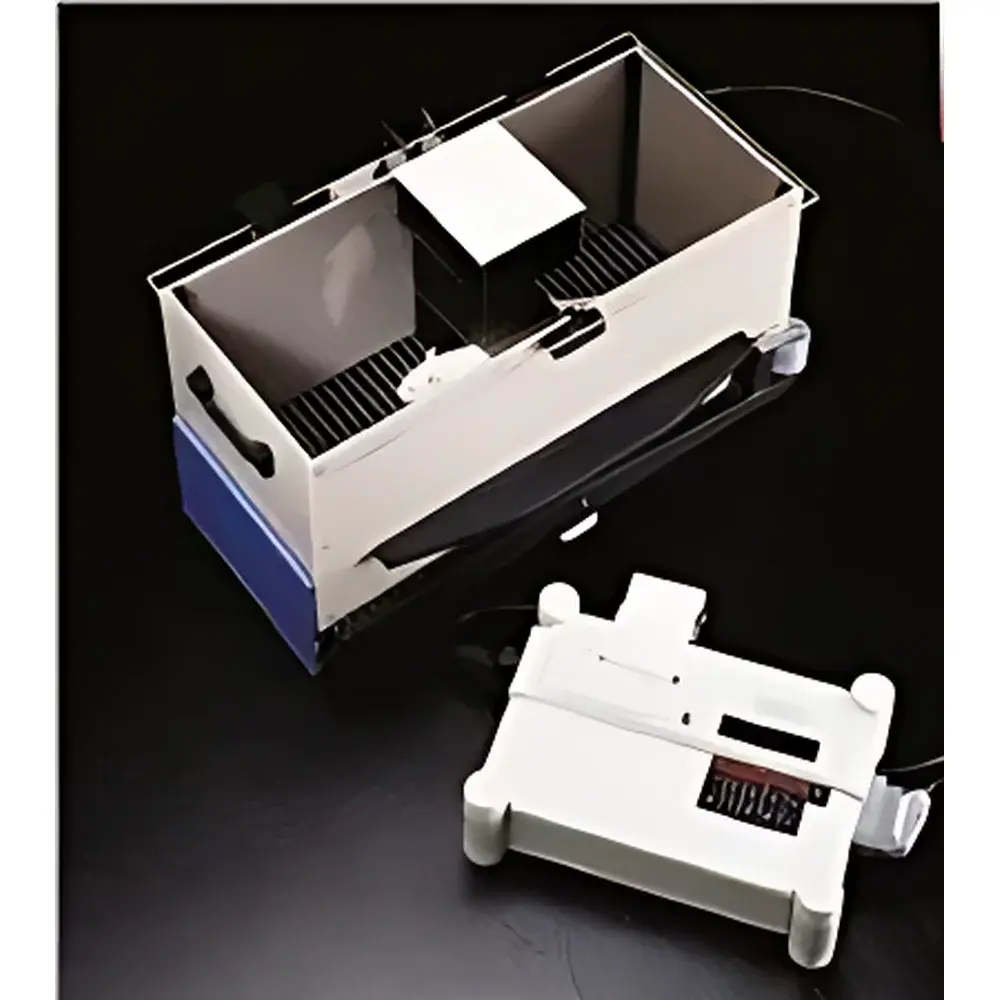
Shuttle Box System for Animal Behavior Research
| Origin | USA |
|---|---|
| Manufacturer Type | Authorized Distributor |
| Origin Category | Imported |
| Model | Shuttle Box System |
| Pricing | Available Upon Request |
Overview
The Shuttle Box System for Animal Behavior Research is a fully automated, computer-controlled apparatus designed to assess associative learning and memory in rodents through active avoidance paradigms. Based on the classical two-way shuttle box paradigm, the system enables precise quantification of conditioned behavioral responses—specifically, the animal’s ability to shuttle between two compartments to avoid an aversive stimulus (e.g., mild foot shock) cued by a discriminative stimulus (light or tone). This paradigm relies on operant conditioning principles grounded in Pavlovian and instrumental learning theory, making it a foundational tool in translational neuroscience for evaluating hippocampal- and amygdala-dependent learning, fear extinction, cognitive flexibility, and sensorimotor gating. The system operates under controlled environmental conditions (ambient light, sound-dampened enclosure, standardized floor grid configuration), ensuring high inter-laboratory reproducibility and compliance with NIH and OECD guidelines for behavioral phenotyping.
Key Features
- Fully integrated bidirectional avoidance conditioning platform with real-time stimulus delivery and response detection.
- Programmable visual cue system: independent control of LED illumination intensity and duration in each compartment (450–650 nm spectral range, <1 ms rise time).
- Configurable auditory stimulus generator: frequency-tunable tone output from 2 kHz to 20 kHz (±0.5% accuracy), with adjustable amplitude (20–90 dB SPL, calibrated per ANSI S3.6).
- Foot shock delivery module: constant-current stimulation (0.05–0.8 mA, ±1% precision), programmable pulse width (10–500 ms), and inter-stimulus interval control (1–30 s).
- High-resolution video tracking subsystem: 60 fps monochrome CMOS camera with IR illumination, supporting automated detection of animal position, velocity, latency to shuttle, and entry/exit events via pixel-based motion analysis.
- Modular software architecture with built-in experiment templates (e.g., passive avoidance, active avoidance, discrimination reversal) and support for custom protocol scripting via Python-compatible API.
Sample Compatibility & Compliance
The Shuttle Box System is validated for use with adult mice (C57BL/6, BALB/c, FVB/N) and rats (Sprague-Dawley, Wistar), accommodating standard weight ranges (18–45 g for mice; 200–400 g for rats). Chamber dimensions comply with AAALAC International housing and testing standards (minimum floor area: 30 × 15 cm per compartment; wall height: 30 cm). All electrical components meet IEC 61000-4 electromagnetic compatibility requirements and UL 61010-1 safety standards for laboratory equipment. Data acquisition and storage adhere to GLP-compliant audit trail protocols, including timestamped event logs, user authentication, and immutable raw data export (CSV, HDF5 formats) suitable for FDA 21 CFR Part 11–regulated studies.
Software & Data Management
The proprietary ShuttleBox Control Suite (v4.2+) provides a graphical interface for protocol design, real-time monitoring, and post-hoc behavioral analytics. It supports synchronized multimodal event logging (light onset, tone start, shock delivery, shuttle crossing) with sub-10 ms temporal resolution. Built-in metrics include escape latency, avoidance rate, inter-trial interval distribution, freezing duration (via motion thresholding), and session-wise performance curves. Export modules enable direct integration with MATLAB, R, and Python-based neuroinformatics pipelines (e.g., NeuroPy, EthoLoop). Audit trails record all parameter modifications, user logins, and data exports—fully traceable for regulatory submissions under ISO/IEC 17025 or OECD Test Guideline 426.
Applications
- Evaluation of learning deficits in transgenic Alzheimer’s disease models (e.g., APP/PS1, 5xFAD) and tauopathy strains.
- Pharmacological screening of nootropic, anxiolytic, or antipsychotic compounds targeting NMDA, GABAA, or dopaminergic pathways.
- Investigation of age-related cognitive decline and neuroinflammatory modulation of synaptic plasticity.
- Validation of optogenetic or chemogenetic interventions in defined neural circuits (e.g., basolateral amygdala → prefrontal cortex projections).
- Standardized preclinical assessment for CNS drug development programs aligned with FDA Guidance for Industry on Cognitive Endpoints (2022).
FAQ
Is the shuttle box compatible with third-party electrophysiology or optogenetics setups?
Yes—the system features TTL-compatible trigger I/O ports (5 V logic) for hardware synchronization with patch-clamp amplifiers, photometry systems, or laser diode drivers.
Can behavioral data be exported in FAIR-compliant format?
Yes—raw event streams and processed metrics are exportable in BIDS-derivatives-compliant JSON-LD metadata structures alongside NWB 2.6 schema support.
What calibration documentation is provided?
Each unit ships with NIST-traceable calibration certificates for shock current, acoustic pressure, and photometric output, updated annually per ISO/IEC 17025 requirements.
Does the software support multi-session longitudinal analysis?
Yes—longitudinal cohort tracking is enabled via subject ID-linked databases, with automated statistical comparison across sessions using mixed-effects modeling frameworks.
Is remote monitoring supported during experiments?
Yes—secure WebSocket-based remote access allows real-time video streaming and live parameter adjustment via authenticated HTTPS interface, compliant with HIPAA/FERPA data transmission standards.
Related Products



