
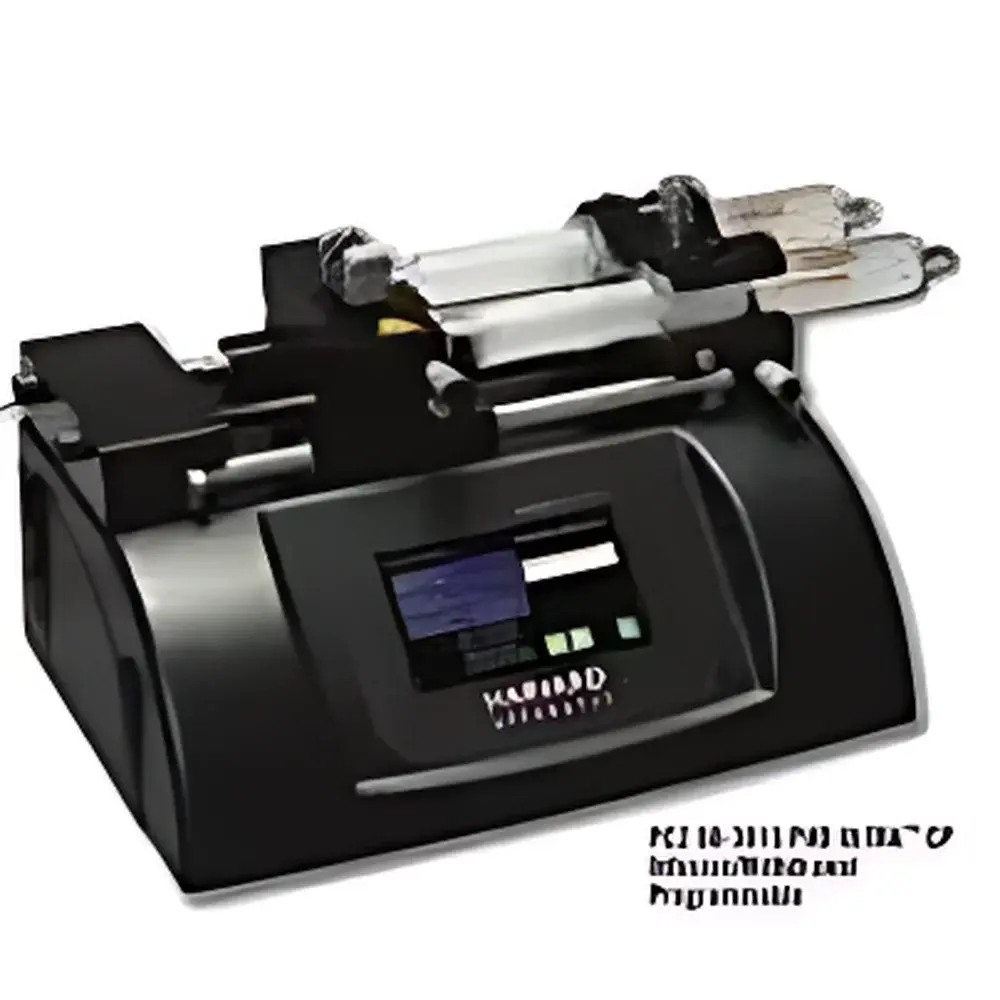
Harvard Apparatus PHD ULTRA CP Constant-Pressure Microinfusion Pump
| Brand | Harvard Apparatus |
|---|---|
| Origin | USA |
| Model | PHD ULTRA CP |
| Pump Type | Programmable Dual-Mode (Constant Pressure & Constant Flow) Peristaltic Infusion Pump |
| Pressure Control Accuracy | ±2% of setpoint |
| Pressure Units | mmHg, kPa, psi |
| Analog Input | 0–10 V DC (compatible with integrated pressure sensor/amplifier modules) |
| Communication Interface | RS-232 |
| Dual-Function | Infusion and Withdrawal |
| Warranty | 24 months |
| Compliance | Designed for GLP-compliant preclinical research environments |
Overview
The Harvard Apparatus PHD ULTRA CP Constant-Pressure Microinfusion Pump is an engineered solution for precision fluid delivery in physiologically sensitive applications where pressure stability—not volumetric flow rate—is the primary control variable. Unlike conventional syringe or peristaltic pumps operating in open-loop constant-flow mode, the PHD ULTRA CP implements closed-loop pressure regulation via real-time feedback from externally connected pressure transducers. It operates on the principle of dynamic flow modulation: the pump continuously adjusts motor speed and occlusion force to maintain user-defined pressure at the infusion site, compensating for changes in system resistance—including vascular compliance, catheter friction, tissue backpressure, or viscoelastic barrier formation. This architecture is particularly critical in ex vivo organ perfusion, intracerebral microinjection, ocular delivery, and microfluidic systems where transient pressure spikes or drift may compromise cellular integrity, induce edema, or trigger unintended physiological responses.
Key Features
- Dual operational modes: selectable constant-pressure mode (closed-loop) and high-accuracy constant-flow mode (open-loop), both programmable via front-panel interface or RS-232 command protocol.
- Real-time pressure regulation with ±2% setpoint stability across the full operating range, achieved through proprietary Harvard Apparatus motor control firmware and adaptive PID tuning.
- Configurable sensitivity parameter allowing users to adjust response time to pressure deviations—critical for balancing system stability against dynamic responsiveness in compliant biological loads.
- Native analog input (0–10 V DC) for direct integration with commercially available pressure sensor/amplifier modules; no external signal conditioners or secondary controllers required.
- Simultaneous on-screen display of set pressure, actual measured pressure, and instantaneous flow rate during constant-pressure operation—enabling correlation of mechanical stimulus with volumetric output.
- Full bidirectional functionality: programmable infusion and withdrawal sequences with independent ramping, dwell, and step profiles.
- Robust mechanical architecture optimized for continuous operation under sustained load, delivering up to 1000 lbf (4.45 kN) of linear push force via precision lead-screw actuation.
Sample Compatibility & Compliance
The PHD ULTRA CP is compatible with standard Luer-lock syringes (1 µL to 60 mL capacity), flexible tubing (ID 0.01–0.125 in), and microbore catheters used in rodent, avian, and ex vivo organ preparations. Its pressure monitoring architecture supports integration with FDA-cleared or ISO 13485–certified pressure sensors for use in regulated preclinical studies. The device is designed to support Good Laboratory Practice (GLP) workflows: audit-trail-capable software logging (via optional Harvard Apparatus PumpControl™ Suite), timestamped pressure/flow data export in CSV format, and deterministic command-response latency suitable for synchronization with electrophysiology or imaging platforms. While not a medical device, its performance characteristics align with ASTM F2397 (Standard Guide for Evaluation of Infusion Pumps) and USP requirements for pressure-controlled delivery verification.
Software & Data Management
The pump communicates via industry-standard RS-232 serial protocol using ASCII-based SCPI-like commands, enabling seamless integration into LabVIEW, MATLAB, Python (pySerial), or custom C++ acquisition frameworks. Harvard Apparatus PumpControl™ software (Windows-compatible) provides graphical configuration of pressure setpoints, sensitivity thresholds, and dual-mode transition logic. All pressure and flow telemetry is timestamped and exportable with millisecond resolution. Data files include metadata headers specifying calibration date, sensor model, analog gain settings, and user-defined experiment identifiers—facilitating traceability in multi-investigator studies. The system supports 21 CFR Part 11–compliant electronic signatures when deployed with validated software configurations and access-controlled user accounts.
Applications
- Ex vivo organ perfusion (e.g., isolated heart, kidney, or lung preparations) requiring stable hydrostatic pressure to preserve capillary integrity and avoid barotrauma.
- Targeted intracerebral or intravitreal injection in small-animal models, where pressure-limited delivery prevents tissue rupture or reflux.
- Controlled chemical or viral vector infusion into confined anatomical spaces (e.g., spinal cord parenchyma, cochlear duct) where flow resistance varies dynamically.
- Microfluidic platform priming and reagent loading under defined backpressure conditions to prevent bubble nucleation or channel delamination.
- Pharmacokinetic studies involving timed, pressure-gated bolus delivery across semi-permeable membranes or endothelial monolayers.
- Calibration and validation of pressure-sensitive biosensors or microscale flow meters in benchtop test rigs.
FAQ
How does the PHD ULTRA CP differ from traditional constant-flow infusion pumps?
It replaces open-loop volumetric control with closed-loop pressure regulation, using real-time analog feedback to modulate motor output—ensuring pressure constancy despite variable downstream resistance.
Can the pump be used without a pressure sensor?
Yes—switching to constant-flow mode enables standalone operation; however, constant-pressure functionality requires connection to a 0–10 V DC pressure transducer or amplifier module.
What pressure units are supported, and how is unit conversion handled?
mmHg, kPa, and psi are natively supported; conversions are performed internally using NIST-traceable coefficients and displayed without rounding artifacts.
Is the RS-232 interface optically isolated?
No—electrical isolation must be implemented externally if connecting to grounded instrumentation in electrically noisy environments.
Does the two-year warranty cover sensor integration components?
The warranty applies to the pump hardware and embedded firmware only; third-party pressure sensors, cables, or signal conditioners are covered under their respective manufacturer terms.



