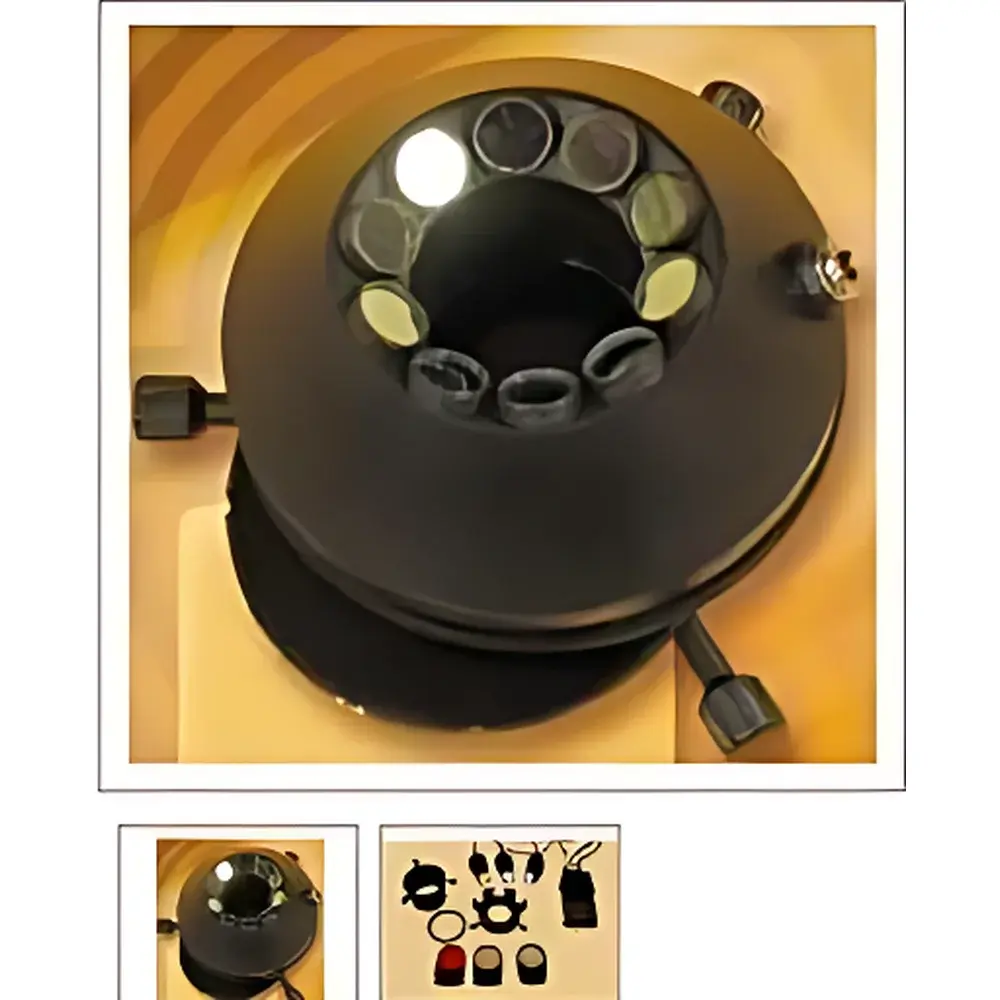
BLS FMA-04 Universal Fluorescence Illumination Adapter for Stereo Microscopes
| Brand | BLS |
|---|---|
| Origin | Imported |
| Manufacturer Type | Authorized Distributor |
| Model | FMA-04 |
| Excitation Source | High-Brightness LED(s) |
| Compatible Eyepiece Diameter (D1) | Custom-adaptable, typically 23–30 mm |
| Tube Diameter (D2) | Custom-adaptable, typically 35–45 mm |
| Eyepiece Barrel Length (L1) | Configurable per microscope platform |
| Focal Range (Fmin–Fmax) | 120–220 mm |
| Emission Filter Options | GFP (500–515 nm), GFP/YFP dual-band (500–550 nm), YFP (515–550 nm) |
| Power Supply | 6 V DC |
| Mounting | Three-screw mechanical attachment to focus collar |
| Filter Wheel Positions | “No Filter” (white-light alignment), Green-dot (GFP), Yellow-dot (YFP), Green-Yellow-dot (dual-band) |
| Compliance | CE-marked optical accessory |
Overview
The BLS FMA-04 is a modular, externally mounted fluorescence illumination adapter engineered for integration with standard stereo (dissecting) microscopes used in clinical laboratory, histopathology, and biomedical research settings. Unlike integrated fluorescence systems requiring optical redesign or proprietary microscope platforms, the FMA-04 operates on the principle of epifluorescence illumination via coaxial LED excitation—positioned outside the eyepiece tube without altering the microscope’s optical path or mechanical integrity. It leverages high-luminance monochromatic LEDs (typically 470 ± 10 nm peak for blue excitation) to induce fluorescence in common genetically encoded probes—including CFP, GFP, YFP—and conventional dyes such as FITC and TRITC. Its passive thermal management and regulated 6 V DC input ensure stable radiometric output over extended imaging sessions, supporting qualitative and semi-quantitative fluorescence observation under ambient or controlled darkroom conditions.
Key Features
- Non-invasive mechanical integration: mounts directly onto the focus collar using three M3 screws—no disassembly or permanent modification of the base microscope required.
- Modular filter wheel with four calibrated positions: “No Filter” (for white-light focusing and alignment), Green-dot (500–515 nm bandpass, optimized for GFP), Yellow-dot (515–550 nm, optimized for YFP), and Green-Yellow-dot (500–550 nm dual-band, enabling simultaneous detection of GFP/YFP co-expression).
- Adjustable collimation optics: integrated focusing ring enables precise spatial alignment of the excitation beam at the specimen plane, maximizing signal-to-background ratio without introducing spherical aberration.
- Universal eyepiece coupling: accommodates variable D1 (eyepiece outer diameter) and D2 (body tube outer diameter) dimensions via precision-machined adapter rings—validated for Leica MZ series, Olympus SZX, Zeiss Stemi, and Nikon SMZ platforms.
- Compliance-ready design: constructed with USP Class VI-certified silicone gaskets and RoHS-compliant PCBs; CE-marked per EN 61326-1 (electromagnetic compatibility) and EN 62471 (photobiological safety).
Sample Compatibility & Compliance
The FMA-04 supports live and fixed biological specimens imaged under low-magnification stereomicroscopy (6×–50×), including fluorescently labeled tissue sections, transgenic zebrafish embryos, GFP-expressing bacterial colonies, and immunofluorescent whole-mount preparations. It is routinely deployed in CLIA-certified laboratories for rapid screening of reporter gene expression and in GLP-compliant preclinical studies where documentation of illumination consistency is required. While not a standalone diagnostic device, the adapter complies with IEC 61010-1 for laboratory electrical equipment safety and is compatible with FDA 21 CFR Part 11–enabled image capture workflows when paired with validated digital cameras and acquisition software.
Software & Data Management
As a hardware-only illumination module, the FMA-04 does not include embedded firmware or proprietary software. It functions transparently within existing imaging ecosystems—including NIS-Elements (Nikon), ZEN (Zeiss), LAS X (Leica), and open-source platforms such as Micro-Manager and Fiji/ImageJ. When used with time-stamped camera systems, excitation state metadata (e.g., filter position, LED activation timestamp) can be logged externally via TTL synchronization signals (optional add-on). Audit trails for illumination configuration changes are maintained through laboratory notebook entries or LIMS-integrated instrument logs—supporting traceability requirements under ISO/IEC 17025 and CAP accreditation standards.
Applications
- Routine fluorescence screening of transgenic model organisms during phenotypic analysis.
- Intraoperative margin assessment using topical fluorescent dyes (e.g., indocyanine green) in surgical pathology labs.
- Quality control of antibody-conjugated nanoparticles in diagnostic reagent manufacturing.
- Educational demonstrations of protein localization and subcellular trafficking in undergraduate cell biology labs.
- Field-deployable fluorescence verification in resource-limited settings—paired with portable 6 V battery packs and USB-powered CMOS cameras.
FAQ
Is the FMA-04 compatible with zoom-stereo microscopes featuring variable interpupillary distance?
Yes—the adapter’s mounting interface is decoupled from the binocular head mechanism and remains stable across interpupillary adjustments and zoom magnification changes.
Can emission filters be user-replaced?
Yes—filter cartridges are housed in a standardized SM1-threaded mount (1.035″-40 UNEF); third-party bandpass filters meeting ANSI ITU-T G.694.1 spectral tolerance may be substituted.
Does the FMA-04 require calibration before first use?
No formal calibration is required; however, alignment verification using a fluorescent reference slide (e.g., TetraSpec™) is recommended prior to critical imaging sessions.
What is the expected LED service life under continuous operation?
Rated minimum 15,000 hours at 25 °C ambient temperature, with lumen maintenance >70% at end-of-life per LM-80 testing protocol.
Is technical support available for custom adapter fabrication?
Yes—BLS provides engineering consultation for non-standard microscope platforms; submission of manufacturer, model, D1/D2/L1/Fmin/Fmax, and filter holder positional markings is required prior to adapter machining.