
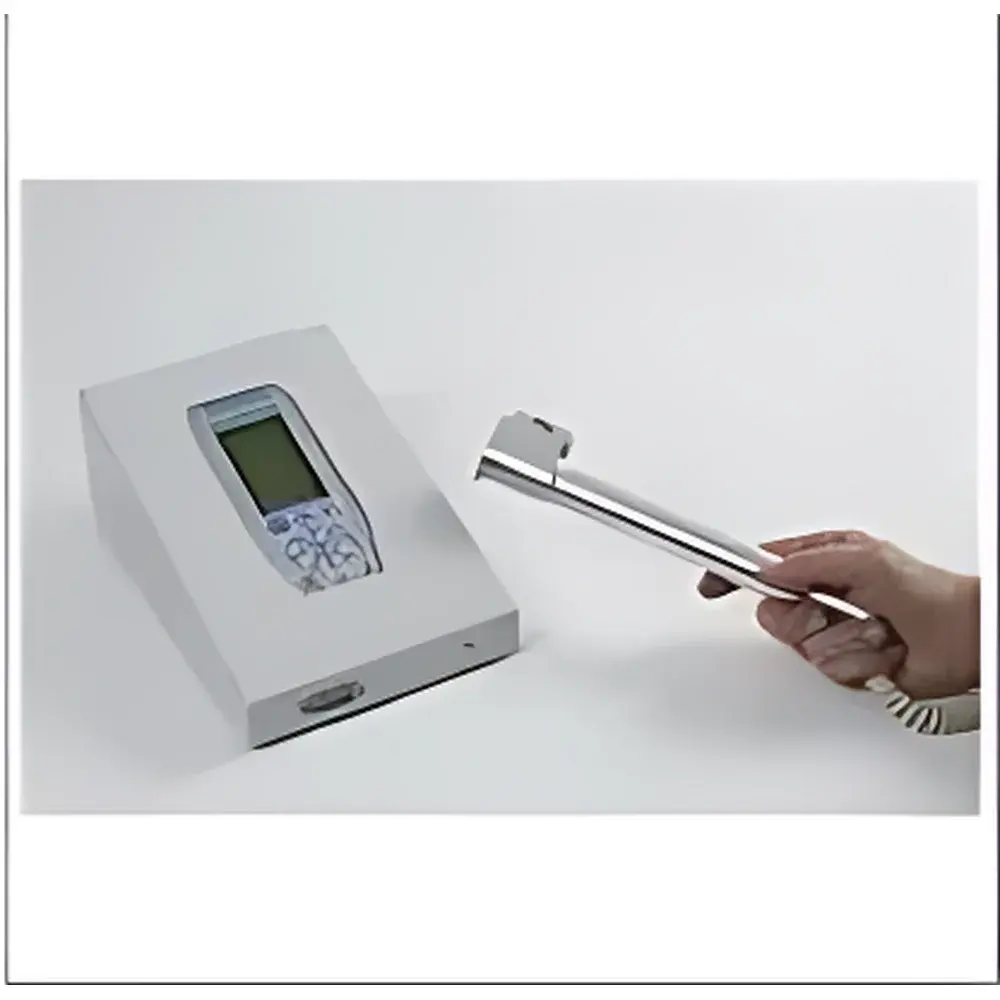
Bioseb BIO-EVF3 Electronic Von Frey Anesthesiometer
| Origin | Italy |
|---|---|
| Manufacturer Type | Distributor |
| Origin Category | Imported |
| Model | BIO-EVF3 |
| Price | Upon Request |
| Measurement Range | 0–500 g (0–5 N) |
| Resolution | 0.1 g |
| Accuracy | ±0.2 g |
| Internal Memory | 100 Test Records |
| Includes | 10 Disposable Plastic Filaments + 1 Elastic Filament (Rat/Mouse Compatible) |
Overview
The Bioseb BIO-EVF3 Electronic Von Frey Anesthesiometer is a precision-engineered instrument designed for quantitative assessment of mechanical allodynia and hyperalgesia in rodent models—primarily mice and rats. It operates on the principle of calibrated filament-based mechanical stimulation, adhering to the standardized up-down method (Dixon, 1980) and modified Randall-Selitto protocols widely adopted in preclinical pain research. Unlike manual Von Frey filaments, the BIO-EVF3 delivers traceable, repeatable force application through motorized, linearly actuated filaments with real-time load feedback. The system measures the minimal force (in grams or newtons) required to elicit a paw-withdrawal reflex—serving as an objective behavioral endpoint for evaluating sensory threshold shifts induced by neuropathic, inflammatory, or chemically mediated nociceptive pathways. Its design conforms to GLP-aligned experimental workflows, supporting longitudinal studies where inter-operator variability and stimulus consistency are critical.
Key Features
- High-resolution force transduction (0.1 g resolution, ±0.2 g accuracy) across a 0–500 g (0–5 N) dynamic range, enabling detection of subtle threshold changes in both acute and chronic pain models.
- Motor-driven filament extension mechanism ensures perpendicular, controlled contact with the plantar surface—eliminating operator-dependent angle or velocity artifacts common in manual assays.
- Integrated footswitch enables hands-free zeroing before each trial, minimizing handling stress and preserving baseline behavioral state.
- Backlit LCD display shows real-time force curve, peak value, and automatic hold function; the “Patient” freeze mode locks the peak reading for unambiguous data capture during rapid withdrawal responses.
- Onboard statistical engine computes mean, standard deviation, and coefficient of variation across multiple trials—reducing post-hoc analysis burden and supporting immediate intra-session decision-making.
- Internal non-volatile memory stores up to 100 complete test records with timestamp, animal ID, and force profile metadata—fully traceable without external hardware dependency.
- COFRAC-accredited calibration certificate (traceable to national standards, ISO/IEC 17025 compliant) ensures metrological validity for regulatory submissions and peer-reviewed publications.
Sample Compatibility & Compliance
The BIO-EVF3 is validated for use with C57BL/6, BALB/c, Sprague-Dawley, and Wistar rodents under standardized housing and acclimation conditions (e.g., 30-min habituation on elevated mesh platforms per IASP guidelines). Its included filament set comprises ten single-use plastic filaments (ranging from 0.008–500 g bending force) and one elastic filament optimized for low-threshold testing in hypersensitive models. All filaments meet ISO 13485-compliant manufacturing specifications. The device complies with electromagnetic compatibility requirements per EN 61326-1 (industrial/scientific equipment), and its mechanical safety design satisfies IEC 61010-1 for laboratory instrumentation. While not FDA-cleared for human use, it supports non-clinical study conduct aligned with OECD TG 407, ICH S5(R3), and NIH Office of Laboratory Animal Welfare (OLAW) reporting expectations.
Software & Data Management
Data export is supported via RS232 serial interface using Bioseb’s optional RSIC (Rodent Sensory Interface Console) software—a Windows-based application enabling automated trial logging, graphical force-time curve visualization, batch statistical reporting (ANOVA, t-test integration), and export to CSV, Excel, or XML formats. RSIC supports 21 CFR Part 11-compliant user access control, electronic signatures, and full audit trail generation—including timestamped modifications to calibration parameters or subject metadata. Raw sensor data retains native 100 Hz sampling fidelity, permitting retrospective re-analysis of transient response kinetics (e.g., latency-to-withdrawal, force ramp rate). All stored datasets include embedded calibration certificate IDs and firmware version stamps for full analytical provenance.
Applications
- Preclinical evaluation of analgesic compounds (e.g., gabapentinoids, TRPV1 antagonists, monoclonal antibodies targeting NGF or Nav1.7).
- Neuropathic pain modeling: partial sciatic nerve ligation (PSNL), chronic constriction injury (CCI), streptozotocin-induced diabetic neuropathy.
- Inflammatory pain assessment: CFA-induced monoarthritis, carrageenan edema, LPS systemic challenge.
- Genetic phenotyping of nociceptor-specific knockouts (e.g., Nav1.8−/−, TRPA1−/−) and conditional Cre-driver lines.
- Toxicity screening for chemotherapy-induced peripheral neuropathy (CIPN) using paclitaxel or oxaliplatin regimens.
- Validation of novel neuromodulation techniques (e.g., transcutaneous electrical nerve stimulation, optogenetic inhibition of dorsal horn neurons).
FAQ
Is the BIO-EVF3 compatible with automated behavioral tracking systems?
Yes—the RS232 output can be synchronized with third-party video acquisition platforms (e.g., EthoVision XT, ANY-maze) via TTL pulse triggering to align force application timestamps with kinematic event detection.
Does the device require annual recalibration?
Bioseb recommends recalibration every 12 months or after 10,000 actuations, whichever occurs first; COFRAC-certified service is available through authorized distributors.
Can filament force values be customized beyond the supplied set?
While the standard set covers 0.008–500 g, Bioseb provides custom filament fabrication upon request—subject to mechanical validation and updated calibration documentation.
How is thermal drift compensated during extended sessions?
The load cell incorporates temperature-compensated strain gauge circuitry and auto-zero stabilization algorithms, maintaining accuracy across ambient ranges of 15–30°C without user intervention.
Is the RSIC software validated for GxP environments?
RSIC v3.2+ includes IQ/OQ documentation templates and supports installation qualification under GMP Annex 11, with full configuration management and change control logs.




