
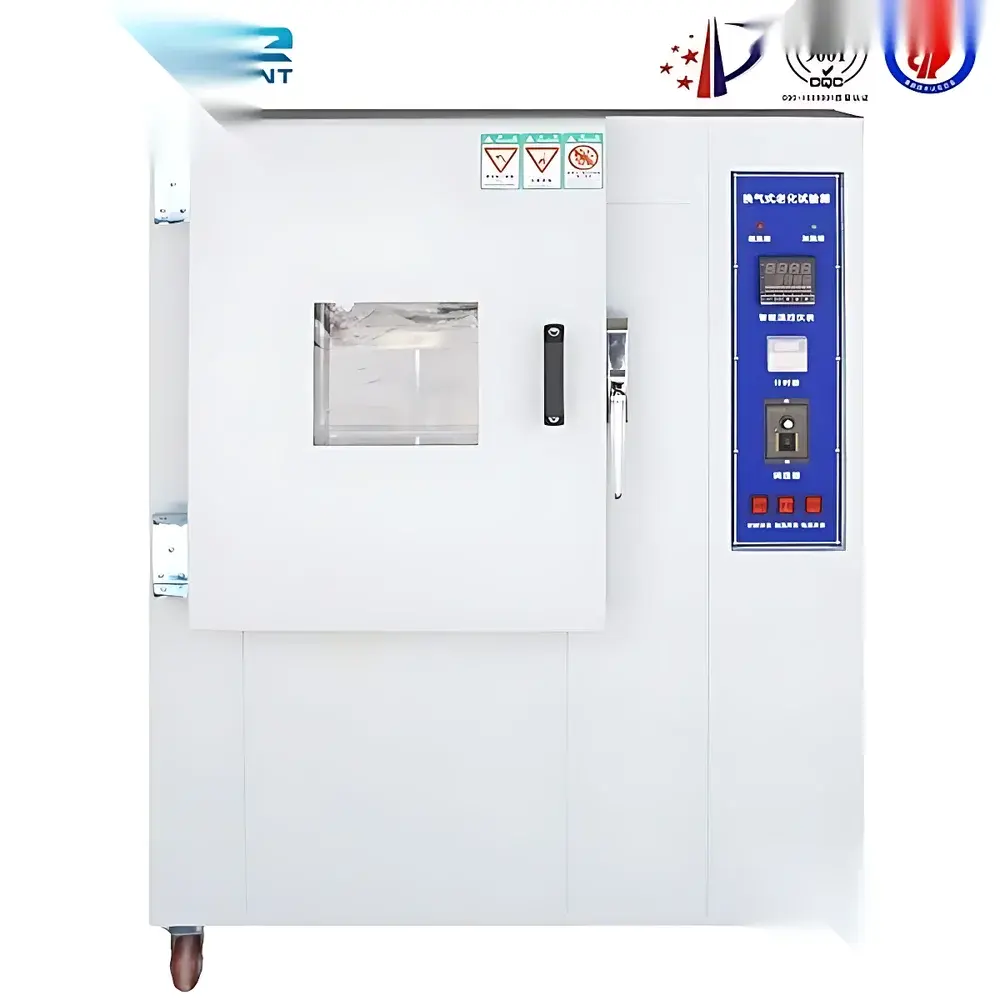
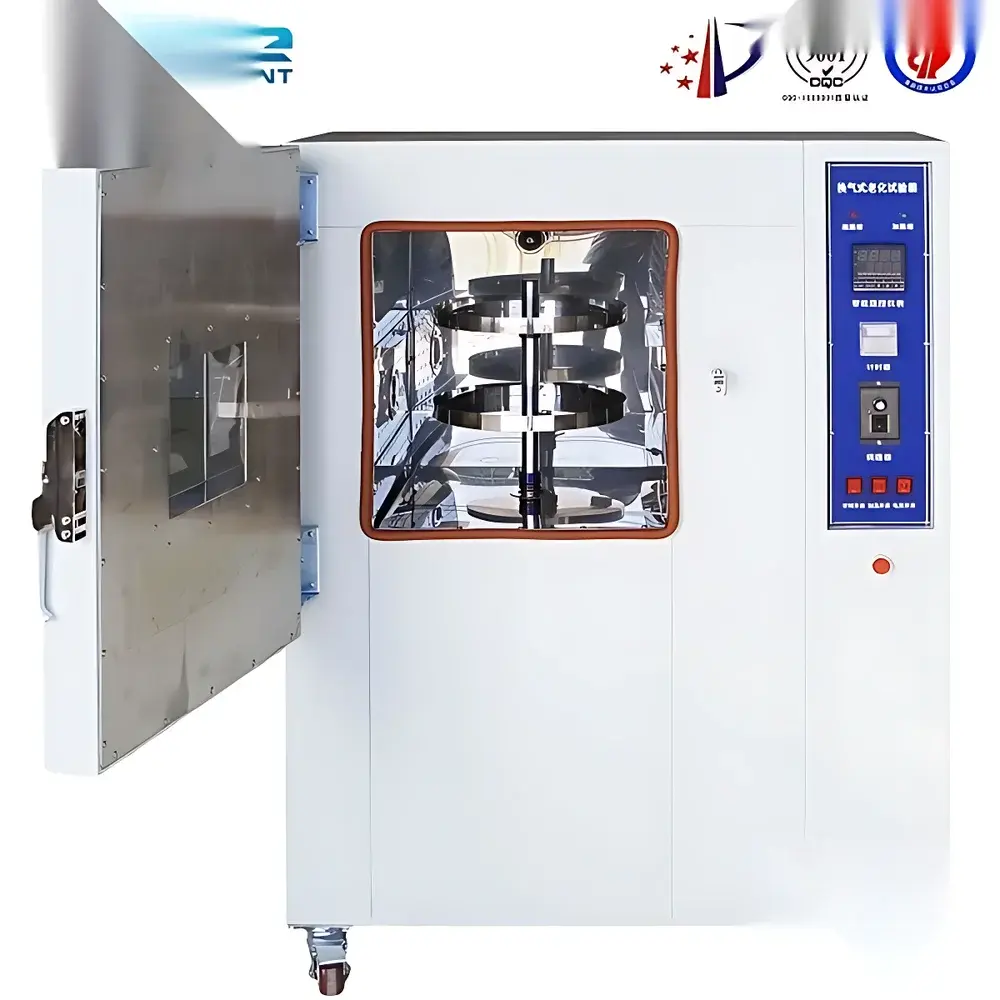
OK-HQ Series Air Thermal Aging Test Chamber
| Brand | Other Brands |
|---|---|
| Origin | Imported |
| Manufacturer Type | General Distributor |
| Price | USD 2,600 (Reference Only) |
| Temperature Range | RT+10°C to 200°C / 300°C |
| Temperature Uniformity | ±2°C |
| Temperature Stability | ±0.5°C |
| Air Exchange Rate | 2–100 cycles/hour |
| Adjustable Air Exchange Interval | 1 min – 99 h |
| Power Rating | 4.0–9.0 kW |
| Internal Dimensions (L×W×H, mm) | 450×450×500 to 800×1000×1000 |
| External Dimensions (L×W×H, mm) | 1100×830×1600 to 1450×1400×2100 |
| Turntable Diameter | Φ250–Φ700 mm |
| Compliance | ASTM D5423-09 (Type II), ASTM D5374-93 (2005), UL 1581, GB, VDE, JIS, IEC |
Overview
The OK-HQ Series Air Thermal Aging Test Chamber is an engineered environmental test system designed for accelerated thermal aging evaluation of polymeric and elastomeric materials under controlled, ventilated high-temperature conditions. Based on the principle of forced-air convection and programmable air exchange regulation, it replicates long-term thermal degradation effects—such as oxidation, embrittlement, discoloration, and tensile strength loss—in a condensed timeframe. This chamber is specifically optimized for compliance-driven testing of insulated wires, cables, rubber compounds, textiles, leather, and plastic components per internationally recognized standards including ASTM D5423-09 (Type II laboratory ovens), ASTM D5374-93 (2005), UL 1581, and harmonized national standards (GB, JIS, VDE, IEC). Its core function is not merely temperature exposure but precise, traceable air renewal—ensuring consistent oxygen partial pressure and removal of volatile decomposition byproducts during aging cycles.
Key Features
- Precision-engineered air exchange control system with digital adjustment of exchange frequency (2–100 cycles/hour) and interval timing (1 minute to 99 hours), enabling reproducible oxidative aging profiles.
- Horizontal forced-air circulation architecture featuring high-temperature-rated centrifugal blower and symmetrical airflow baffles, delivering ±2°C temperature uniformity across the working chamber.
- Double-wall construction: inner chamber fabricated from polished SUS304 stainless steel (mirror finish, argon-arc welded); outer shell made of A3 cold-rolled steel with electrostatic powder coating for corrosion resistance and cleanroom-compatible surface integrity.
- Intelligent microprocessor-based controller with PID + SSR algorithm, offering 0.1°C resolution for both setpoint and display, integrated timer (1–9999 minutes), and real-time monitoring of voltage, current, and energy consumption (kWh).
- High-clarity tempered glass observation window with integrated LED lighting, facilitating non-intrusive visual inspection without thermal disturbance.
- Low-speed rotating turntable (Φ250–Φ700 mm, model-dependent) ensures uniform thermal exposure for vertically mounted or asymmetric specimens.
- Energy-efficient insulation using ultra-fine glass fiber cotton (≥100 mm thickness), minimizing thermal leakage and supporting stable operation at 300°C.
- Standard 50 mm diameter test port on left side wall for external sensor integration, power feedthrough, or signal line routing—sealed with high-temp silicone gasket.
Sample Compatibility & Compliance
The OK-HQ chamber accommodates a broad range of specimen geometries—including insulated wire reels, molded rubber seals, textile swatches, polymer films, and composite laminates—without requiring custom fixtures. Its internal dimensions (from 450×450×500 mm to 800×1000×1000 mm) support full-scale cable bundles and multi-layer material stacks. All models meet the structural and performance requirements of ASTM D5423-09 (Type II forced-ventilation laboratory oven), including minimum airflow velocity, air exchange verification methodology, and temperature gradient limits. The system supports audit-ready documentation for GLP and GMP environments through optional data logging and timestamped event records (e.g., door openings, temperature deviations, cycle completions). Compliance with UL 1581 Section 1060 (heat aging of insulations) and IEC 60811-1-2 (aging in air ovens) is verified via third-party calibration certificates traceable to NIST or equivalent national metrology institutes.
Software & Data Management
While the base configuration employs a standalone LED/PID controller, optional RS485/Modbus RTU interface enables integration with centralized lab management systems (LIMS) or SCADA platforms. Real-time temperature, air exchange count, elapsed time, and power metrics can be logged at user-defined intervals (1 s to 10 min). For regulated laboratories, optional firmware upgrade supports 21 CFR Part 11-compliant electronic signatures, audit trails (including operator ID, parameter changes, and alarm acknowledgments), and encrypted data export (CSV/Excel). Calibration history, maintenance logs, and chamber validation reports (IQ/OQ/PQ templates provided) are maintained within the embedded file system.
Applications
- Accelerated aging of electrical insulation materials (PVC, XLPE, EPR, silicone rubber) per UL 1581 and IEC 60811 series.
- Oxidative stability assessment of automotive elastomers (hoses, gaskets, bushings) under SAE J2236 and ISO 188 protocols.
- Thermal endurance evaluation of aerospace-grade composites and adhesives per ASTM D3418 and MIL-STD-810.
- Pre-qualification screening of packaging films and medical device polymers prior to ISO 10993 biocompatibility studies.
- Quality assurance testing for wire-and-cable manufacturers conducting routine lot-release aging per GB/T 2951.12 and VDE 0472-811.
FAQ
What standards does this chamber validate against?
It meets ASTM D5423-09 (Type II), ASTM D5374-93 (2005), UL 1581, GB/T 2951.12, IEC 60811-1-2, and JIS C 3005 requirements for forced-ventilation thermal aging.
Can air exchange rate be verified independently?
Yes—the chamber includes calibrated digital ammeter/voltmeter/wattmeter and a dedicated airflow measurement port; users may install an anemometer or thermal mass flow meter to validate actual exchange volume per ISO 105-B02 Annex B.
Is the turntable speed adjustable?
No—the turntable operates at fixed low RPM (≤6 rpm) to prevent mechanical stress on specimens; speed is optimized for thermal uniformity, not rotational dynamics.
Does the controller support ramp-soak profiles?
The standard LED controller supports single-setpoint timed aging only; multi-step ramp-soak functionality requires optional programmable logic controller (PLC) upgrade.
What maintenance is required for long-term reliability?
Quarterly inspection of fan bearings, annual recalibration of temperature sensors (per ISO/IEC 17025), and biannual replacement of glass fiber insulation if exposed to frequent thermal cycling above 250°C.



