
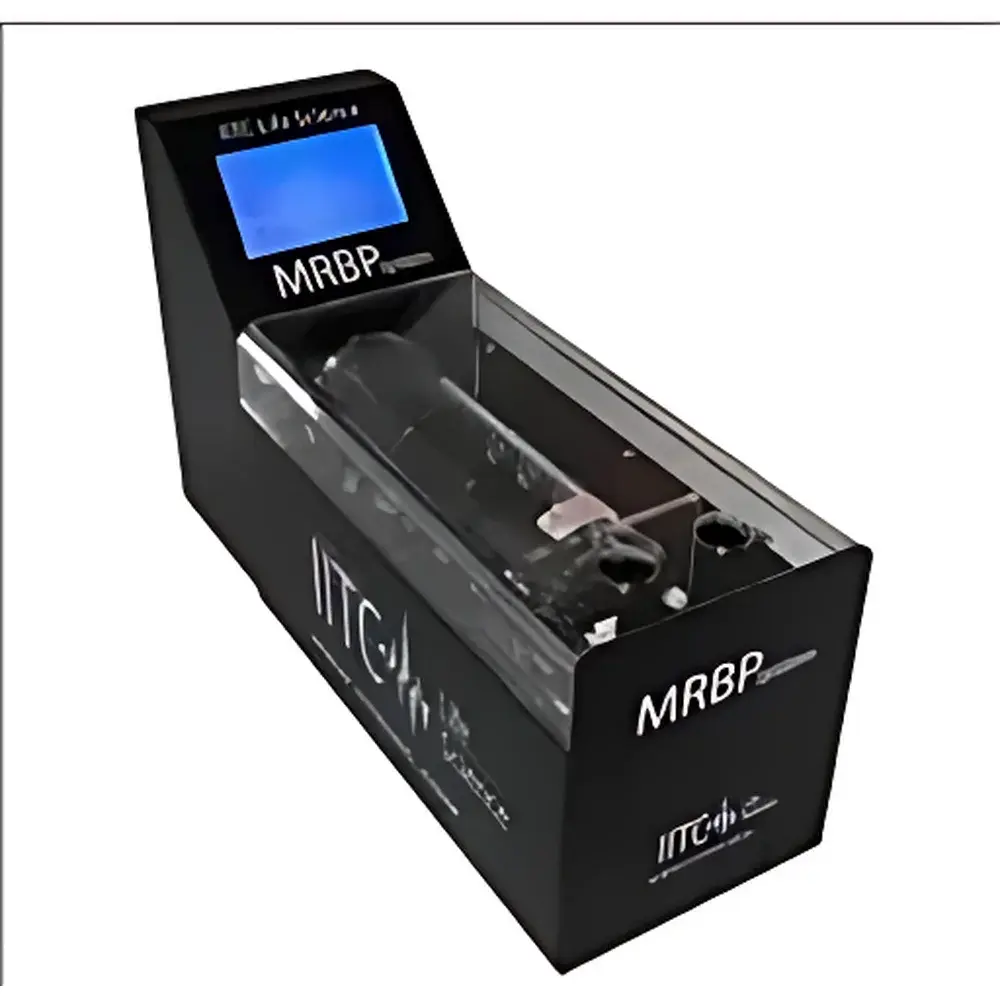
IITC Non-Invasive Blood Pressure Measurement System for Rodents
| Origin | USA |
|---|---|
| Manufacturer Type | Authorized Distributor |
| Origin Category | Imported |
| Model | IITC |
| Pricing | Available Upon Request |
Overview
The IITC Non-Invasive Blood Pressure (NIBP) Measurement System is a rigorously validated, photoelectric-based tail-cuff platform engineered specifically for longitudinal, conscious, and stress-minimized arterial pressure assessment in rodents. Unlike conventional piezoelectric or oscillometric systems that rely on thermal vasodilation to amplify pulse amplitude—requiring tail heating to 36–40 °C—the IITC system employs proprietary photoplethysmographic (PPG) sensing technology. This method detects subtle changes in tail blood volume via optical absorption modulation, enabling reliable systolic pressure acquisition at ambient or sub-thermoneutral temperatures (as low as 26 °C for rats and 28 °C for mice). The system operates on the physiological principle that tail perfusion is dynamically regulated by central thermoregulatory pathways; excessive external heating disrupts autonomic homeostasis and introduces systematic bias (+12 to +28 mmHg), compromising data integrity and reproducibility. IITC’s design eliminates mechanical compression artifacts through non-contact optical detection and precision-engineered cuff actuation, supporting GLP-compliant, repeatable measurements across awake, unrestrained subjects.
Key Features
- Proprietary photoplethysmographic (PPG) sensor architecture—no piezoelectric elements, no thermal dependency, no mechanical coupling to tail tissue
- Validated operation at ambient room temperature (26–30 °C), eliminating heat-induced hemodynamic artifacts and animal distress
- Modular channel configuration: scalable from 1 to 24 independent measurement channels without hardware replacement
- Integrated touchscreen control interface managing incubator temperature, cuff inflation/deflation cycles, calibration sequences, and real-time waveform preview
- Analog output compatibility with standard single- or dual-channel physiologic recorders (e.g., Grass, ADInstruments PowerLab), avoiding vendor-locked data acquisition ecosystems
- Dedicated rodent restraint modules with adjustable tail ports, calibrated pneumatic cuffs, and temperature-stabilized incubation chambers
- Full system lifetime warranty on sensor electronics and embedded firmware—reflecting proven long-term signal stability and drift resistance
Sample Compatibility & Compliance
The system supports conscious, non-restrained blood pressure monitoring in rats (25–500 g), mice (15–45 g), and larger species including guinea pigs, rabbits, cats, dogs, and non-human primates (via optional large-animal sensor kits). All components comply with ISO 10993-1 (biocompatibility of medical device materials) and meet electromagnetic compatibility requirements per IEC 61326-1. The NIBP methodology has been cited in over 350 peer-reviewed publications and is referenced in hypertension research guidelines from the American Heart Association (AHA) and the European Society of Hypertension (ESH). Data acquisition workflows support audit trails, user authentication, and timestamped metadata export—facilitating alignment with FDA 21 CFR Part 11 and GLP/GMP documentation standards where required.
Software & Data Management
Data capture is performed via embedded firmware with onboard waveform storage (≥10,000 measurement cycles per channel). Raw PPG traces, cuff pressure profiles, and systolic peak detection timestamps are exported in CSV and MATLAB-compatible formats. Optional IITC DataLink software provides automated systolic pressure calculation using derivative-based peak detection algorithms, configurable averaging windows (3–10 cycles), and outlier rejection based on pulse amplitude variance thresholds. Exported datasets include full metadata: ambient temperature, incubator setpoint, animal weight, session duration, operator ID, and calibration status. Integration with LabChart, Spike2, or custom Python-based analysis pipelines is supported via ASCII protocol documentation and serial command-line interface (CLI).
Applications
- Chronic hypertension phenotyping in transgenic and diet-induced rodent models
- Pharmacodynamic evaluation of antihypertensive agents under conscious, non-anesthetized conditions
- Longitudinal cardiovascular safety assessment during preclinical toxicology studies
- Integration with MRI-compatible setups—no RF interference, no ferromagnetic components
- Combined modalities: simultaneous NIBP and von Frey mechanical allodynia testing, CO2 plethysmography, or metabolic cage monitoring
- Telemetry validation studies—peer-reviewed literature confirms high concordance (r = 0.92–0.96) between IITC NIBP and radiotelemetry-derived systolic values in C57BL/6 mice and Sprague-Dawley rats
FAQ
How does the IITC system differ from conventional tail-cuff devices?
It replaces thermally dependent piezoelectric detection with ambient-temperature photoplethysmography, eliminating heat-induced BP artifacts and enabling measurements below 30 °C.
Can the system be used during MRI scanning?
Yes—fully non-magnetic construction and absence of active RF-emitting components permit safe integration into 3T and 7T MRI suites.
Is anesthesia required?
No—measurements are performed on fully conscious, unrestrained animals acclimated to handling and restraint protocols.
What is the minimum and maximum animal weight range?
Standard configurations cover 15–500 g; optional large-animal sensor kits extend compatibility up to 10 kg (e.g., juvenile pigs, beagles).
Does the system support regulatory submissions?
Yes—full traceability, electronic signatures, audit logs, and raw waveform archiving align with FDA 21 CFR Part 11 and OECD GLP Annex III requirements.



