
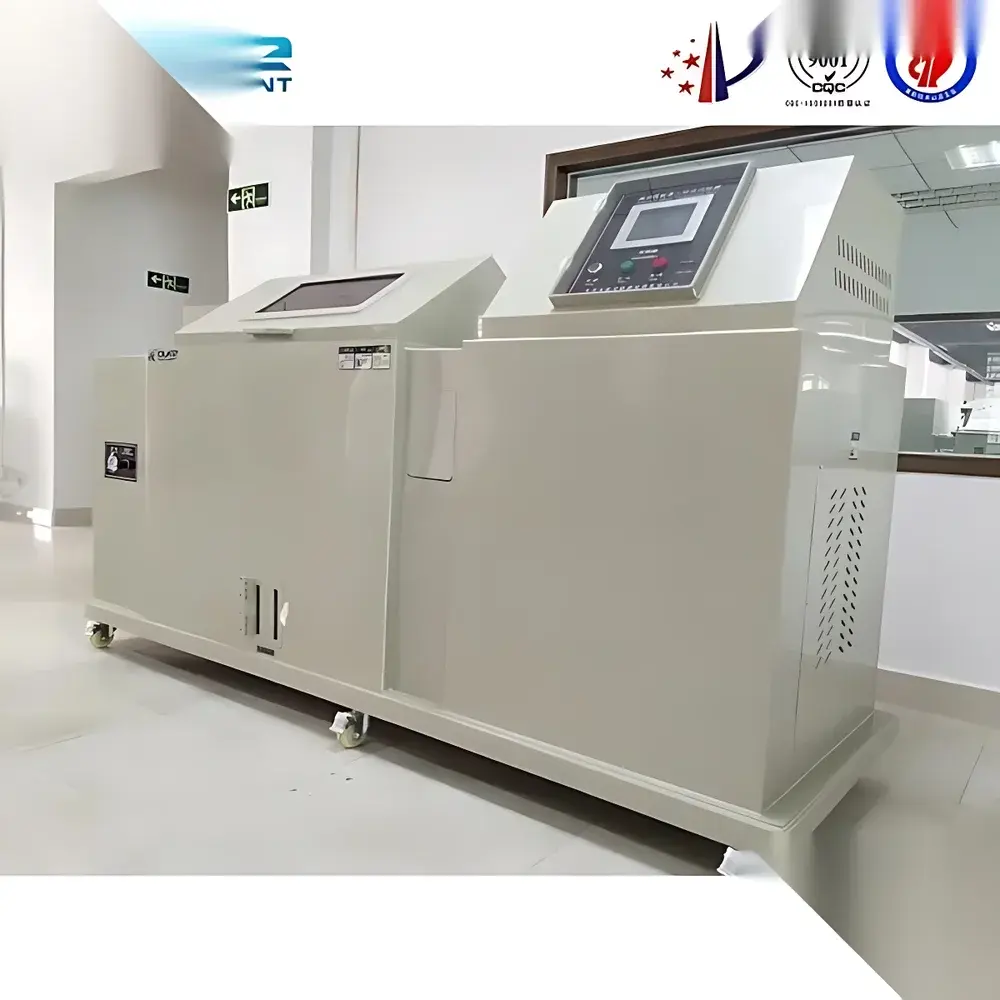
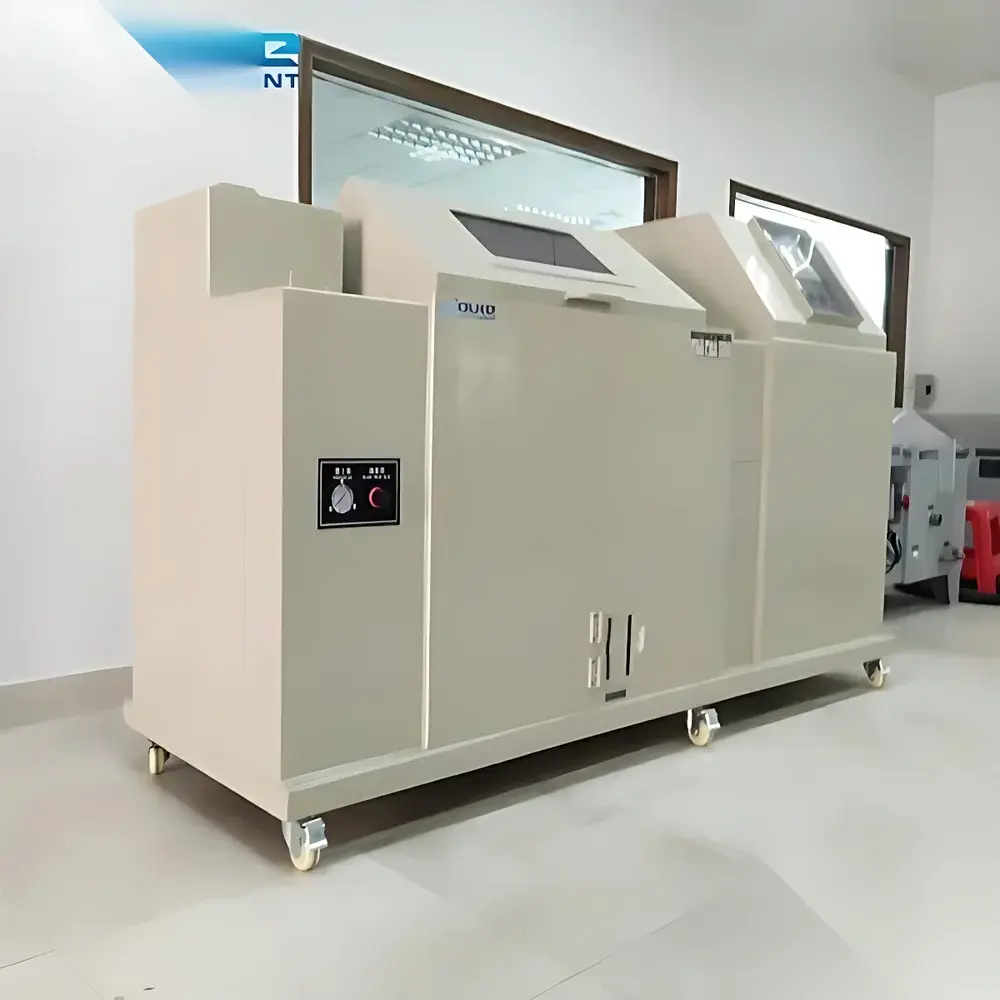
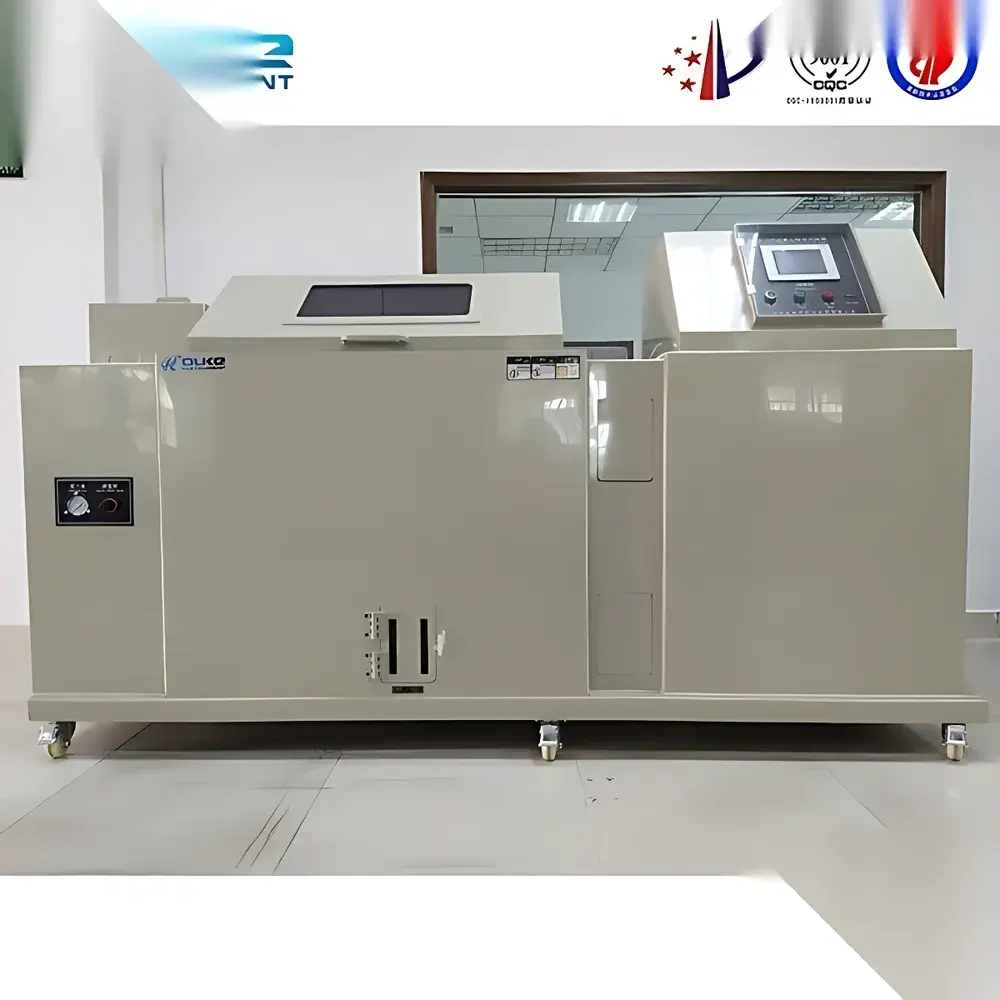
Generic Brand SST-1200 Advanced Salt Spray Test Chamber
| Brand | Other Brands |
|---|---|
| Origin | Imported |
| Manufacturer Type | Authorized Distributor |
| Price | USD 12,500 (FOB) |
| Chamber Dimensions (W×H×D) | 120 × 50 × 100 cm |
| Temperature Range | Ambient +5°C to 60°C |
| Temperature Uniformity | ±2°C |
| Temperature Stability | ±0.5°C |
| Salt Spray Deposition Rate | 1–2 mL/80 cm²·h |
| Spray Mode | Continuous or Cyclic |
| Material | German-imported gray PVC (acid-alkali resistant, high-humidity stable) |
| Viewing Window | 5 mm thick imported acrylic, 100° angled roof design |
| Saturated Air Tank | German PVC, corrosion-resistant cylindrical construction |
| Sample Rack | V-shaped PVC bars with 10 mm O-ring glass supports, adjustable tilt 15°–30° |
| Nozzle Material | Fused quartz glass, Bernoulli-optimized geometry, >10,000 h service life under standard maintenance |
| Control System | PID controller with PT100 sensor, ±0.1°C accuracy, dual pressure regulation, dual overtemperature protection, dry-run and phase-loss safeguards |
Overview
The Generic Brand SST-1200 Advanced Salt Spray Test Chamber is a precision-engineered environmental test system designed to accelerate corrosion evaluation of metallic components, coated surfaces, and protective finishes under controlled saline aerosol exposure. Based on the ASTM B117 and ISO 9227 standardized salt spray testing methodology, this chamber replicates aggressive marine atmospheric conditions by generating a continuous or cyclic fog of neutral 5% NaCl solution at elevated temperature and humidity. Its primary function is to assess the integrity and longevity of corrosion-inhibiting treatments—including electroplating, phosphating, anodizing, organic coatings, rust inhibitors, and conversion coatings—through quantifiable degradation metrics such as white rust formation, red rust onset, blistering, delamination, and coating adhesion loss. The chamber operates within a tightly regulated thermal envelope (ambient +5°C to 60°C), ensuring reproducible test conditions essential for comparative analysis across material batches, supplier qualification, and QC release protocols in automotive, aerospace, electronics, and industrial hardware manufacturing.
Key Features
- Corrosion-resistant chamber construction using German-sourced gray PVC板材 (not stainless steel), engineered for long-term stability under acidic, alkaline, and high-humidity environments—eliminating oxidation-related calibration drift and structural degradation.
- 100° angled, 5 mm thick imported acrylic viewing roof with gravity-assisted condensate channeling, preventing droplet contamination of test specimens during observation.
- Integrated saturated air tank fabricated from seamless gray PVC with optimized cylindrical geometry, eliminating rust-prone weld seams and maintaining consistent air saturation pressure across extended test cycles.
- V-shaped sample support rack with 10 mm diameter O-ring glass spacers enables precise angular positioning (15°–30°) per ISO 7253 and ASTM B117 specimen orientation requirements.
- Tower-type spray system with fused quartz nozzles—designed via Bernoulli principle for laminar flow, uniform droplet distribution (1–2 mL/80 cm²·h), and minimal clogging—even after 10,000 hours of operation under routine maintenance.
- PID-based temperature control with PT100 platinum resistance thermometers, achieving ±0.1°C setpoint accuracy and incorporating redundant safety layers: dual overtemperature cutoffs, low-water detection, phase-loss monitoring, and pressure imbalance alarms.
Sample Compatibility & Compliance
The SST-1200 accommodates flat, curved, or irregularly shaped specimens up to 120 cm wide, 50 cm high, and 100 cm deep—including PCB assemblies, fasteners, stamped chassis parts, galvanized brackets, and painted automotive trim. It supports multiple standardized test modes: Neutral Salt Spray (NSS), Acetic Acid Salt Spray (AASS), and Copper-Accelerated Acetic Acid Salt Spray (CASS), all compliant with ASTM B117, ISO 9227, JIS Z2371, GB/T 2423.17, and DIN 50021. Chamber validation includes quarterly temperature mapping per ISO/IEC 17025 guidelines and documented traceability to NIST-traceable reference standards. All operational logs—including temperature, spray duration, and alarm events—are timestamped and exportable for GLP/GMP audit readiness.
Software & Data Management
While the base model features an intuitive front-panel interface with real-time parameter display and manual mode selection, optional RS-485/Modbus RTU connectivity enables integration into centralized lab management systems (LIMS). Logged data—including chamber temperature, saturation tank pressure, elapsed spray time, and fault codes—is stored internally for ≥30 days and exportable via USB or serial output. For regulated environments, optional firmware upgrade supports FDA 21 CFR Part 11-compliant electronic signatures, audit trails, and user-access tiering (operator, supervisor, administrator). All calibration records and maintenance logs are retained in accordance with ISO/IEC 17025 Clause 7.7 requirements.
Applications
This chamber serves critical roles in incoming material inspection (e.g., verifying zinc-nickel plating thickness equivalence), process validation (e.g., optimizing chromate conversion coating dwell times), and failure root-cause analysis (e.g., correlating coating porosity with early-stage red rust propagation). It is routinely deployed in Tier-1 automotive suppliers for PPAP submissions, in electronics OEMs for conformal coating qualification per IPC-CC-830, and in defense contractors for MIL-STD-810H Method 509.1 compliance verification. Its robust construction and repeatable fog generation make it suitable for both R&D screening and production-line pass/fail testing where statistical confidence in corrosion resistance is required.
FAQ
What standards does this chamber comply with?
ASTM B117, ISO 9227, JIS Z2371, GB/T 2423.17, and DIN 50021—fully validated for NSS, AASS, and CASS test methods.
Can the chamber perform cyclic corrosion testing (CCT)?
Yes—when equipped with optional programmable controller firmware, it supports multi-phase sequences including salt spray, drying, and high-humidity conditioning per ASTM G85 Annex A5.
Is the PVC chamber material compatible with acetic acid or copper chloride solutions?
Yes—the German-imported gray PVC formulation resists degradation from pH 3.0–12.0 solutions, including AASS and CASS reagents, without swelling or leaching.
How often does the quartz nozzle require cleaning or replacement?
Under standard 5% NaCl use and weekly deionized water rinses, nozzles maintain specification for ≥10,000 operational hours; annual visual inspection and flow calibration are recommended.
Does the system include temperature mapping documentation?
Yes—factory-installed thermocouple ports enable third-party mapping per ISO/IEC 17025; a certified map report is included with shipment.



