
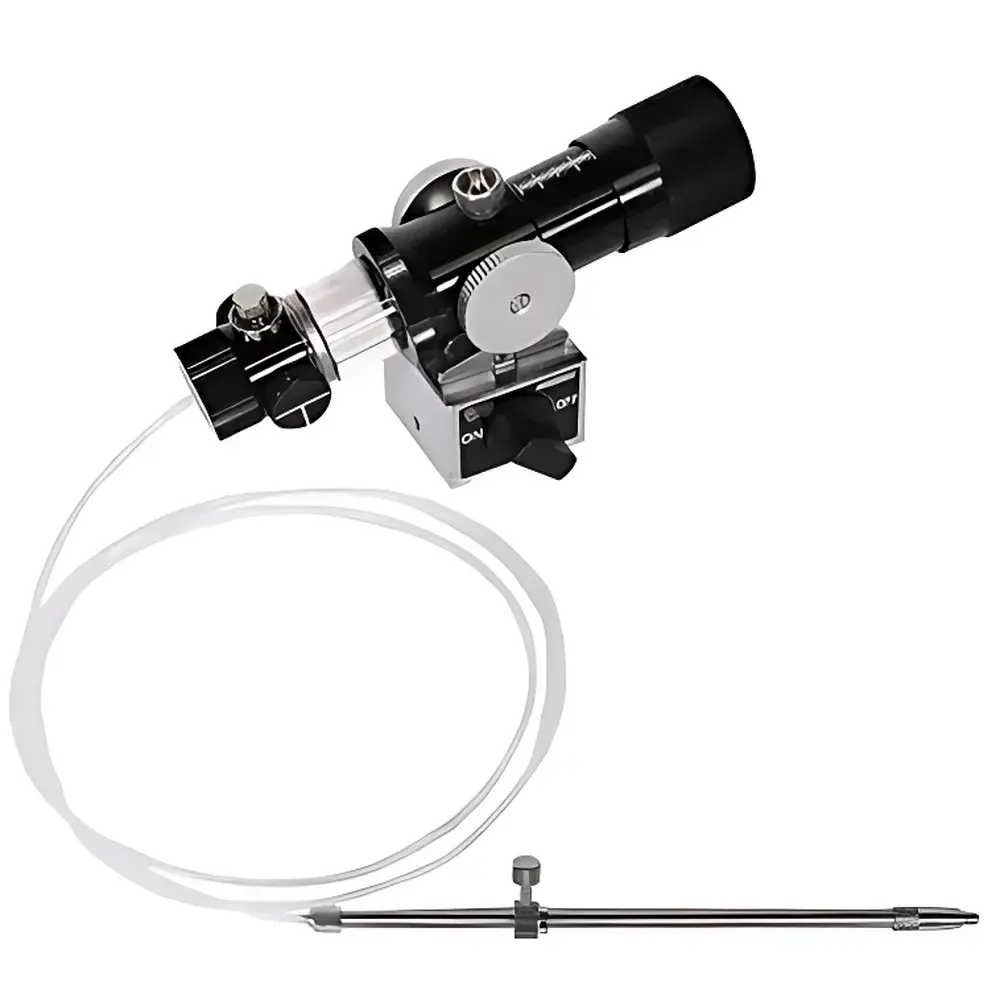
Narishige IM-21 Manual Microinjector
| Origin | Japan |
|---|---|
| Manufacturer Type | Distributor |
| Origin Category | Imported |
| Model | IM-21 |
| Pricing | Upon Request |
Overview
The Narishige IM-21 Manual Microinjector is a precision-engineered, hand-operated microinjection system designed for reproducible, low-volume fluid delivery in demanding life science applications. Built upon Narishige’s decades-long expertise in micromanipulation instrumentation, the IM-21 operates on a calibrated mechanical displacement principle: rotation of the precision-machined micrometer knob translates linear motion of the syringe plunger via a high-ratio gear mechanism, enabling controlled volumetric delivery without reliance on electricity, compressed air, or external controllers. This purely mechanical architecture ensures intrinsic stability, zero drift, and immunity to electromagnetic interference—critical attributes for intracellular injection workflows conducted inside electrophysiology rigs, inverted microscopes, or laminar flow hoods. The device is optimized for use with standard 10–100 µL glass capillary syringes (e.g., Drummond Nanoject-type) and integrates seamlessly with Narishige’s full suite of micromanipulators (e.g., MMO-202ND, MN-401) and stereotaxic holders.
Key Features
- Precision micrometer drive: Full revolution of the control knob advances the plunger by 500 µm, corresponding to approximately 10 µL displacement per turn when used with a 10 µL syringe (calibration dependent on syringe inner diameter and plunger geometry).
- 20 mm total plunger travel range, supporting extended injection sequences without re-filling.
- Tool-free syringe loading and oil priming: Redesigned fluid path and integrated purge port significantly reduce time and complexity associated with hydraulic filling—eliminating air bubble entrapment common in earlier manual injectors.
- Ergonomic aluminum alloy housing (W127–147 × D55 × H78 mm; mass: 620 g) with non-slip rubber feet and low center of gravity for stable placement on microscope stages or vibration-isolated platforms.
- Modular accessory compatibility: Includes IM-H3 syringe holder clamp, HI01PK01 silicone cleaning rod, IMO4 O-ring seals, and silicone grease for long-term seal integrity and smooth actuation.
- 1 m length medical-grade silicone tubing (inner diameter: 0.5 mm, outer diameter: 1.6 mm) supplied as standard, rated for repeated sterilization and compatible with aqueous, glycerol-based, and low-viscosity lipid solutions.
Sample Compatibility & Compliance
The IM-21 supports direct injection into biological specimens ranging from single mammalian oocytes (ICSI), zebrafish and Xenopus embryos, murine blastocysts, and adherent or suspension-cultured stem cells (ES/iPS). Its mechanical design avoids thermal or pressure transients that could compromise membrane integrity during sub-nanoliter delivery. While the instrument itself carries no embedded electronics or software, its operation aligns with GLP-compliant laboratory practices when paired with documented SOPs for syringe calibration, sterility validation (autoclavable components: IM-H3 clamp, cleaning rod, metal housing), and maintenance logs. All elastomeric parts meet USP Class VI biocompatibility standards; silicone tubing complies with ISO 10993-5 cytotoxicity requirements.
Software & Data Management
As a fully manual, analog microinjector, the IM-21 does not incorporate digital interfaces, firmware, or data logging capabilities. Volume delivery is determined solely by mechanical displacement and must be verified externally using gravimetric methods (e.g., analytical balance + distilled water) or fluorescent dye dilution assays. For laboratories requiring audit trails under FDA 21 CFR Part 11 or ISO/IEC 17025, volume settings and injection events are recorded manually in bound lab notebooks or LIMS-integrated electronic notebooks. Calibration certificates for syringes used with the IM-21 should be maintained per institutional QA protocols.
Applications
- Intracytoplasmic sperm injection (ICSI) in human and bovine assisted reproductive technology (ART) labs.
- Genome editing delivery: CRISPR-Cas9 ribonucleoprotein (RNP), sgRNA, and donor DNA constructs into zygotes and embryonic stem cells.
- Nuclear transfer procedures, including somatic cell nuclear transfer (SCNT) and pronuclear transfer.
- Cytoplasmic or nuclear injection of mRNA, morpholinos, and fluorescent tracers for lineage tracing and functional genomics.
- Microinjection of synthetic liposomes or viral vectors into primary neurons or organoid cultures.
- Cell capture and immobilization via gentle hydrodynamic suction prior to patch-clamp or optical manipulation.
FAQ
What syringe types are compatible with the IM-21?
Standard 10 µL and 25 µL glass capillary syringes with Luer-Lok or fixed-tip configurations (e.g., Drummond Wiretrol, WPI NanoFil) are supported. Syringe inner diameter must fall within 0.3–0.8 mm for optimal force transmission.
Can the IM-21 be used with viscous solutions such as dextran or agarose?
Yes—provided viscosity remains below ~200 mPa·s at 25°C. Higher viscosities require slower knob rotation and verification of plunger slippage or stiction via pre-test calibration.
Is the IM-21 suitable for sterile tissue culture environments?
All metallic and silicone components may be autoclaved (121°C, 20 min) or sterilized via 70% ethanol immersion. Tubing and O-rings should be replaced after ≥5 autoclave cycles.
How is accuracy validated for regulatory submissions?
Accuracy is established through three-point gravimetric calibration (e.g., 1, 5, and 10 µL water dispensed onto a microbalance) performed before each experimental series and documented in the lab’s instrument logbook.
Does Narishige provide ISO 17025-accredited calibration services for the IM-21?
Narishige offers factory calibration reports traceable to JCSS standards; however, full ISO/IEC 17025 accreditation requires third-party metrology providers due to the device’s passive mechanical nature.




