
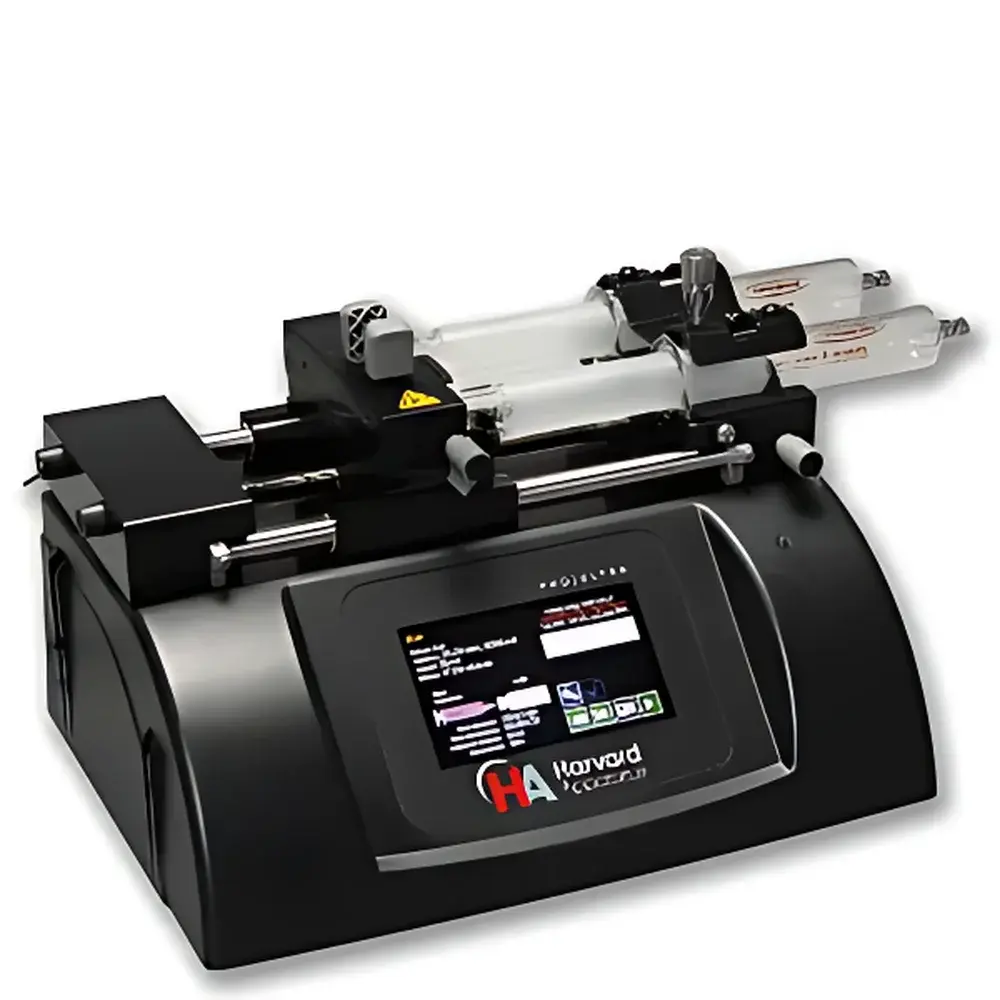
Harvard Apparatus PHD ULTRA™ 703005 Syringe Pump
| Brand | Harvard Apparatus |
|---|---|
| Origin | USA |
| Model | PHD ULTRA™ 703005 |
| Accuracy | ±0.25% |
| Repeatability | ±0.05% |
| Flow Range | 1.56 pL/min to 220 mL/min |
| Max Linear Force | 75 lbf |
| Display | 4.3" WQVGA TFT color touchscreen |
| Dimensions (L×D×H) | 30.48 × 21.59 × 18.42 cm |
| Weight | 4.5 kg |
| Certifications | CE, UL, CSA, CB Scheme, RoHS |
| Connectivity | RS232, USB, RS485, 15-pin D-Sub I/O with TTL |
| Power | 50 W, 0.5 A fuse |
| Stepper Resolution | 12,800 microsteps per revolution |
| Min/Max Plunger Speed | 0.18 µm/min to 190.8 mm/min |
| Syringe Capacity | 0.5 µL to 140 mL |
| Non-volatile Memory | Yes |
| Operating Humidity | 20–80% RH (non-condensing) |
Overview
The Harvard Apparatus PHD ULTRA™ 703005 Syringe Pump is a high-precision, microprocessor-controlled fluid delivery system engineered for demanding laboratory applications requiring exceptional accuracy, repeatability, and operational flexibility. Utilizing proprietary fluidic actuation mechanics and advanced 1/16 microstepping motor control, the PHD ULTRA™ delivers smooth, pulse-free flow across an unprecedented dynamic range—from picoliter-per-minute dosing in single-cell microinjection to milliliter-per-minute perfusion in large-volume chromatography or bioreactor feeding. Its core architecture eliminates mechanical backlash and minimizes step-induced flow perturbations through optimized lead-screw kinematics and real-time angular position feedback. Designed for integration into regulated environments, the pump operates without external computing hardware while maintaining full traceability of all user-defined protocols—making it suitable for GLP-compliant workflows and method validation under ISO/IEC 17025 or FDA 21 CFR Part 11 frameworks where audit-ready parameter logging is required.
Key Features
- Proprietary mechanical drive system with optimized syringe clamping geometry, enabling consistent linear force up to 75 lbf and minimizing plunger slippage across diverse syringe materials (glass, polypropylene, stainless steel)
- Full-color 4.3″ WQVGA resistive touchscreen interface with intuitive GUI—supports standalone programming from simple constant-rate infusion to multi-segment gradient profiles, time-based triggers, and conditional logic sequences
- Ultra-wide flow range: 1.56 pL/min (with 0.5 µL Hamilton syringes) to 220 mL/min (with 140 mL glass syringes), validated across >109 flow orders of magnitude
- High-resolution motion control: 12,800 microsteps per lead-screw revolution; minimum plunger displacement resolution of 0.18 µm/min ensures sub-nanoliter volumetric precision
- Modular mounting architecture: accommodates standard dual-syringe configuration, remote pump head placement, and optional multi-channel adapters—including 6/10-syringe racks, 4×140 mL racks, and 4×microsyringe carriers
- Built-in non-volatile memory stores all user configurations, calibration offsets, and method histories—retained after power cycling without reliance on external storage media
Sample Compatibility & Compliance
The PHD ULTRA™ supports syringes ranging from 0.5 µL microbore Hamilton glass units to industrial-grade 140 mL borosilicate reservoirs. Its universal syringe detection mechanism auto-identifies diameter and stroke length via mechanical sensing—not optical or barcode-based—ensuring compatibility with legacy and custom-fabricated barrels. All wetted components are chemically inert (stainless steel pusher, PTFE-coated rails, ceramic-tipped actuators), compatible with aqueous buffers, organic solvents (including acetonitrile, DMSO, THF), and viscous biological matrices (e.g., collagen gels, cell-laden hydrogels). Regulatory compliance includes CE marking per Directive 2014/30/EU (EMC) and 2014/35/EU (LVD), UL 61010-1, CSA C22.2 No. 61010-1, CB Scheme certification, and EU RoHS 2011/65/EU. Firmware supports configurable audit trails for electronic records per FDA 21 CFR Part 11 when connected to validated host systems.
Software & Data Management
While fully functional as a stand-alone instrument, the PHD ULTRA™ integrates seamlessly with Harvard’s EZ Pro software suite via USB or RS232. EZ Pro enables method export/import, batch protocol deployment, real-time flow monitoring with timestamped CSV logging, and remote synchronization across multi-pump networks using RS485 daisy-chaining. All onboard settings—including flow profiles, pause conditions, error thresholds, and safety interlocks—are stored in EEPROM with write-cycle endurance exceeding 100,000 cycles. The 15-pin D-Sub I/O port provides TTL-level digital inputs/outputs for hardware-triggered start/stop, external sensor feedback (e.g., pressure switch, photodiode signal), and programmable status indicators—facilitating closed-loop control in automated assay platforms.
Applications
- Microfluidics: Precise reagent metering in droplet generation, organ-on-chip perfusion, and laminar flow patterning
- Pharmacology & Nutrition: Chronopharmacokinetic dosing, enteral nutrient infusion modeling, and controlled-release formulation testing
- Cell Culture & Bioprocessing: pH-stat feeding, inducer gradient establishment in microbial fermenters, and shear-sensitive stem cell expansion protocols
- Low-Pressure Chromatography: Isocratic and gradient elution in flash, ion-exchange, and size-exclusion systems operating below 100 psi
- Continuous Flow Synthesis: Stoichiometric reactant delivery in photochemical, electrochemical, and catalytic reactors
- Neuroscience & Electrophysiology: Intracerebral microinfusion, patch-clamp pipette filling, and calibrated drug application in slice preparations
FAQ
Does the PHD ULTRA™ require a computer for basic operation?
No. All functions—including multi-step gradient programming, timer-based triggers, and syringe calibration—are accessible directly via the front-panel touchscreen without external hardware.
Can the pump be integrated into a GMP-regulated manufacturing process?
Yes. When used with validated EZ Pro software and configured with electronic signature-enabled audit logs, it meets foundational requirements for FDA 21 CFR Part 11 compliance in pharmaceutical process development.
What is the maximum backpressure tolerance of the PHD ULTRA™?
The pump is rated for continuous operation up to 100 psi (6.9 bar) with standard syringes; higher pressures may be achieved using reinforced syringes and pressure-rated tubing, though force limits remain governed by the 75 lbf linear output specification.
Is firmware update capability available in the field?
Yes. Updates are delivered via USB stick or serial connection using Harvard-provided signed binaries; version history and checksum verification are logged in non-volatile memory.
How does the PHD ULTRA™ handle syringe diameter variation during long-duration infusions?
The system continuously monitors plunger position via high-resolution rotary encoder feedback and dynamically adjusts step timing to compensate for thermal expansion or mechanical creep—maintaining volumetric accuracy over multi-day runs.



