
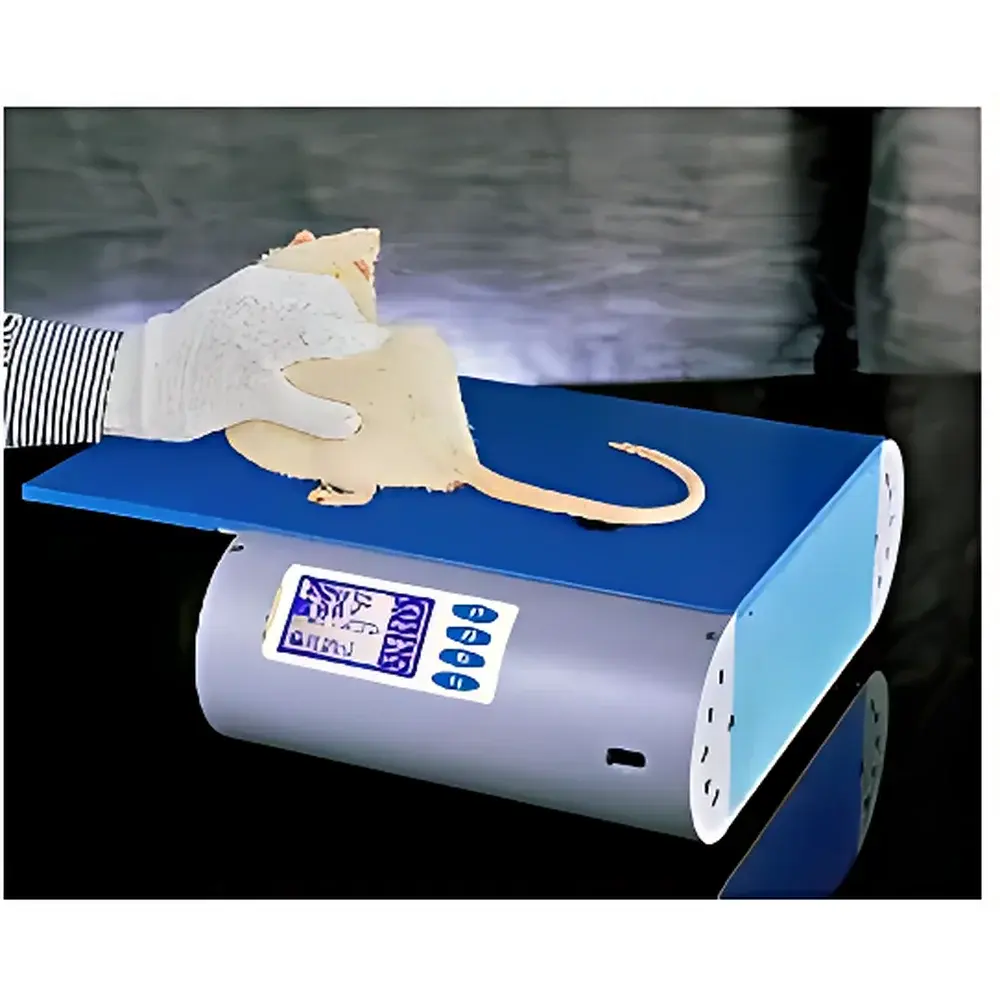
Ugo Basile Model 37360 Tail-Flick Nociception Analyzer
| Brand | Ugo Basile |
|---|---|
| Origin | Italy |
| Model | 37360 |
| Infrared Intensity Range | 10–99 (arbitrary units) |
| Reaction Time Resolution | 0.1 s |
| Cut-off Time Range | 15–60 s |
| Power Supply | 85–264 VAC, 50–60 Hz |
| Operating Temperature | 15–30 °C |
| Acoustic Noise Level | < 70 dB |
| Interface | 9-pin DELTA connector + USB |
| Display | LCD screen |
| Data Export | USB flash drive or USB cable |
| Optional Accessories | Thermal printer (sold separately), infrared radiometer for calibration (sold separately) |
Overview
The Ugo Basile Model 37360 Tail-Flick Nociception Analyzer is a precision-engineered instrument designed for quantitative assessment of thermal nociceptive thresholds in rodents—primarily mice and rats—using the standardized tail-flick reflex paradigm. Based on the classical method first described by D’Amour & Smith (1941), the system delivers calibrated infrared radiation to a defined segment of the animal’s tail, eliciting a rapid withdrawal response when the thermal stimulus exceeds the subject’s pain threshold. The device operates on the principle of radiant heat-induced nocifensive behavior, where the latency between stimulus onset and tail movement is recorded as the primary endpoint. This latency reflects central and peripheral neural processing of noxious thermal input and serves as a validated, reproducible metric in preclinical analgesia research, neuropharmacology, and pain mechanism studies.
Key Features
- Adjustable infrared intensity (10–99 arbitrary units) via parabolic reflector optics, enabling precise titration of thermal stimulus across experimental conditions
- Automated detection of tail-flick response using high-sensitivity mechanical contact sensors embedded in the platform surface—eliminating observer bias and inter-rater variability
- Programmable cut-off time (15–60 s) to prevent tissue damage during prolonged exposure; system automatically terminates irradiation upon either response detection or timer expiration
- Integrated LCD display showing real-time reaction time with 0.1-second resolution, infrared intensity setting, and operational status
- Standalone operation capability with internal memory and USB flash drive support for data export; also compatible with PC-based acquisition via USB or 9-pin DELTA interface
- Low-noise (<70 dB) design compliant with institutional animal care facility acoustic standards; smooth, unobstructed work surface minimizing handling stress and ensuring consistent tail positioning
- Universal power supply (85–264 VAC, 50–60 Hz) for global deployment without voltage conversion hardware
Sample Compatibility & Compliance
The Model 37360 is optimized for use with adult and adolescent mice (C57BL/6, CD-1, BALB/c, etc.) and rats (Sprague-Dawley, Wistar). Tail diameter and pigmentation may influence radiant absorption; therefore, baseline characterization per strain is recommended. The instrument supports adherence to internationally recognized guidelines including the NIH Guide for the Care and Use of Laboratory Animals, EU Directive 2010/63/EU, and AAALAC International standards. While not inherently GLP-certified, the system’s deterministic response logic, timestamped event logging, and audit-ready data export facilitate integration into GLP-compliant workflows when paired with appropriate SOPs and electronic lab notebook (ELN) systems. Calibration traceability requires optional infrared radiometer (sold separately) to verify spectral irradiance output against ISO/IEC 17025-accredited reference standards.
Software & Data Management
Data acquisition and analysis are supported through Ugo Basile’s proprietary Delta software suite (compatible with Windows 10/11), which enables synchronized multi-animal testing, batch parameter configuration, automated latency averaging, and statistical summary generation (mean ± SEM, ANOVA-ready export). All raw trials—including stimulus intensity, reaction time, cut-off status, and session metadata—are stored in CSV and XML formats to ensure interoperability with third-party analysis platforms (e.g., GraphPad Prism, R, Python pandas). The system logs timestamps with millisecond precision and maintains an immutable record of operator-initiated events (e.g., start/stop, intensity changes), supporting FDA 21 CFR Part 11 compliance when deployed within validated IT environments with user access controls and electronic signature functionality.
Applications
- Preclinical evaluation of opioid and non-opioid analgesics (e.g., morphine, gabapentin, NSAIDs) in acute and inflammatory pain models
- Characterization of genetic knockouts or transgenic lines affecting nociceptive pathways (e.g., NK1R−/−, Oprm1−/−, OXTR−/−)
- Assessment of tolerance development following chronic drug administration
- Investigation of spinal vs. supraspinal mechanisms via intrathecal or systemic delivery paradigms
- Validation of novel analgesic targets in neuropathic and cancer-related pain models
- Standardized endpoint measurement in regulatory toxicology studies requiring objective nociceptive readouts
FAQ
Is the Model 37360 suitable for use with albino or heavily pigmented rodents?
Yes, though melanin content affects infrared absorption kinetics; users should establish strain-specific baseline latencies and consider intensity adjustment to maintain assay sensitivity.
Does the system meet ICH or FDA requirements for regulated studies?
The hardware and software architecture support validation protocols required under ICH S5(R3) and FDA guidance for nonclinical safety studies when implemented within a documented quality management system.
Can multiple animals be tested sequentially without recalibration?
Yes—the optical path and sensor response remain stable across sessions; however, periodic verification using the optional radiometer is recommended every 100 test cycles or weekly, whichever occurs first.
Is foot-withdrawal testing possible with this instrument?
No—the Model 37360 is specifically engineered for tail-flick methodology; Ugo Basile offers separate platforms (e.g., Plantar Test Model 37370) for paw-withdrawal assays.
What documentation is provided for installation qualification (IQ) and operational qualification (OQ)?
Ugo Basile supplies comprehensive IQ/OQ templates, calibration checklists, and performance verification protocols aligned with ISO 13485 and GAMP5 principles, intended for completion by qualified laboratory personnel or certified service engineers.
Related Products





