
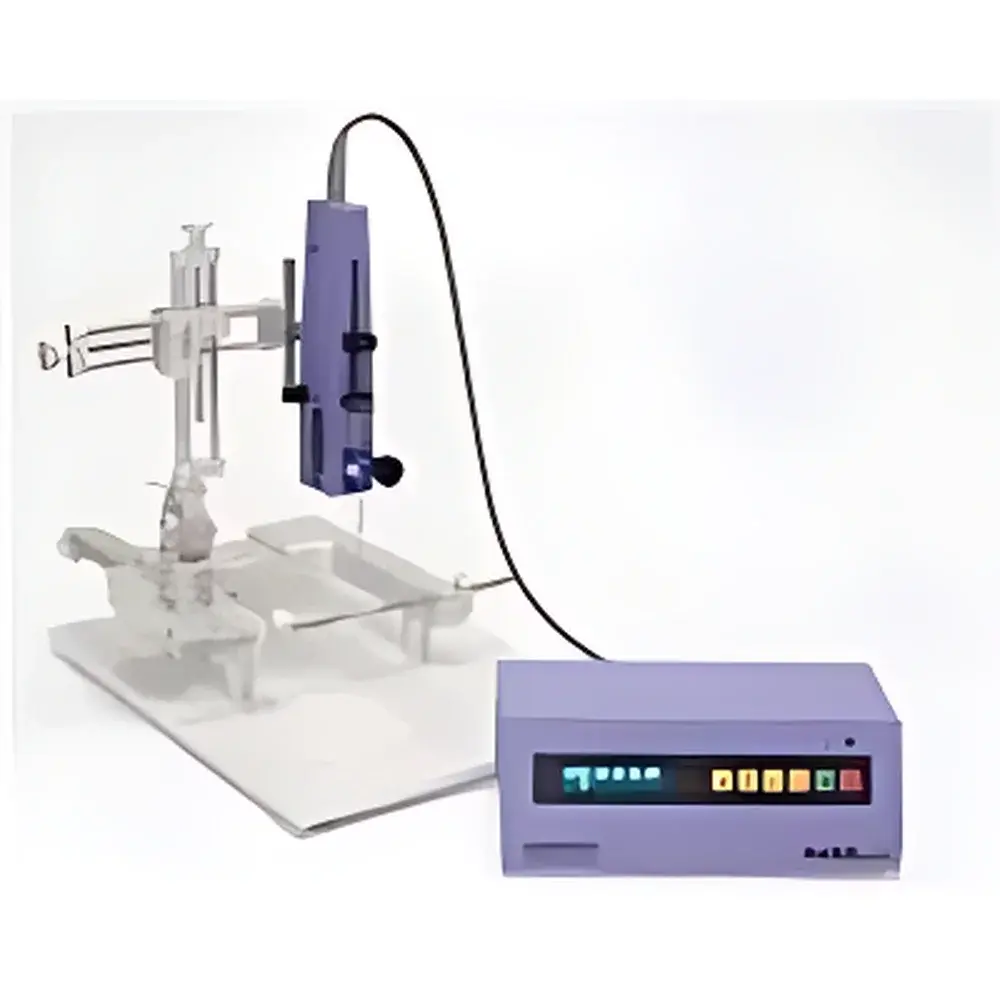
Harvard Apparatus Nanomite Micro-Infusion Pump
| Brand | Harvard Apparatus |
|---|---|
| Origin | USA |
| Model | Nanomite Pump |
| Drive Type | Microprocessor-Controlled Syringe Pump |
| Infusion/Withdrawal | Programmable |
| Accuracy | ±0.5% |
| Repeatability | ±0.05% |
| Syringe Capacity | 0.5 µL – 10 mL |
| Flow Rate Range | 0.54 pL/min – 11.7 mL/min |
| Display | 4.3" WQVGA TFT Color Touchscreen |
| Linear Force | 5 kg (11 lbf) |
| Step Resolution | 0.198 µm/step |
| Input Voltage | 12–30 VDC |
| Dimensions (Controller) | 22.6 × 17.78 × 15 cm |
| Weight | 1.96 kg |
| Compliance | CE, ETL (UL/CSA), WEEE, EU RoHS, CB Scheme |
| Interfaces | RS-232, USB, TTL Footswitch, RS-485, IEEE-1394, 15-pin D-Sub, Mini-Phono Jack |
Overview
The Harvard Apparatus Nanomite Micro-Infusion Pump is a high-precision, microprocessor-driven syringe pump engineered for ultra-low-flow applications requiring nanoliter- to picoliter-level dosing accuracy. Operating on a precision lead-screw actuation principle, the Nanomite delivers continuous, pulse-free fluid displacement through closed-loop motor control and enhanced microstepping technology—eliminating flow pulsatility inherent in conventional peristaltic or stepper-based systems. Its core architecture is optimized for integration into advanced life science instrumentation platforms, including stereotaxic rigs, micromanipulator systems, and automated microinjection workstations. Unlike general-purpose peristaltic pumps, the Nanomite employs direct syringe plunger actuation, enabling bidirectional programmable infusion and withdrawal with traceable, reproducible volumetric delivery—critical for neuroscientific intracerebral injection, single-cell electrophysiology, microfluidic reagent loading, and quantitative assay calibration.
Key Features
- Ultra-low flow capability: Programmable rates from 0.54 pL/min to 11.7 mL/min across four scalable units (pL/min, pL/hr, µL/min, µL/hr)
- High-accuracy dispensing: ±0.5% volumetric accuracy and ±0.05% repeatability over full syringe range (0.5 µL–10 mL glass or plastic syringes)
- Modular head design: Lightweight pump head (mechanical module: 6.35 × 5.08 × 19.05 cm) decoupled from controller for seamless mounting on micromanipulators, motorized stages, or stereotaxic frames
- Smooth Flow™ technology: Proprietary microstepping algorithm and high-torque linear actuator ensure laminar, non-pulsatile delivery—essential for pressure-sensitive biological samples
- Full bidirectional control: Independent programming of infusion, withdrawal, and pause sequences with user-defined ramp profiles
- Intuitive human interface: 4.3-inch WQVGA color touchscreen with tactile feedback, supporting multi-language UI and real-time flow visualization
- Robust I/O architecture: Native support for RS-232, USB, TTL footswitch triggering, RS-485 daisy-chaining, IEEE-1394 (FireWire), 15-pin D-Sub, and mini-phono jack for external synchronization
Sample Compatibility & Compliance
The Nanomite accommodates standard Luer-lock and small-bore syringes (0.5 µL–10 mL), including borosilicate glass, polypropylene, and fluoropolymer-lined variants—ensuring chemical compatibility with aqueous buffers, organic solvents, viscous hydrogels, and low-surface-tension reagents. Its mechanical design conforms to ISO 8536-4 (syringes for medical use) dimensional standards and supports GLP/GMP-aligned workflows via non-volatile memory storage of all protocol parameters—including timestamps, operator IDs, and syringe calibration coefficients. Regulatory compliance includes CE marking under Directive 2014/30/EU (EMC) and 2014/35/EU (LVD), ETL certification to UL 61010-1 and CSA C22.2 No. 61010-1, WEEE directive adherence, EU RoHS 2011/65/EU, and IECEE CB Scheme certification—facilitating audit readiness in regulated pharmaceutical, academic, and clinical research environments.
Software & Data Management
The Nanomite operates natively via its embedded firmware but integrates seamlessly with Harvard Apparatus’ PumpControl™ software suite (Windows/macOS) for remote configuration, multi-pump synchronization, and time-stamped data logging. All settings—including flow profiles, acceleration/deceleration ramps, and error logs—are retained in non-volatile memory, enabling protocol recall without reconfiguration. Audit-trail functionality records parameter changes with timestamp and user ID, satisfying FDA 21 CFR Part 11 requirements when deployed with validated electronic signatures. Optional Python and LabVIEW drivers enable custom automation within larger experimental frameworks, while TTL-triggered start/stop ensures precise temporal alignment with electrophysiology recording or high-speed imaging systems.
Applications
- Stereotaxic microinjection in rodent and non-human primate neuroscience models (e.g., viral vector delivery, pharmacological agents, tracers)
- Single-cell microinjection for CRISPR/Cas9 editing, mRNA transfection, or organelle labeling
- Microfluidic chip priming and reagent metering in organ-on-chip and droplet-based assays
- In vitro fertilization (IVF) and embryology workflows requiring sub-nanoliter oocyte manipulation
- Calibration of analytical instruments such as ICP-MS, LC-MS, and capillary electrophoresis systems
- Controlled release studies in biomaterial scaffolds and hydrogel matrices
FAQ
What syringe types are compatible with the Nanomite pump?
Standard Luer-lock syringes ranging from 0.5 µL to 10 mL, including glass, polypropylene, and fluoropolymer-coated variants—validated for compatibility with aqueous, alcoholic, and mildly corrosive solutions.
Does the Nanomite support regulatory-compliant data integrity protocols?
Yes. With PumpControl™ software and proper system validation, it supports 21 CFR Part 11-compliant electronic records, including audit trails, role-based access control, and digital signature enforcement.
Can multiple Nanomite pumps be synchronized?
Yes. Via RS-485 daisy-chaining or IEEE-1394 bus, up to 32 units can be coordinated for multi-channel infusion/withdrawal with sub-millisecond timing resolution.
Is the pump head suitable for inverted or tilted mounting configurations?
Yes. The low-mass, modular pump head (≤190 g) features symmetric mounting holes and gravity-compensated drive mechanics, enabling stable operation at angles up to ±45° relative to horizontal.
What maintenance is required for long-term precision stability?
Annual recalibration using NIST-traceable syringes and verification against gravimetric flow standards is recommended; no routine lubrication or belt replacement is needed due to its brushless DC motor and hardened-steel lead-screw design.
Related Products



