
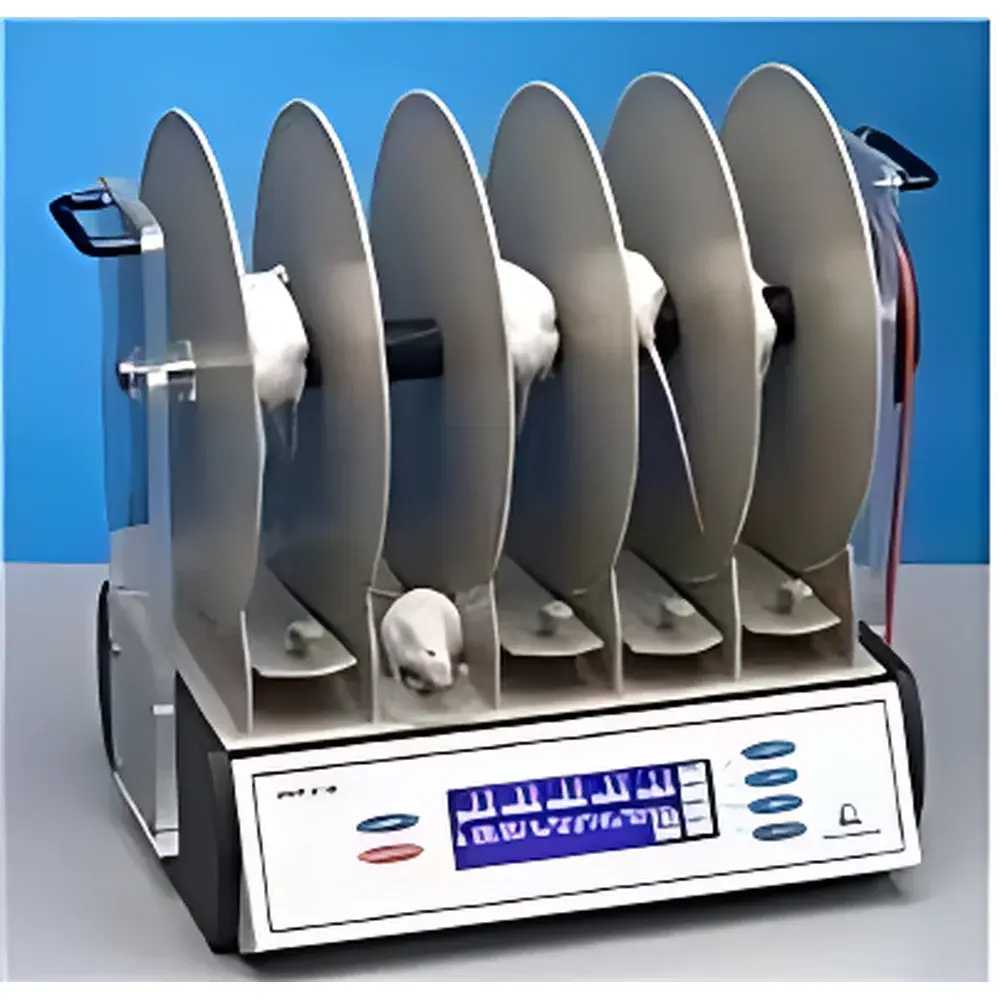
Rotarod Fatigue Testing System for Rodents
| Origin | USA |
|---|---|
| Manufacturer Type | Authorized Distributor |
| Origin Category | Imported |
| Model | Rotarod Fatigue Testing System |
| Pricing | Available Upon Request |
Overview
The Rotarod Fatigue Testing System is a standardized, motor-driven behavioral assessment instrument engineered for quantitative evaluation of motor coordination, balance, endurance, and neuromuscular function in rodents—primarily mice and rats. Based on the principle of forced locomotion on a rotating cylindrical drum (rotarod), the system measures latency-to-fall—the time an animal remains upright and actively walking on the rotating surface—as a robust, reproducible endpoint for fatigue onset, motor deficit progression, or pharmacological intervention efficacy. This paradigm is grounded in established neurobehavioral physiology: sustained performance requires integrated input from cerebellar circuitry, basal ganglia modulation, spinal reflex integrity, and skeletal muscle metabolic capacity. As such, the Rotarod assay is widely adopted in preclinical neuroscience, pharmacology, toxicology, and musculoskeletal research to assess functional outcomes following drug administration, genetic manipulation, lesion induction, or disease modeling.
Key Features
- Programmable rotational control with precise speed regulation across 1–60 rpm, supporting both constant-velocity and acceleration protocols (e.g., linear ramp from 4 to 40 rpm over 300 s)
- Dedicated independent timing channels per testing lane, enabling concurrent multi-animal trials with millisecond-resolution latency-to-fall recording
- Optical beam interruption detection system: infrared emitter-detector pairs positioned beneath each rodent compartment register fall events with sub-100 ms response latency
- Modular, ventilated acrylic chamber design compliant with IACUC housing standards; adjustable inter-compartment dividers accommodate varying strain sizes and experimental groupings
- Robust mechanical architecture with low-vibration DC servo motor and precision-machined aluminum drum surface (diameter: 73 mm, length: 300 mm) to ensure consistent torque delivery and minimize thermal drift
- Integrated safety cutoff: automatic rotation halt upon detection of sustained immobility (>5 s) or repeated falls within a single trial
Sample Compatibility & Compliance
The system is validated for use with adult C57BL/6, BALB/c, CD-1, and Sprague-Dawley rodents (body weight range: 18–45 g for mice; 200–400 g for rats). All hardware components meet ISO 13485-aligned manufacturing controls for laboratory equipment. Experimental protocols align with OECD Test Guideline 426 (Neurotoxicity Study) and ASTM E3102-19 (Standard Guide for Preclinical Behavioral Assessment in Rodents). Data acquisition workflows support GLP-compliant study execution, including user-access logging, audit trail generation, and electronic signature capability when paired with validated LIMS integration.
Software & Data Management
The system operates via dedicated Windows-based control software featuring real-time visualization of rotational speed, elapsed time, and fall event markers. Each trial generates a timestamped .csv output containing: subject ID, start time, end time, latency-to-fall, peak speed achieved, and acceleration profile metadata. Raw data files are immutable post-acquisition; version-controlled software updates adhere to FDA 21 CFR Part 11 requirements for electronic records and signatures. Optional API integration enables bidirectional data exchange with ELN platforms (e.g., LabArchives, Benchling) and statistical analysis suites (GraphPad Prism, R).
Applications
- Evaluation of central nervous system depressants (e.g., benzodiazepines, barbiturates) and stimulants via dose-dependent changes in motor endurance
- Characterization of neuromuscular deficits in transgenic models of amyotrophic lateral sclerosis (ALS), spinal muscular atrophy (SMA), or dystrophinopathy
- Assessment of anti-fatigue mechanisms of natural compounds (e.g., ginsenosides, caffeine analogs) and synthetic therapeutics targeting mitochondrial biogenesis or calcium handling
- Toxicity screening for off-target effects on motor function during IND-enabling safety pharmacology studies
- Functional validation of gene-editing interventions in cerebellar or striatal circuits
- Longitudinal monitoring of recovery kinetics following ischemic stroke or traumatic brain injury
FAQ
What species and age ranges are supported?
The system is optimized for adult mice (6–20 weeks) and rats (8–24 weeks) meeting standard IACUC weight and health criteria.
Can the rotarod drum surface be sterilized between trials?
Yes—acrylic chambers and removable drum sleeves are compatible with 70% ethanol wipe-down and UV-C irradiation (254 nm, 30 min); autoclaving is not recommended.
Is protocol randomization available to prevent order effects?
Yes—software supports randomized trial sequencing across subjects and automated assignment of velocity profiles based on predefined block designs.
How is inter-laboratory variability minimized?
Calibration routines include rotational speed verification using NIST-traceable tachometers and optical sensor alignment checks; SOP templates are provided per AAALAC International recommendations.
Does the system comply with FDA or EMA regulatory submission requirements?
Raw data structure, audit trails, and electronic signature implementation conform to ICH M7 and ICH S7A guidance for nonclinical safety studies submitted to regulatory agencies.
Related Products





