
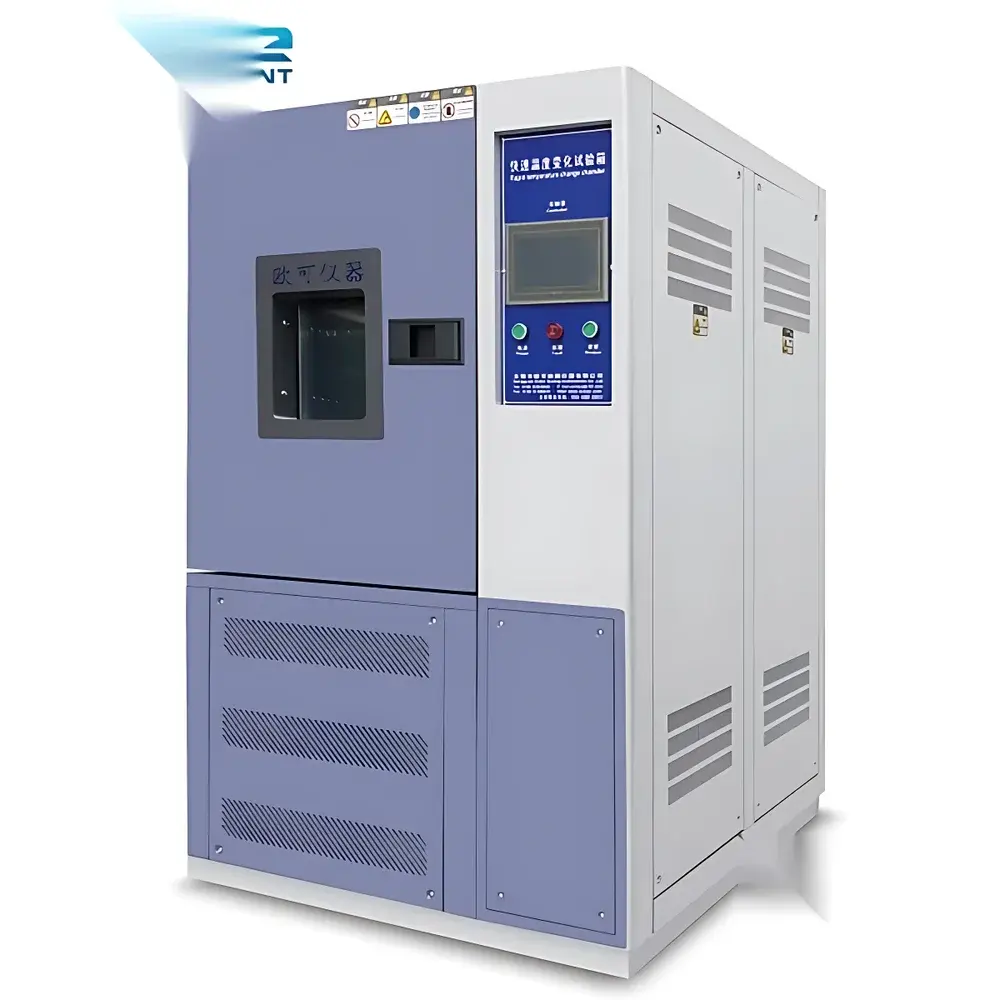
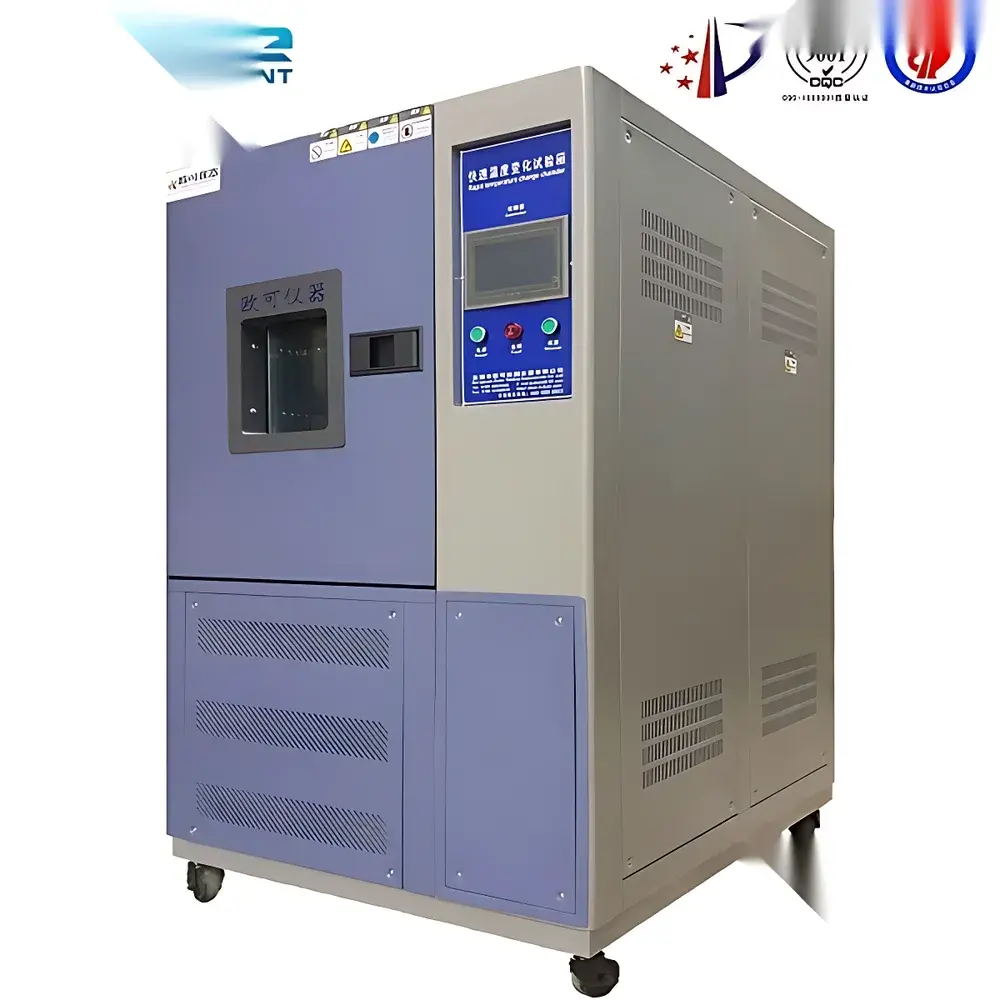
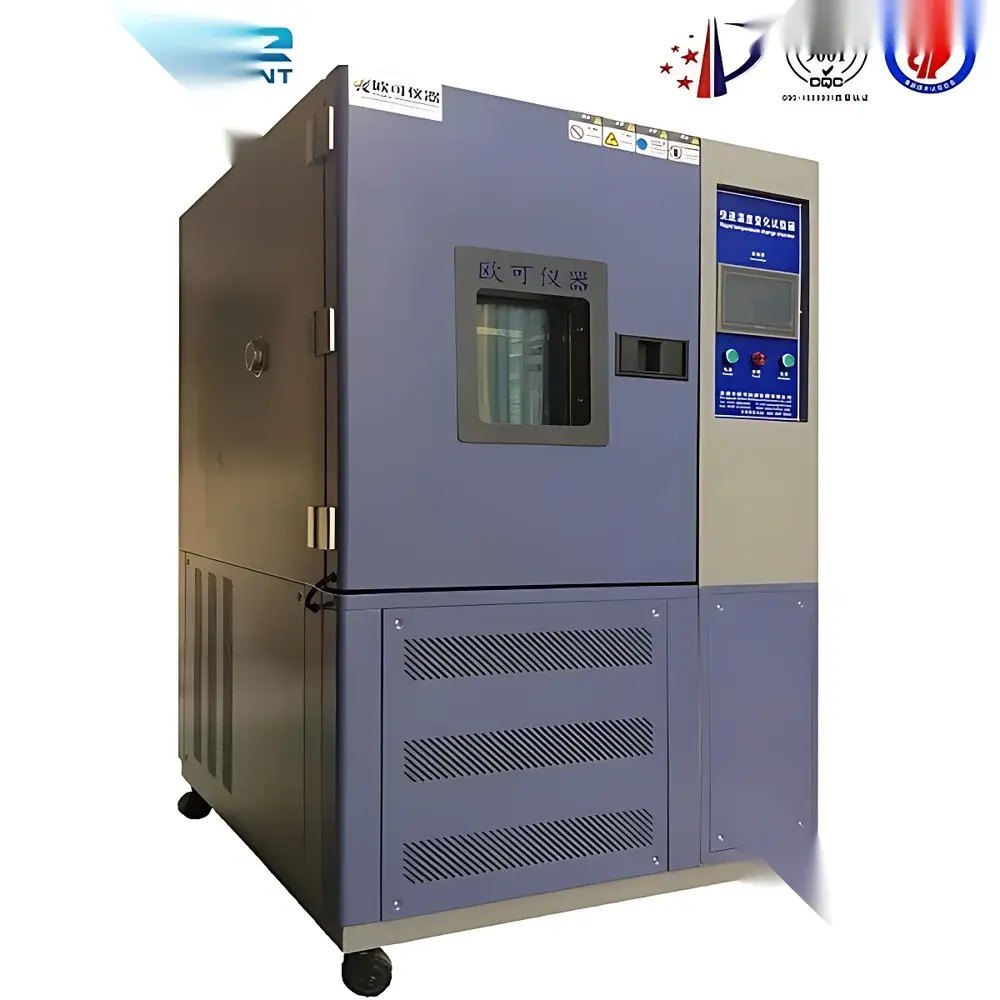
High-Low Temperature Rapid Transition Environmental Chamber
| Brand | Custom OEM |
|---|---|
| Origin | Imported |
| Manufacturer Type | Authorized Distributor |
| Price | USD 14,500 (FOB) |
| [Volume | 225 / 408 / 800 / 1000 L |
| Temperature Range | -65°C to +150°C (standard models) |
| Ramp Rate | Linear 5–15°C/min or Nonlinear 5–20°C/min (user-selectable) |
| Temperature Uniformity | ≤2.0°C (at steady state) |
| Temperature Stability | ±0.5°C (at steady state) |
| Control Method | Balanced Temperature Cycling (BTC) |
| Refrigeration System | Dual-stage cascade compression refrigeration |
| Compressor | Hermetic or semi-hermetic ultra-low-temperature compressor |
| Cooling Mode | Air-cooled or water-cooled (configurable) |
| Heating System | Low-thermal-mass rapid-response heater |
| Circulation | High-speed centrifugal blower with multi-stage variable-speed airflow control |
| Sensor | PT100 Class A precision temperature sensor |
| Controller | Imported industrial-grade touchscreen programmable controller (RS232 interface standard, RS485/ethernet optional) |
| Power Supply | 3-phase 5-wire 380 VAC ±10%, 50 Hz |
| Safety Protection | Overvoltage, overcurrent, and overtemperature cut-off circuits |
| Cabinet Material | Exterior & interior SUS304 stainless steel |
| Insulation | Rigid polyurethane foam (≥120 mm thickness, thermal conductivity ≤0.022 W/m·K) |
| Structural Design | Split-system configuration for transport and installation] |
Overview
The High-Low Temperature Rapid Transition Environmental Chamber is an engineered thermal stress test system designed for accelerated reliability evaluation of electronic components, automotive modules, aerospace materials, and medical devices under dynamically controlled extreme temperature conditions. Utilizing balanced temperature cycling (BTC) methodology, the chamber maintains precise thermal equilibrium during rapid transitions by simultaneously modulating heating power and refrigerant flow—eliminating overshoot and minimizing dwell time at setpoints. Its dual-stage cascade refrigeration architecture enables stable operation down to −65°C while sustaining rapid ramp rates up to 20°C/min in nonlinear mode. The system complies with core thermal test standards including IEC 60068-2-1 (cold), IEC 60068-2-2 (dry heat), MIL-STD-810H Method 502.7 (low temperature), and Method 503.7 (temperature shock), supporting qualification testing per JEDEC JESD22-A104 and A119.
Key Features
- Multi-stage variable-speed air circulation system ensures uniform thermal distribution (≤2.0°C deviation) across the full working volume, validated per IEC 60068-3-5.
- Dynamic PID auto-tuning algorithm continuously adapts control parameters during ramp phases to maintain programmed rate accuracy within ±10% tolerance.
- Energy-adaptive power management reduces peak load demand by up to 35% compared to fixed-power systems, meeting ISO 50001 energy performance benchmarks.
- Intelligent power recovery logic resumes interrupted tests from the exact breakpoint after power loss—critical for long-duration HALT/HASS protocols requiring uninterrupted thermal history.
- Redundant safety architecture includes independent mechanical overtemperature cutoffs, refrigerant pressure monitoring, and real-time compressor current surveillance.
- Split-system mechanical layout separates refrigeration unit from test chamber, enabling modular transport through standard elevator shafts and installation in constrained lab spaces.
Sample Compatibility & Compliance
The chamber accommodates DUTs ranging from PCB assemblies to complete vehicle ECUs, with standardized 50 mm diameter test ports (optional sealing kits available for pressurized or inert-atmosphere testing). Internal dimensions support fixtures compliant with ASTM E1512 mounting requirements. All electrical interfaces meet CE/UKCA EMC Directive 2014/30/EU and Low Voltage Directive 2014/35/EU. Optional validation packages include IQ/OQ documentation aligned with FDA 21 CFR Part 11 data integrity requirements and GLP-compliant audit trails for regulated industries.
Software & Data Management
The embedded controller logs timestamped temperature, ramp rate, and system status data at user-defined intervals (100 ms minimum resolution) to internal flash memory (≥16 GB). RS232 serial output supports real-time streaming to third-party SCADA platforms (e.g., LabVIEW, MATLAB, or custom Python-based acquisition tools). Optional software modules provide automated report generation per ISO/IEC 17025 clause 7.8.2, including uncertainty budgeting per GUM (JCGM 100:2008) and statistical process control charts (X̄-R, Cpk). Data export formats include CSV, XML, and PDF with digital signature capability.
Applications
- Temperature cycling qualification per IPC-9701A for solder joint reliability assessment.
- Thermal shock screening of MEMS sensors and optoelectronic packages (IEC 60749-25).
- Pre-conditioning of lithium-ion battery cells prior to electrochemical testing (UN 38.3 T1–T5 simulation).
- Material coefficient-of-thermal-expansion (CTE) characterization via in-situ dimensional metrology integration.
- Environmental stress screening (ESS) of avionics hardware per RTCA DO-160G Section 4.
- Accelerated aging studies of polymer encapsulants and conformal coatings (ASTM D3045).
FAQ
What is the maximum achievable ramp rate for a 1000 L chamber configured with water-cooled refrigeration?
For the 1000 L model with water-cooled condenser and optimized airflow, the nonlinear ramp rate reaches 20°C/min between −40°C and +85°C under no-load conditions per IEC 60068-3-11 Annex B.
Does the controller support profile sequencing with conditional branching (e.g., hold until DUT internal temperature stabilizes)?
Yes—the programmable controller supports up to 999 segments per profile and allows external trigger inputs (TTL or dry contact) to initiate hold steps or branch to alternate subroutines.
Can the chamber be integrated into a centralized facility monitoring network?
Standard RS232 is provided; optional Ethernet/IP or Modbus TCP gateways enable integration with BMS or MES platforms using OPC UA or MQTT protocols.
Is calibration traceability available to national standards?
Factory calibration certificates are traceable to NIST (USA) or PTB (Germany) via UKAS-accredited subcontractors; on-site verification services include as-found/as-left reports per ISO/IEC 17025.
What maintenance intervals are recommended for the cascade refrigeration system?
Compressor oil analysis and refrigerant moisture testing every 12 months; full system leak check and filter-drier replacement every 24 months—documented in the included maintenance logbook.



