
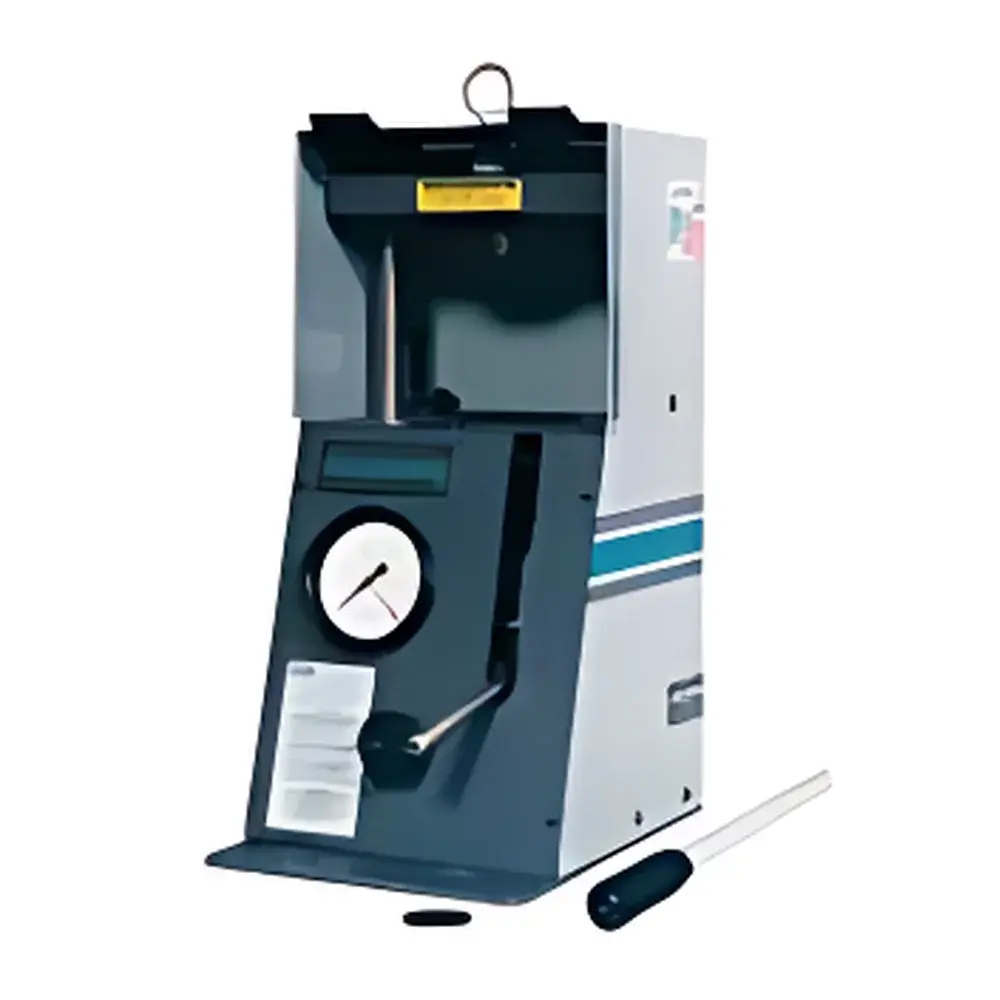
CARVER 4350 Manual Pellet Press for Bulk Density & Compaction Analysis
| Brand | CARVER |
|---|---|
| Origin | USA |
| Model | 4350 |
| Type | Manual Pellet Press |
| Maximum Force | 12 tons (24,000 lbf) |
| Platen Diameter | 10.16 cm |
| Die Cavity Compatibility | 13 mm |
| Ram Stroke | 13 cm |
| Jaw Opening Range | 0–13.97 cm |
| Pressure Gauge Range | 0–24,000 psi |
| Dimensions (L×W×H) | 26×20×51 cm |
| Net Weight | 57.5 kg |
| Base Color | Dark Gray |
Overview
The CARVER 4350 Manual Pellet Press is a precision-engineered compaction instrument designed for reproducible preparation of uniform solid pellets used in bulk density measurement, powder characterization, X-ray fluorescence (XRF) sample preparation, infrared (FTIR) spectroscopy, and pharmaceutical tabletability studies. Built upon CARVER’s legacy of over 85 years in laboratory press manufacturing, the 4350 leverages a robust dual-column, fully threaded mechanical architecture to deliver consistent force transmission with minimal deflection—critical for achieving high inter-run repeatability in compaction density profiling. Unlike hydraulic or pneumatic systems, its manually actuated toggle-lever mechanism provides direct operator control over compression rate and dwell time, enabling precise simulation of low-speed consolidation processes relevant to ASTM D5928 (Standard Practice for Preparation of Pressed Powder Pellets for Spectrochemical Analysis) and ISO 13320 (Laser Diffraction Particle Size Analysis—sample dispersion protocols). The unit operates on fundamental principles of uniaxial cold compaction, where applied load (in tons) is converted into compressive stress (MPa) via known platen area, allowing quantitative correlation between input force and resultant pellet density.
Key Features
- Dual-column, fully threaded frame design ensures exceptional rigidity and axial alignment—minimizing eccentric loading and improving pellet dimensional consistency.
- Hardened dual-metal platens (steel/aluminum composite) provide thermal stability and resistance to surface deformation during repeated high-load cycles.
- Deep-gray cast-iron base enhances vibration damping and long-term structural integrity under laboratory benchtop conditions.
- Calibrated analog pressure gauge (0–24,000 lbf) with linear response enables traceable force monitoring; compatible with optional digital load cell retrofitting for GLP-compliant data logging.
- Adjustable jaw opening (0–13.97 cm) accommodates standard CARVER die sets—including 13 mm diameter molds—as well as custom tooling up to 25 mm per ISO 23147 specifications.
- 13 cm ram stroke supports multi-step compaction protocols, including pre-pressing, dwell, and final densification—essential for studying powder rheology and Heckel analysis.
Sample Compatibility & Compliance
The 4350 is routinely deployed across material classes including metal oxides, geological powders, polymer blends, catalyst precursors, and pharmaceutical excipients. Its 13 mm die compatibility aligns with ASTM E1621 (XRF Pellet Preparation), USP Analytical Instrument Qualification (AIQ) for manual compaction tools, and ICH Q5C stability-indicating assay workflows. The absence of motorized components simplifies 21 CFR Part 11 compliance when paired with validated external data acquisition systems. All structural materials meet RoHS Directive 2011/65/EU restrictions, and the press is certified for use in ISO/IEC 17025-accredited testing laboratories performing density calibration per ISO 16792.
Software & Data Management
As a manually operated instrument, the 4350 does not include embedded firmware or proprietary software. However, it integrates seamlessly with third-party force transducers (e.g., Omega LCM series) and digital densitometers (e.g., Quantachrome Ultrapyc 1200e) via analog 0–5 V or 4–20 mA outputs. LabManager Suite v4.2 and LabArchives ELN support structured metadata capture—including lot number, dwell time, ambient RH/T, and operator ID—for audit-ready electronic records. Calibration certificates are issued annually per ISO/IEC 17025:2017 Annex A.2, with traceability to NIST SRM 2814 (load calibration standards).
Applications
- Preparation of homogeneous pellets for XRF, XRD, and FTIR spectral analysis with minimized matrix effects.
- Quantitative bulk density and tapped density determination per USP and Ph. Eur. 2.9.34.
- Compaction behavior modeling (e.g., Kawakita, Heckel, and Walker equations) in preformulation studies.
- Reference standard fabrication for gravimetric calibration of industrial powder feeders and loss-in-weight hoppers.
- Geotechnical soil simulacra compaction for ASTM D698/D1557 Proctor testing method validation.
FAQ
Is the CARVER 4350 compliant with GLP requirements for regulated laboratories?
Yes—when used with documented calibration schedules, operator training records, and controlled environmental logs, the 4350 meets core GLP principles outlined in OECD Series on Principles of Good Laboratory Practice.
Can I use non-CARVER 13 mm dies with this press?
Yes, provided the die assembly conforms to ANSI/ISO 80601-2-69 mechanical interface tolerances and does not exceed 25 mm outer diameter.
What maintenance is required for long-term accuracy?
Annual torque verification of column nuts (120 N·m), platen flatness inspection per ASME B89.3.7, and gauge recalibration against NIST-traceable deadweight testers.
Does the 4350 support automated data export?
Not natively—but analog output ports enable integration with SCADA systems, LabVIEW DAQ modules, or LIMS via RS-485/Modbus RTU adapters.
Is training available for first-time operators?
CARVER-certified application engineers deliver on-site or virtual SOP development and hands-on technique validation aligned with ISO 21748 guidance on measurement uncertainty.



