
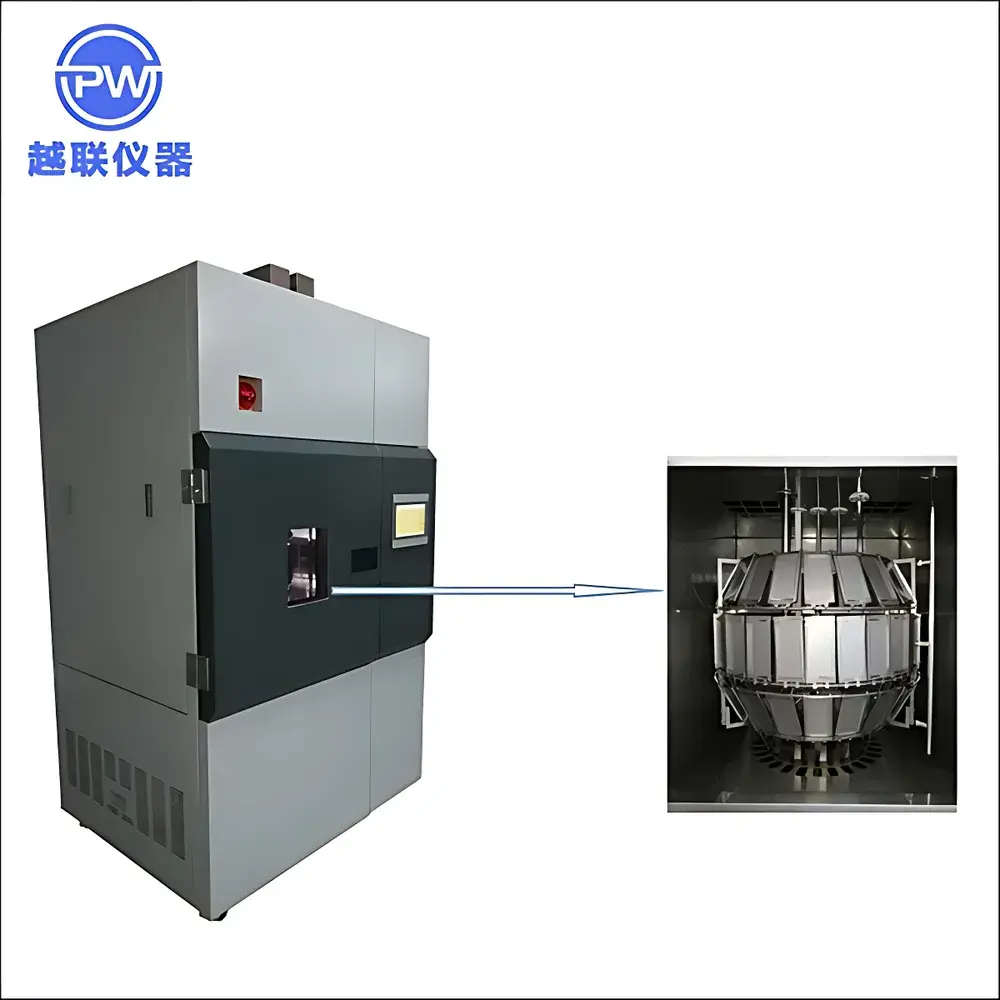
Yuelian PW-CX6500B Water-Cooled Xenon Arc Weathering Chamber
| Brand | Yuelian / PW |
|---|---|
| Origin | Guangdong, China |
| Manufacturer Type | Authorized Distributor |
| Country of Origin | China |
| Model | PW-CX6500B |
| Price | Upon Request |
| Internal Chamber Dimensions | 760 × 760 × 760 mm (D×W×H) |
| External Dimensions | 1050 × 1270 × 2100 mm (D×W×H) |
| Xenon Lamp Power | 6.5 kW |
| Lamp Quantity | 1 × Imported Long-Arc Xenon Lamp |
| Lamp Lifetime | ≥1500 h |
| Irradiance Control Points | @340 nm, @420 nm, 300–400 nm, 280–800 nm |
| Irradiance Range | 0.25–0.68 W/m² (@340 nm) |
| Air Temperature Range | 38–80 °C ±3 °C |
| Black Panel Temperature (BPT) | 40–100 °C ±3 °C |
| Black Standard Temperature (BST) | 40–110 °C ±3 °C |
| Relative Humidity Range | 10–75 %RH (light cycle), 45–100 %RH (dark cycle) |
| Humidity Uniformity | ±5 %RH |
| Temperature Uniformity | ±3 °C |
| Sample Capacity | 67 × 70 × 150 mm specimens (3-tier rotating drum) |
| Effective Exposure Area | 6500 cm² |
| Rotation Speed | 1 rpm, 360° continuous |
| Spray Rate | 0.4 L/min (front + rear combined) |
| Cooling System | Industrial-grade water chiller with scroll compressor |
| Control Interface | 10.4″ Weinview color touchscreen (bilingual: English/Chinese) |
| Data Export | USB port for Excel-compatible data logging |
| Remote Monitoring | Web-enabled Ethernet + mobile app support |
| Compliance Standards | GB/T 16422.2-2014, GB/T 32088-2015, GB/T 1865-1997, ISO 4892-2, ISO 11341, AATCC TM16, AATCC 169, GB/T 8427-2008, ASTM G155, YT-C374-2010 |
Overview
The Yuelian PW-CX6500B Water-Cooled Xenon Arc Weathering Chamber is an engineered solution for accelerated laboratory simulation of solar radiation, thermal stress, humidity cycling, and moisture exposure in accordance with internationally recognized weathering standards. It employs a high-intensity, water-cooled 6.5 kW long-arc xenon lamp as its primary irradiation source—capable of reproducing the spectral power distribution (SPD) of natural sunlight with >98% fidelity across the UV–visible–near-IR range (280–800 nm). The system integrates dual-filter optical assemblies (A-type daylight and B-type window-glass configurations) to meet specific spectral requirements defined in ISO, ASTM, AATCC, GB, and JIS test methods. Unlike air-cooled alternatives, the dedicated industrial chiller ensures stable lamp operation under extended duty cycles (≥1000 h continuous), minimizes thermal drift in irradiance output, and maintains consistent spectral stability over time—critical for inter-laboratory reproducibility in materials qualification protocols.
Key Features
- Triple-layer rotating drum sample holder (1 rpm, 360° continuous rotation) ensuring uniform exposure across all 67 standard 70 × 150 mm specimens (total exposure area: 6500 cm²)
- Dual-sensor temperature monitoring: simultaneous real-time measurement of air temperature (CHT), black panel temperature (BPT), and black standard temperature (BST) at specimen level—each with independent PID control and ±3 °C accuracy
- Multi-band irradiance regulation via closed-loop fiber-optic “Sun Eye” sensor system, supporting selectable monitoring at 340 nm, 420 nm, 300–400 nm, or full 280–800 nm bandwidths with ±0.1% control precision
- Nanotechnology-enhanced PTC humidification system delivering precise RH control (10–100 %RH) with <0.2 L/min water consumption at 38 °C / 95 %RH—reducing operational cost and maintenance frequency
- Independent front- and rear-spray modules generating calibrated deionized water mist (0.4 L/min total) to simulate rain, thermal shock, and condensation effects during dark cycles
- 10.4″ industrial-grade touchscreen HMI with bilingual interface, programmable multi-step test profiles (11 built-in standard templates), graphical real-time curve plotting, and alarm-driven diagnostics
- Comprehensive safety architecture: chiller fault interlock, lamp overtemperature shutdown, water-level sensing, phase-loss detection, dry-run protection for humidifier, and SSR-based solid-state heating control
- Remote supervision capability via secure Ethernet connection and native iOS/Android application—enabling status monitoring, parameter adjustment, and event-triggered notifications without physical access
Sample Compatibility & Compliance
The PW-CX6500B accommodates rigid and flexible substrates—including automotive interior trim, polymer composites, coated metals, textile fabrics, leather, rubber compounds, paints, inks, and architectural finishes—using standardized clip-on fixtures compatible with ISO 11341, AATCC TM16, and GB/T 8427 specimen geometries. Its dual-filter configuration enables direct correlation between test conditions and end-use environments: A-type filters replicate unfiltered terrestrial sunlight (ISO 4892-2 Method A), while B-type filters emulate solar radiation transmitted through standard architectural glass (ISO 4892-2 Method B). All operational parameters—including irradiance setpoints, temperature ramp rates, humidity dwell times, and spray duration—are traceable to calibration records compliant with ISO/IEC 17025 requirements. The system supports audit-ready data integrity features including electronic signature, user access levels, and timestamped change logs—fully aligned with GLP and FDA 21 CFR Part 11 principles for regulated testing laboratories.
Software & Data Management
The embedded controller firmware provides non-volatile storage for up to six months of continuous test data, including irradiance integrals (J/m²), temperature/humidity histories, and system fault logs. All datasets are exportable in .CSV format via USB flash drive for post-processing in Excel, MATLAB, or statistical analysis platforms. The HMI supports three concurrent display modes: numeric readouts, time-series trend curves (with zoom/pan functionality), and tabular summary tables—all synchronized to the active test step. For enterprise integration, optional Modbus TCP or OPC UA gateways enable bidirectional communication with LIMS or MES systems. Firmware updates are performed remotely via encrypted HTTPS push, maintaining version control and cybersecurity compliance per IEC 62443-3-3 guidelines.
Applications
This chamber serves as a core tool for R&D validation, quality assurance, and regulatory submission testing across multiple sectors. In automotive engineering, it validates dashboard material resistance to UV-induced cracking and pigment fade per SAE J2412 and GB/T 32088. In textile manufacturing, it quantifies colorfastness to light and light-plus-sweat per AATCC 169 and ISO 105-B02. Polymer compounders use it to assess photo-oxidative degradation kinetics in polyolefins and elastomers under ISO 4892-2 cyclic exposures. Coatings laboratories apply it for gloss retention, chalking evaluation, and adhesion loss tracking in accordance with ASTM D4329 and GB/T 1865. Additionally, the system supports custom aging protocols for medical device packaging, photovoltaic encapsulants, and aerospace sealants where long-term outdoor durability must be predicted within compressed timelines.
FAQ
What cooling medium is required for the xenon lamp?
Deionized water (resistivity ≥1 MΩ·cm) supplied by an external purified water system is mandatory. Tap water or softened water will cause scaling and premature lamp failure.
Can the chamber operate unattended for extended periods?
Yes—the integrated safety interlocks, auto-recovery logic, and remote monitoring capability support fully autonomous 1000+ hour test runs with no manual intervention.
Is the irradiance sensor NIST-traceable?
The factory-calibrated broadband and narrowband sensors are certified to ISO/IEC 17025-accredited laboratories; annual recalibration services are available with documented uncertainty budgets.
How does the system ensure spectral match consistency over lamp lifetime?
By combining spectral filtering, real-time irradiance feedback, and lamp power modulation—plus scheduled filter replacement intervals based on cumulative radiant exposure (kWh/m²)—the system maintains spectral compliance within ±5% of reference CIE daylight D65 throughout lamp service life.
Does the software support 21 CFR Part 11 compliance?
Yes—user authentication, electronic signatures, audit trails, and data immutability controls are enabled by default and configurable per organizational SOPs.



