
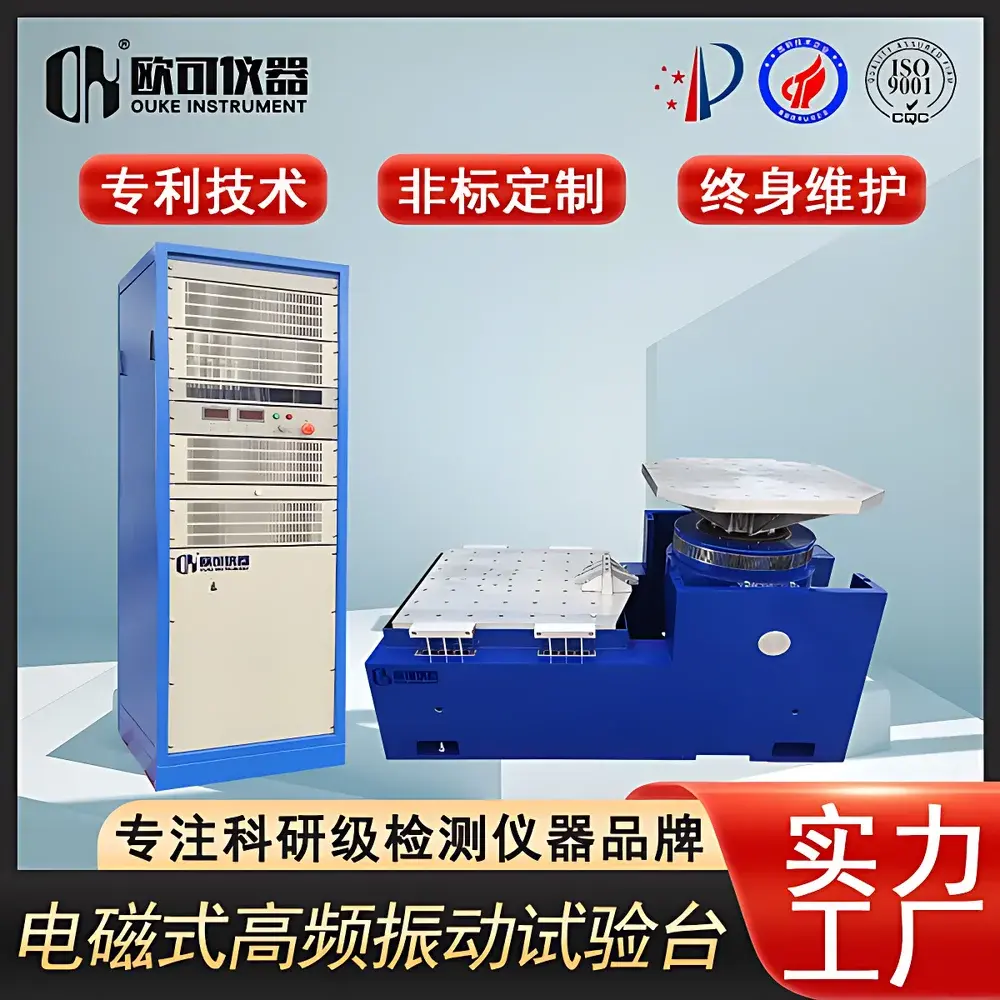
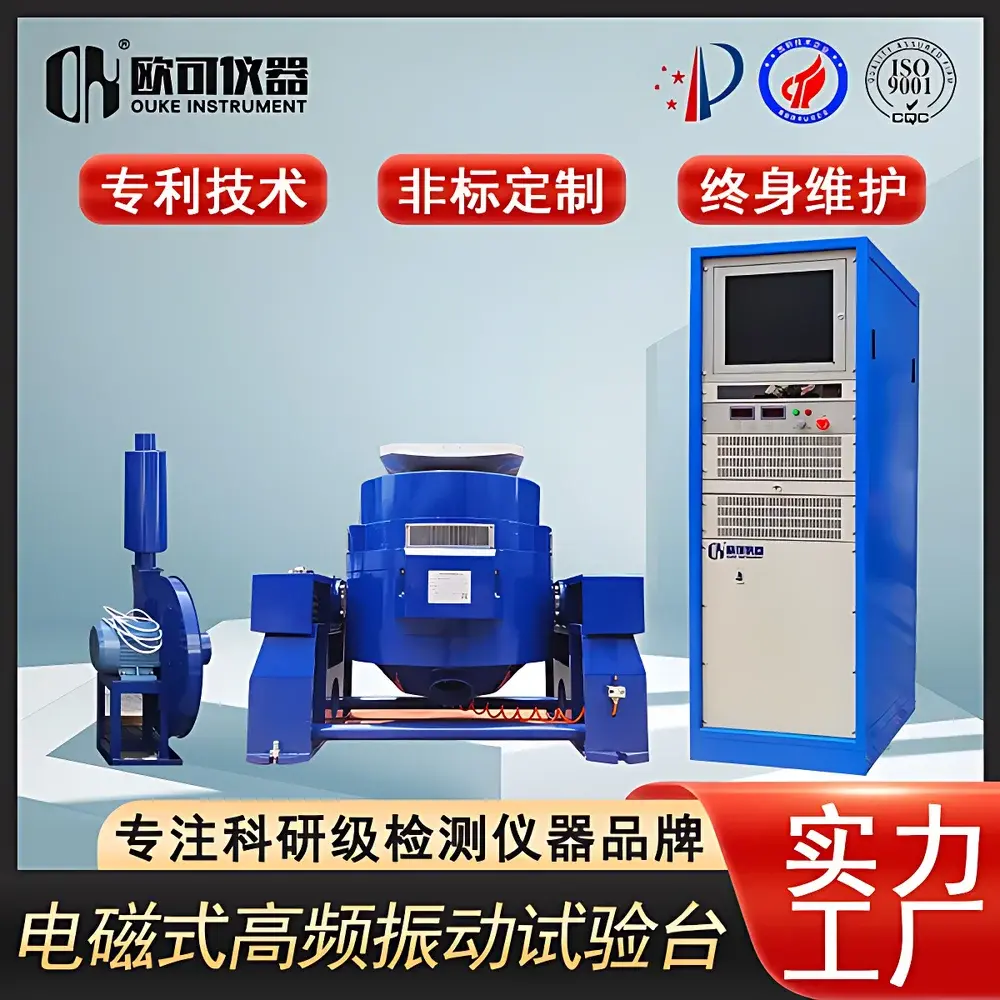
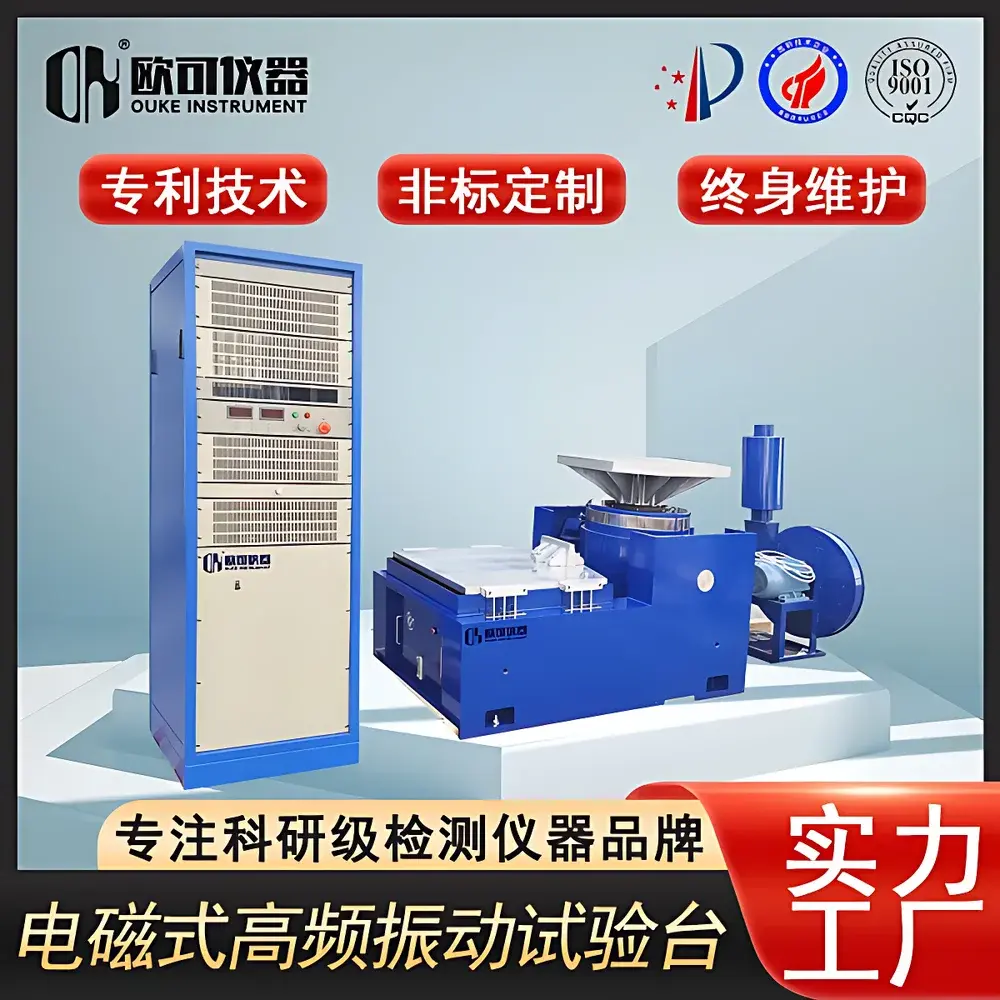
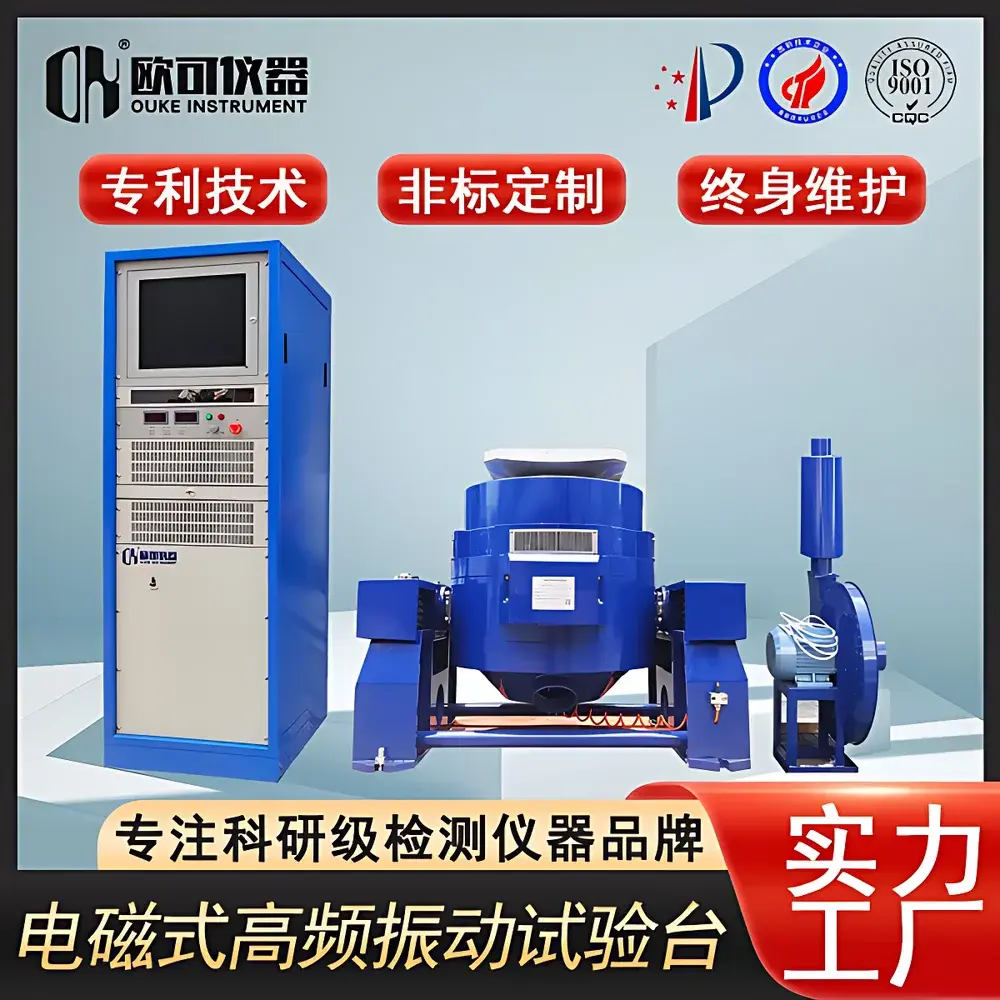
OK-ES Series 1 Electromagnetic High-Frequency Vibration Test System
| Brand | OK Instruments |
|---|---|
| Origin | Guangdong, China |
| Manufacturer Type | OEM/ODM Manufacturer |
| Country of Origin | China |
| Model | OK-ES Series 1 |
| Price | USD 21,000 (FOB Guangdong) |
Overview
The OK-ES Series 1 Electromagnetic High-Frequency Vibration Test System is a precision-engineered electrodynamic shaker platform designed for laboratory-based mechanical environmental simulation. It operates on the fundamental principle of Lorentz force actuation: an air-core voice coil—rigidly coupled to the test table—is suspended within a high-flux permanent magnet gap. When driven by a time-varying current from the power amplifier, the coil experiences a proportional axial force (F = B·L·i), resulting in controlled, bidirectional linear motion. This classical moving-coil architecture enables accurate reproduction of sinusoidal, random, shock, and transient vibration profiles across a broad frequency spectrum. Unlike hydraulic alternatives, the system delivers clean, oil-free excitation with inherently low harmonic distortion above 5 Hz—making it ideal for high-fidelity reliability validation in R&D and quality assurance environments where spectral fidelity, repeatability, and regulatory traceability are critical.
Key Features
- Wide operational frequency range: 5 Hz to 3,000 Hz (standard configuration), optimized for resonance search, fatigue life assessment, and broadband random vibration testing.
- High-force electromagnetic actuation: Capable of delivering peak sinusoidal forces up to 20 kN (model-dependent), supporting test specimens from printed circuit assemblies to automotive ECUs and avionics enclosures.
- Closed-loop digital control architecture: Integrates real-time acceleration feedback via IEPE accelerometers, enabling precise spectral matching (e.g., PSD tracking per MIL-STD-810H, DO-160G) with < ±0.5 dB amplitude tolerance and < ±0.1% frequency accuracy.
- Low-noise, maintenance-optimized design: Eliminates hydraulic fluid, seals, and associated contamination risks; utilizes forced-air or integrated water cooling for sustained random testing at 0.1–1.0 g²/Hz PSD levels.
- Modular mechanical interface: Standard 250 mm × 250 mm horizontal mounting surface with M10 threaded holes; compatible with optional slip tables, isolation frames, and custom fixture plates meeting ISO 5344 mechanical interface specifications.
Sample Compatibility & Compliance
The OK-ES Series 1 accommodates rigidly mounted test items weighing up to 100 kg (dependent on force rating and fixture stiffness). Specimen mounting requires high-rigidity, low-mass fixtures that preserve modal integrity—particularly critical for PCB-level testing where fixture resonance must lie >3× the highest test frequency. The system complies with key international standards for vibration testing methodology, including ISO 10816 (vibration severity evaluation), ISO 2041 (vibration and shock—vocabulary), and ASTM D999 (shipping container vibration testing). Its closed-loop controller supports audit-ready data logging aligned with GLP and GMP documentation requirements, including timestamped waveform metadata, calibration certificate traceability (NIST-traceable accelerometer verification), and user-accessible event logs for FDA 21 CFR Part 11 compliance readiness.
Software & Data Management
The system is operated via OK-VibControl™—a Windows-based, real-time deterministic control software compliant with IEC 61508 SIL2 functional safety principles. It provides intuitive setup for sine sweep, resonant dwell, narrowband random, and time-history replay modes. All test sessions generate binary .tdms files (NI Technical Data Management Streaming format) containing synchronized channel data, control setpoints, and FFT spectra. Export options include CSV, MATLAB .mat, and universal UFF58 formats. Built-in FFT analyzer supports order tracking, coherence calculation, and transmissibility mapping. Software includes password-protected user roles (Operator, Engineer, Administrator), electronic signature capability, and automated report generation with configurable templates adhering to ISO/IEC 17025 reporting guidelines.
Applications
- Aerospace: Qualification of satellite payload components, flight-critical sensors, and UAV structural subassemblies per DO-160 Section 7 and ECSS-Q-ST-70-12C.
- Automotive: NVH characterization of infotainment modules, ADAS camera housings, and battery management systems under road-spectrum random profiles (e.g., ISO 10326-1).
- Electronics: JESD22-B103 (shock) and JESD22-B104 (vibration) compliance testing for semiconductors, flex circuits, and MEMS devices.
- Defense: Environmental stress screening (ESS) of communication terminals, radar subsystems, and guided munition electronics per MIL-STD-202G Method 214.
- Academic research: Structural dynamic identification, damping ratio measurement, and piezoelectric transducer calibration using calibrated reference accelerometers.
FAQ
What is the maximum payload capacity for the OK-ES Series 1?
Payload limits depend on model-specific force rating and required acceleration level. For standard configurations, the safe operating mass is ≤100 kg at 50 g peak acceleration below 1 kHz.
Does the system support real-time remote monitoring and control?
Yes—via Ethernet TCP/IP interface with OPC UA server integration, enabling SCADA-level supervision and third-party test orchestration platforms.
Is factory calibration included, and how often is recalibration recommended?
Each unit ships with a full NIST-traceable calibration certificate valid for 12 months; annual recalibration is recommended per ISO/IEC 17025 Clause 6.5.2.
Can the system perform multi-axis vibration testing?
The OK-ES Series 1 is a single-axis vertical shaker. Horizontal testing requires optional orthogonal slip table integration (OK-HST-250), maintaining ≥95% cross-axis rejection per ISO 5347-13.
What power supply and cooling infrastructure are required?
Standard configuration requires 400 VAC, 3-phase, 50/60 Hz, 63 A supply; water-cooled models need deionized water at 18–25°C, 3 bar pressure, and ≥10 L/min flow rate.



