
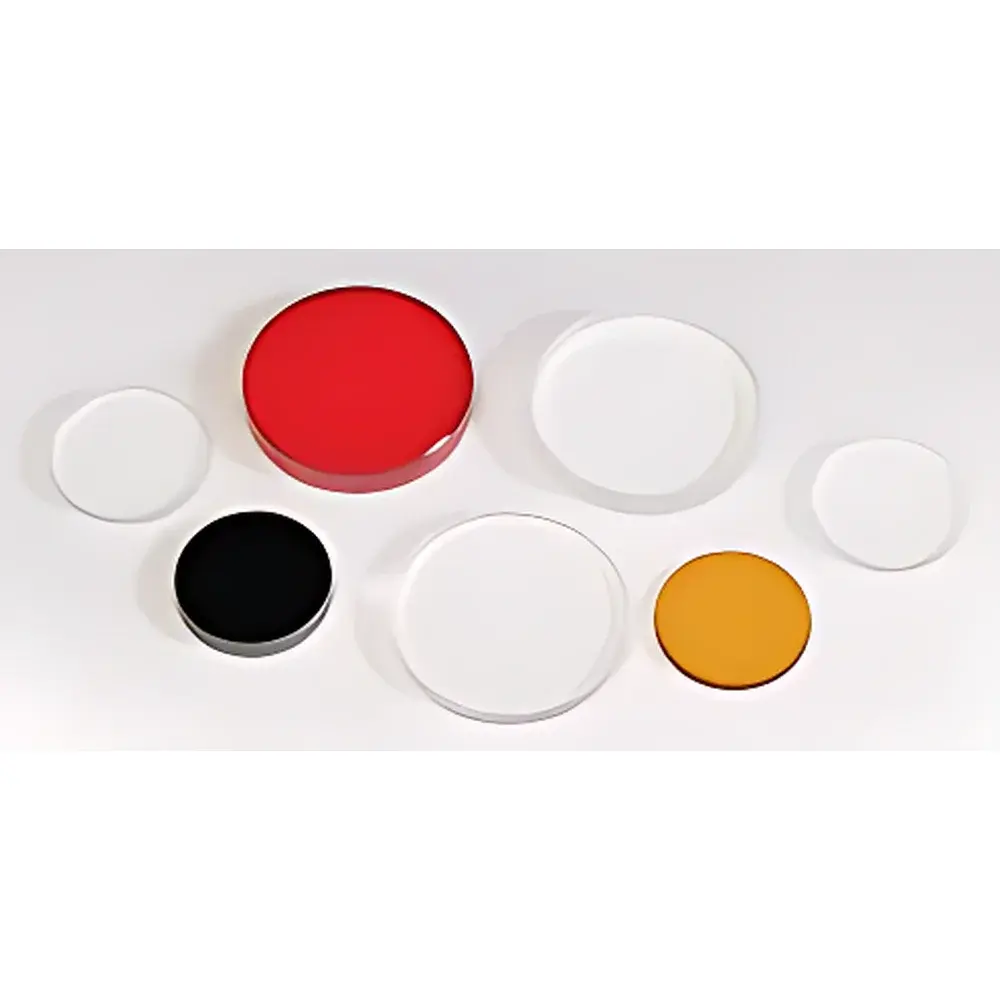
Pike Technologies KBr, ZnSe, and CaF₂ Infrared Transmission Windows
| Brand | Pike Technologies |
|---|---|
| Material Options | KBr, ZnSe, CaF₂ |
| Diameter Options | 13–50 mm (standard increments) |
| Surface Quality | λ/4 @ 633 nm |
| Parallelism | < 10 arcsec |
| Coating | Optional AR coating (3–12 µm broadband) |
| Compliance | ASTM E1421-22 (IR Spectroscopy Calibration Standards), ISO 17025 traceable manufacturing |
| Packaging | Cleanroom-sealed, desiccated blister packs |
Overview
Pike Technologies IR transmission windows are precision optical components engineered for reliable, high-fidelity infrared spectral transmission in Fourier-transform infrared (FTIR) spectrometers, benchtop IR analyzers, and custom optical systems. These windows serve as critical interface elements—mounted in sample compartments, gas cells, or detector housings—to enable beam passage while maintaining environmental isolation and optical alignment integrity. Constructed from single-crystal infrared-transparent materials—including potassium bromide (KBr), zinc selenide (ZnSe), and calcium fluoride (CaF₂)—each window is fabricated using controlled crystal growth, diamond-lapped polishing, and interferometric quality verification to ensure minimal wavefront distortion and maximal transmittance across defined spectral ranges. Unlike polymeric or coated substrates, these monolithic salt and chalcogenide crystals offer intrinsic broadband transparency with no delamination risk, making them indispensable for quantitative FTIR applications requiring long-term stability and calibration reproducibility.
Key Features
- Material-specific spectral transmission profiles: KBr (0.2–25 µm), ZnSe (0.5–20 µm), CaF₂ (0.13–9 µm), each validated per ASTM E1421 Annex A3 for baseline flatness and edge absorption limits
- Diameter tolerance: ±0.05 mm; thickness tolerance: ±0.1 mm (standard); custom thicknesses available for Brewster-angle or etalon-critical configurations
- Surface flatness certified to λ/4 @ 633 nm (RMS), verified via Zygo Verifire™ interferometry; parallelism maintained below 10 arcseconds to prevent beam walk-off in collimated paths
- Hygroscopic handling protocol included: KBr windows supplied with integrated desiccant packaging and silica-gel indicator; all units labeled with batch-specific moisture exposure history
- Optional anti-reflection (AR) coating optimized for 3–12 µm broadband performance (R < 0.5% per surface), deposited via ion-assisted e-beam evaporation under Class 100 cleanroom conditions
- Traceable metrology: Each lot accompanied by a certificate of conformance including refractive index homogeneity data (Δn < 5 × 10⁻⁶), residual stress mapping, and spectral transmittance curves measured on NIST-traceable PerkinElmer Spectrum Two FTIR
Sample Compatibility & Compliance
These windows are compatible with solid pellet preparation (KBr matrix), liquid cell assemblies (including demountable and fixed-pathlength cells), and gas-phase transmission cells used in EPA Method 320, ASTM D6348, and ISO 14912-2 compliance testing. KBr windows are routinely employed for pharmaceutical API characterization per USP and ICH Q5E guidelines, where chloride-free salt matrices are required to avoid spectral interference. ZnSe windows withstand moderate vacuum (10⁻³ Torr) and inert gas purging, supporting GLP-compliant environmental chamber integration. CaF₂ variants meet MIL-O-13830A scratch-dig specifications and are qualified for use in semiconductor process monitoring tools operating under Class 10 cleanroom protocols. All materials comply with RoHS Directive 2011/65/EU and are documented per ISO 9001:2015 manufacturing controls.
Software & Data Management
While physically passive components, Pike IR windows directly impact spectral data fidelity—particularly in quantitative applications governed by FDA 21 CFR Part 11 and EU Annex 11. Their consistent optical properties eliminate variable pathlength artifacts, enabling robust partial least squares (PLS) and principal component regression (PCR) model transfer between instruments. When paired with Thermo Fisher OMNIC, Bruker OPUS, or Agilent MicroLab software suites, window-specific transmittance correction files (in .csv or .spc format) can be loaded into instrument method templates to auto-compensate for material-dependent absorption edges. Audit trails for window installation, replacement, and calibration verification are fully embeddable within LIMS-integrated workflows supporting ISO/IEC 17025 accreditation requirements.
Applications
- Pharmaceutical solid-state analysis: KBr windows for compressed pellet FTIR of polymorph screening, hydrate/dehydrate kinetics, and excipient compatibility studies
- Environmental emissions monitoring: ZnSe windows in heated multi-pass gas cells for real-time detection of NOₓ, SO₂, and VOCs per EPA Performance Specification 18
- Materials science R&D: CaF₂ windows in high-vacuum IR reflection-absorption spectroscopy (IRRAS) cells for thin-film interfacial chemistry studies
- Academic teaching labs: Standardized 25 mm KBr windows for student-operated FTIR training modules aligned with ACS undergraduate curriculum standards
- Forensic toxicology: ZnSe windows in ATR accessories for direct analysis of seized drug samples without solvent extraction
FAQ
How should KBr windows be stored to prevent deliquescence?
Store sealed in desiccated containers with indicating silica gel at 2 minutes during handling. Use nitrogen-purged glove boxes for repeated insertion cycles.
Can ZnSe windows be cleaned with ethanol or acetone?
Yes—ZnSe is chemically inert to common organic solvents; wipe gently with lint-free lens tissue saturated with spectroscopic-grade acetone, followed by dry nitrogen purge. Avoid aqueous solutions.
Is CaF₂ suitable for UV-Vis-IR combined measurements?
Yes—CaF₂ exhibits exceptional transmission from 130 nm (deep UV) through mid-IR to 9 µm, making it ideal for synchrotron-based multimodal spectroscopy setups requiring a single optical interface.
Do these windows require recalibration after installation?
No—transmission characteristics are intrinsic and stable; however, system-level background scans must be acquired post-installation to update the instrument’s reference spectrum per ASTM E1421 Section 7.3.
Are custom diameters or thicknesses available with NIST-traceable certification?
Yes—Pike Technologies offers bespoke geometries with full metrology documentation, including interferometric flatness maps and spectral transmittance reports traceable to NIST SRM 1921b.







