
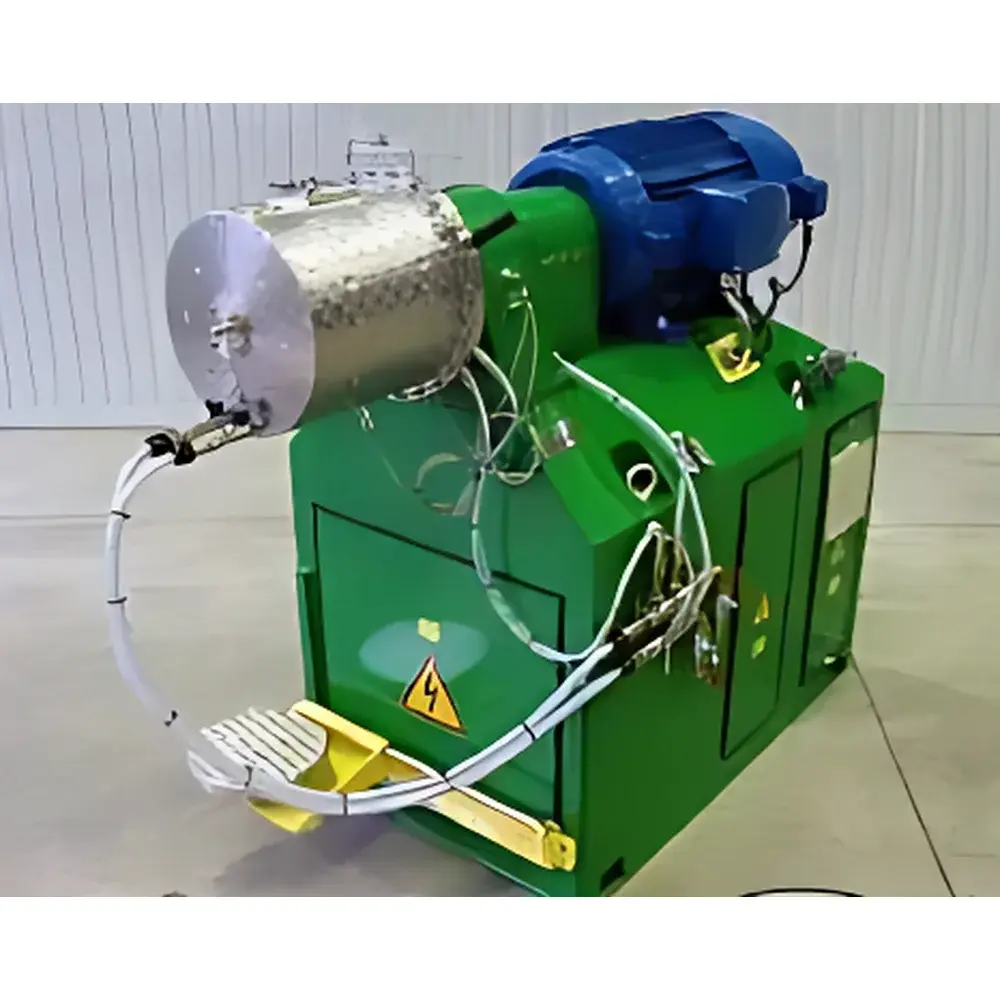
ZOZ Simoloyer CM01–CM900 High-Energy Horizontal Attritor Mill
| Origin | Germany |
|---|---|
| Manufacturer Type | Authorized Distributor |
| Origin Category | Imported |
| Model | Simoloyer CM01–CM900 |
| Instrument Type | High-Energy Horizontal Attritor Mill |
| Sample Suitability | Hard & Brittle Materials |
| Feed Size | ≤20 mm |
| Final Particle Size | <1 µm |
| Batch Processing Capacity | 200 g – 250 kg |
| Drive Power | 2.7–220 kW |
| Grinding Chamber Volume | 0.5–900 L |
| Operating Atmosphere | Air, Inert Gas (N₂, Ar), or Vacuum |
| Temperature Control | Integrated Heating/Cooling Jacket |
| Sealing System | Dual-Rotation Dynamic Seal with Air Lock Interface |
| Rotor Speed Range | Up to 3× Higher Than Conventional Ball Mills |
Overview
The ZOZ Simoloyer CM01–CM900 is a high-energy horizontal attritor mill engineered for precision mechanical alloying, reactive milling, and nanoscale particle size reduction under strictly controlled atmospheres. Unlike conventional vertical ball mills relying on gravitational cascading motion, the Simoloyer employs a horizontally mounted, high-stiffness rotor rotating within a sealed cylindrical grinding chamber. This architecture eliminates gravity-induced media stratification, ensuring uniform kinetic energy distribution across the entire grinding volume. The rotor imparts intense shear, impact, and compressive forces to the charge—comprising feed material and grinding media—enabling solid-state reactions, phase transformations, and grain refinement down to the nanometer regime (typically 10–100 nm). Its design adheres to fundamental principles of mechanochemistry: repeated plastic deformation, cold welding, fracturing, and re-welding drive microstructural evolution far from thermodynamic equilibrium—facilitating synthesis of amorphous alloys, metastable intermetallics, oxide-dispersion-strengthened (ODS) steels, nanostructured ceramics, and catalytically active composites.
Key Features
- Horizontal rotor configuration ensures homogeneous energy input and eliminates dead zones caused by gravitational settling of grinding media
- Dual-stage dynamic sealing system with air-lock interface enables operation under vacuum, inert gas (N₂, Ar), or reactive atmospheres while maintaining process integrity
- Modular grinding chambers (0.5–900 L) support scalable development—from lab-scale feasibility studies (CM01, 200 g) to pilot and industrial production (CM900, 250 kg/batch)
- Integrated temperature control via jacketed chamber allows precise thermal management (–40 °C to +200 °C) during exothermic or endothermic mechanochemical reactions
- Programmable rotor speed (up to 3× conventional mill RPM) and real-time power monitoring enable reproducible energy dosage per unit mass (kWh/kg)
- Intermittent low-/high-speed rotor rotation during discharge prevents powder agglomeration and ensures clean, residue-free transfer
- Full compliance with ISO 13857 (safety distances) and EN 61000-6-4 (EMC emissions); optional ATEX-certified variants available for explosive atmospheres
Sample Compatibility & Compliance
The Simoloyer accommodates hard, brittle, and ductile materials—including metals (Fe, Al, Cu, Ni-based alloys), ceramics (Al₂O₃, SiC, TiN), intermetallics, oxides, and polymer precursors—without requiring pre-crushing beyond 20 mm. Its inert-atmosphere capability supports oxygen-sensitive syntheses (e.g., MgH₂ for hydrogen storage, Fe–Si–B amorphous ribbons) and prevents oxidation during extended milling. All models conform to EU Machinery Directive 2006/42/EC and carry CE marking. For regulated environments, optional audit-trail-enabled firmware complies with FDA 21 CFR Part 11 requirements for electronic records and signatures. Process documentation meets GLP/GMP traceability standards when integrated with MALTOZ® software.
Software & Data Management
The MALTOZ® operating system provides closed-loop automation of milling cycles, including programmable ramp profiles for rotational speed, temperature setpoints, and atmosphere purge sequences. It logs timestamped data for rotor RPM, torque, power consumption, chamber pressure, and jacket temperature at ≥1 Hz resolution. Export formats include CSV and XML for integration into LIMS or statistical process control (SPC) platforms. Batch reports include energy input per gram, total mechanical work, and deviation metrics against reference protocols—critical for technology transfer and regulatory submissions. Remote diagnostics and firmware updates are supported via secure Ethernet interface.
Applications
- Mechanical alloying of immiscible systems (e.g., Cu–Fe, Al–Mg) to produce supersaturated solid solutions and nanocomposites
- Synthesis of amorphous metallic powders for soft magnetic cores (Fe–Si–B, Co–Nb–Zr)
- Reactive milling for mechanochemical synthesis of metal hydrides (Ti–V–Cr–H, Mg–Ni–H) and battery anode materials (Si–C, Sn–Sb)
- Nanocrystallization of coarse-grained alloys to enhance strength and wear resistance (e.g., ODS ferritic steels)
- Surface modification via particle embedding (e.g., PTFE-coated metal powders for self-lubricating bearings)
- Preparation of catalyst precursors (Ni–Mo–Al₂O₃, Pt–CeO₂) with high surface area and dispersion uniformity
- Production of ceramic–metal functionally graded materials (FGMs) for thermal barrier applications
FAQ
What distinguishes the Simoloyer from planetary ball mills?
The Simoloyer’s horizontal rotor generates predominantly shear-dominated stress fields, whereas planetary mills rely on impact-dominated cascading motion. This results in higher energy transfer efficiency, superior scalability, and reduced contamination from vial wear.
Can the system handle reactive or pyrophoric materials?
Yes—when equipped with vacuum/inert gas handling, air-lock feed/discharge modules, and explosion-proof motor enclosures (ATEX Zone 22), it safely processes Li-metal, Al–Mg alloys, and transition metal borides.
Is continuous processing supported?
CM-series models support semi-continuous operation via lock-hopper feeding and pneumatic conveying discharge; fully continuous configurations require custom engineering and are validated per ISO 14123-1.
How is method transfer ensured between lab and production scales?
Energy input (kWh/kg), specific impact energy (J/g), and dimensionless Froude number are maintained as scale-invariant parameters—validated through DEM simulations and experimental correlation across CM01 to CM900.
What maintenance intervals are recommended for the dynamic seal system?
Under standard inert-gas operation, seal inspection is scheduled every 1,000 operating hours; replacement frequency depends on abrasive load and is tracked automatically by MALTOZ®.



