
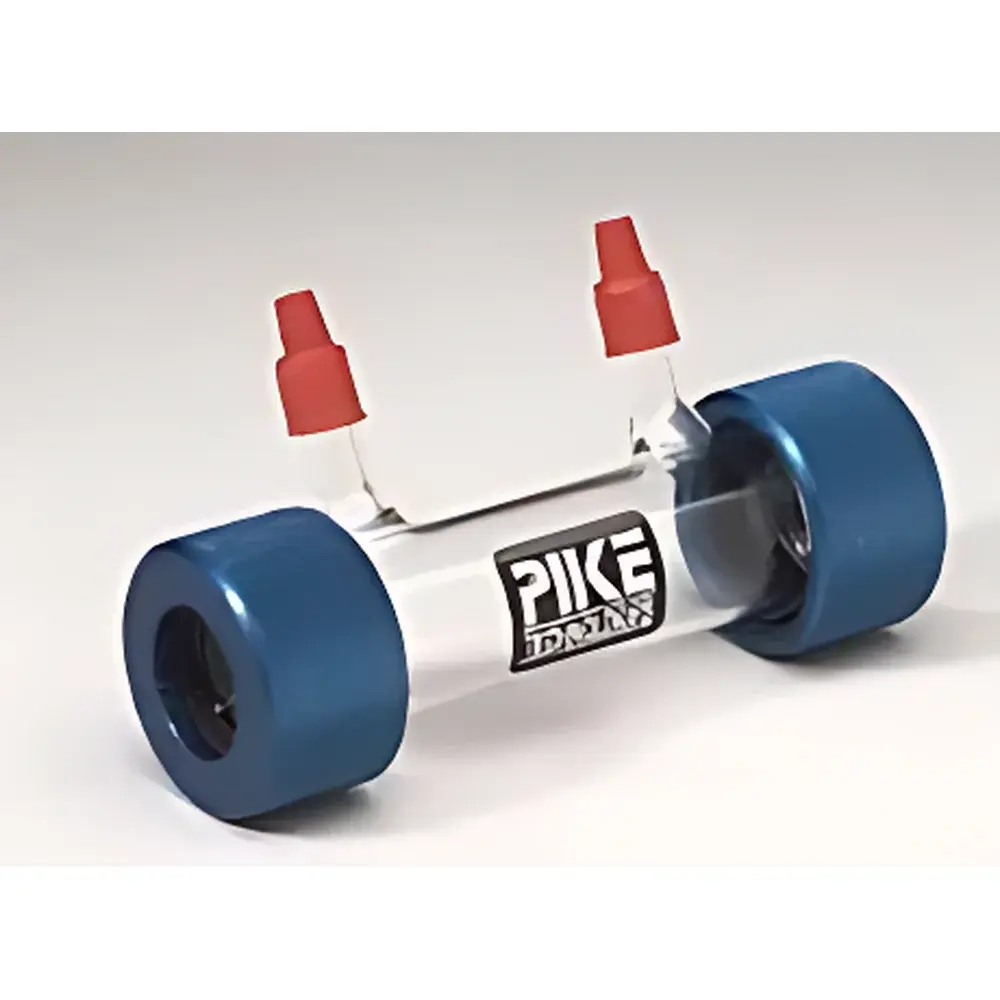
Pike Technologies 16x-xxx Short-Path Gas Cell for FTIR Spectroscopy
| Brand | Pike Technologies |
|---|---|
| Origin | USA |
| Model | 16x-xxx |
| Optical Path Length | 100 mm |
| Construction | Borosilicate Glass Body with Precision-Machined Aluminum Ring and Mounting Frame |
| Compatible Window Material | 25 mm × 4 mm (Thickness) IR-Transmissive Windows (e.g., KBr, ZnSe, CaF₂) |
| Mounting Interface | Standard FTIR Sample Compartment Compatibility (e.g., Thermo Nicolet, Bruker, PerkinElmer) |
Overview
The Pike Technologies 16x-xxx Short-Path Gas Cell is a precision-engineered optical component designed for quantitative and qualitative gas-phase analysis using Fourier Transform Infrared (FTIR) spectroscopy. Operating on the fundamental principle of molecular vibrational absorption—where gaseous analytes exhibit characteristic infrared absorption bands corresponding to bond stretching, bending, and rotational transitions—the cell enables reproducible spectral acquisition under controlled static or dynamic flow conditions. With a nominal optical path length of 100 mm, this cell bridges the sensitivity–resolution trade-off inherent in low-concentration or high-pressure gas measurements: it provides sufficient absorbance for trace-level detection while minimizing pressure-broadening effects and self-absorption artifacts common in longer-path cells. Its modular architecture—comprising a borosilicate glass body, thermally stable aluminum retention ring, and kinematically aligned mounting frame—ensures mechanical rigidity, thermal homogeneity, and repeatable positioning within standard FTIR spectrometer sample compartments (including Thermo Scientific Nicolet iS series, Bruker Tensor platforms, and PerkinElmer Frontier systems).
Key Features
- Borosilicate glass construction offers excellent mid-IR transmission (≥ 80% from 4000–400 cm⁻¹) and superior chemical resistance to non-halogenated vapors and inert gases.
- Precision-machined anodized aluminum ring ensures uniform window compression without distortion, maintaining wavefront flatness < λ/4 across 25 mm clear aperture.
- Integrated O-ring sealing system (Viton® or Kalrez® options available) supports operation up to 10 bar pressure and accommodates purge gas flow rates of 50–500 mL/min for continuous sampling or background subtraction.
- Standard 25 mm × 4 mm window thickness compatibility allows interchangeable use of KBr (hygroscopic, broad-band), ZnSe (non-hygroscopic, 6000–600 cm⁻¹), or CaF₂ (UV-IR extended, 8000–1000 cm⁻¹) substrates based on spectral range and environmental requirements.
- Optimized beam alignment geometry minimizes Fresnel reflection losses and eliminates internal multiple-beam interference through anti-reflection coated windows (optional).
Sample Compatibility & Compliance
The 16x-xxx gas cell is validated for use with volatile organic compounds (VOCs), inorganic gases (CO, CO₂, NOₓ, SO₂, NH₃), halogenated refrigerants, and isotopically labeled species under ambient to moderately elevated temperatures (−20 °C to +80 °C). It complies with ASTM E1421–22 (Standard Practice for Describing and Measuring Performance of FTIR Spectrometers) and supports method validation per USP and EP 2.2.24 for gas-phase identity testing. When integrated into GLP- or GMP-regulated workflows, the cell’s mechanical repeatability (path-length stability ±0.02 mm over 100 thermal cycles) and documentation traceability (NIST-traceable calibration certificate optional) support audit readiness for FDA 21 CFR Part 11-compliant data acquisition systems.
Software & Data Management
No embedded firmware or proprietary software is required; the cell functions as a passive optical element fully compatible with native instrument control suites (e.g., OMNIC, OPUS, Spectrum Touch). Spectral acquisition parameters—including co-addition count, resolution (0.5–4 cm⁻¹), apodization (Blackman-Harris 3-term), and phase correction—are managed entirely at the spectrometer level. For quantitative analysis, the cell’s fixed 100 mm path length enables direct application of the Beer–Lambert law without empirical path-length recalibration. Exported spectra retain full metadata (instrument ID, date/time stamp, aperture setting, detector type), facilitating automated batch processing in LIMS-integrated environments and compliance with ISO/IEC 17025 data integrity requirements.
Applications
- Real-time monitoring of catalytic reaction intermediates in fixed-bed reactors via coupled gas chromatography–FTIR (GC-FTIR) interfaces.
- Verification of residual solvent content (e.g., acetone, dichloromethane) in pharmaceutical active ingredients per ICH Q2(R2) guidelines.
- Calibration transfer studies between laboratory and portable FTIR systems using certified gas standards (NIST SRM 1966, 2029).
- Atmospheric chemistry simulations requiring precise partial pressure control of reactive nitrogen species under UV-irradiated conditions.
- Educational demonstrations of rotational-vibrational fine structure in diatomic gases (e.g., HCl, CO) at sub-atmospheric pressures.
FAQ
Is the 100 mm path length adjustable?
No—the 16x-xxx is a fixed-path cell engineered for metrological stability; variable-path alternatives (e.g., Pike’s Model 17x series) require manual spacer exchange and recalibration.
Can this cell be used with vacuum or corrosive gases?
Yes, with appropriate window material selection (e.g., ZnSe for Cl₂; CaF₂ for HF) and Kalrez® O-rings; vacuum operation down to 10⁻³ mbar is supported with optional vacuum-flange adapters.
Does Pike provide spectral baseline correction protocols?
Yes—application notes (Pike Doc #AN-FTIR-GAS-04) detail purge-gas background acquisition, water vapor subtraction algorithms, and Mie scattering compensation for aerosol-laden streams.
What is the maximum recommended operating temperature?
80 °C continuous; short-term excursions to 100 °C are permissible with ZnSe windows and high-temp Viton® seals.
Is NIST-traceable path-length certification available?
Yes—certification includes interferometric measurement uncertainty ≤ ±0.015 mm (k = 2) and is supplied with each cell upon request.






