
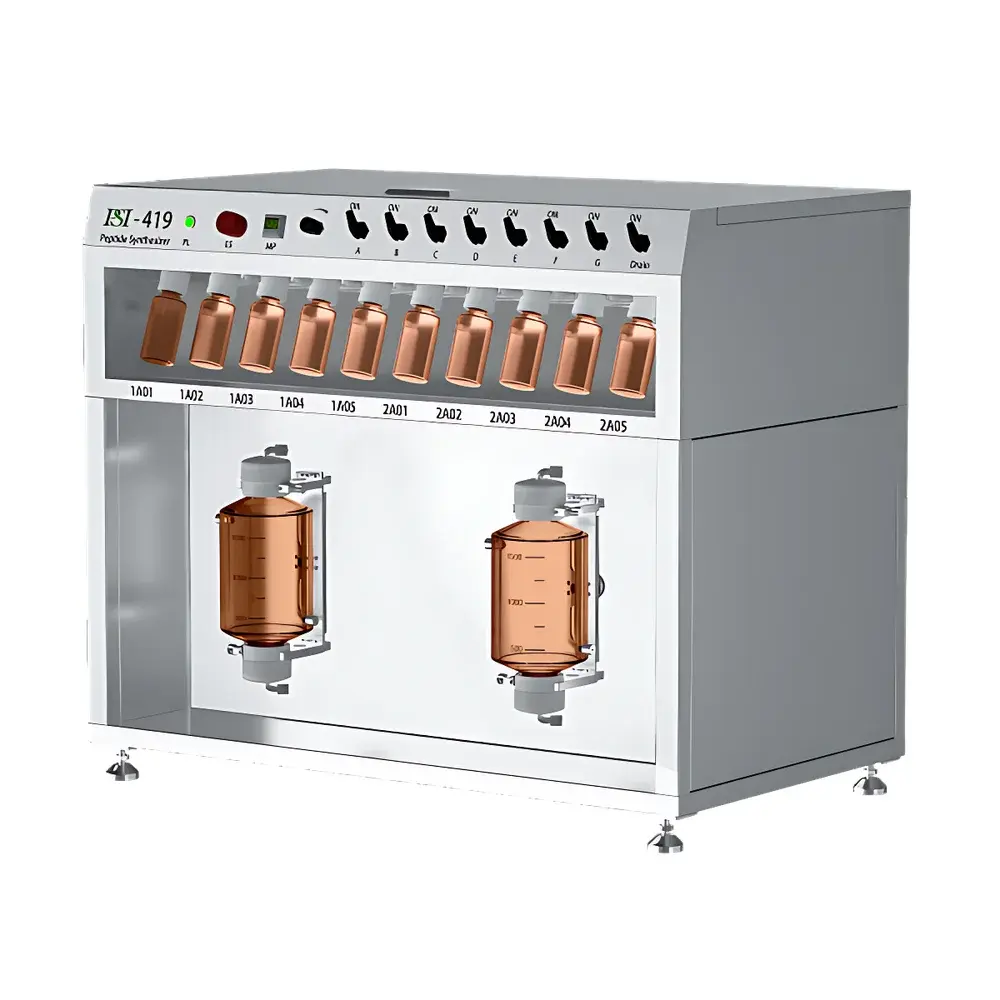
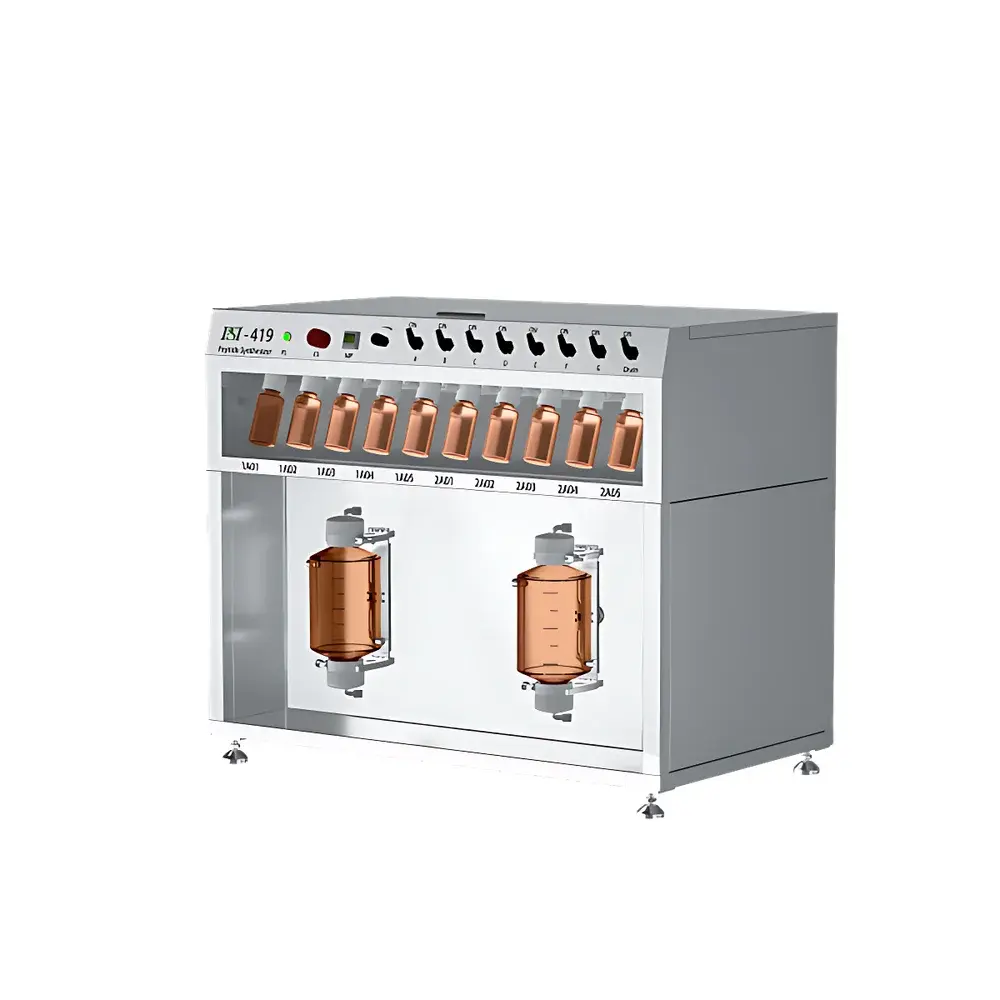
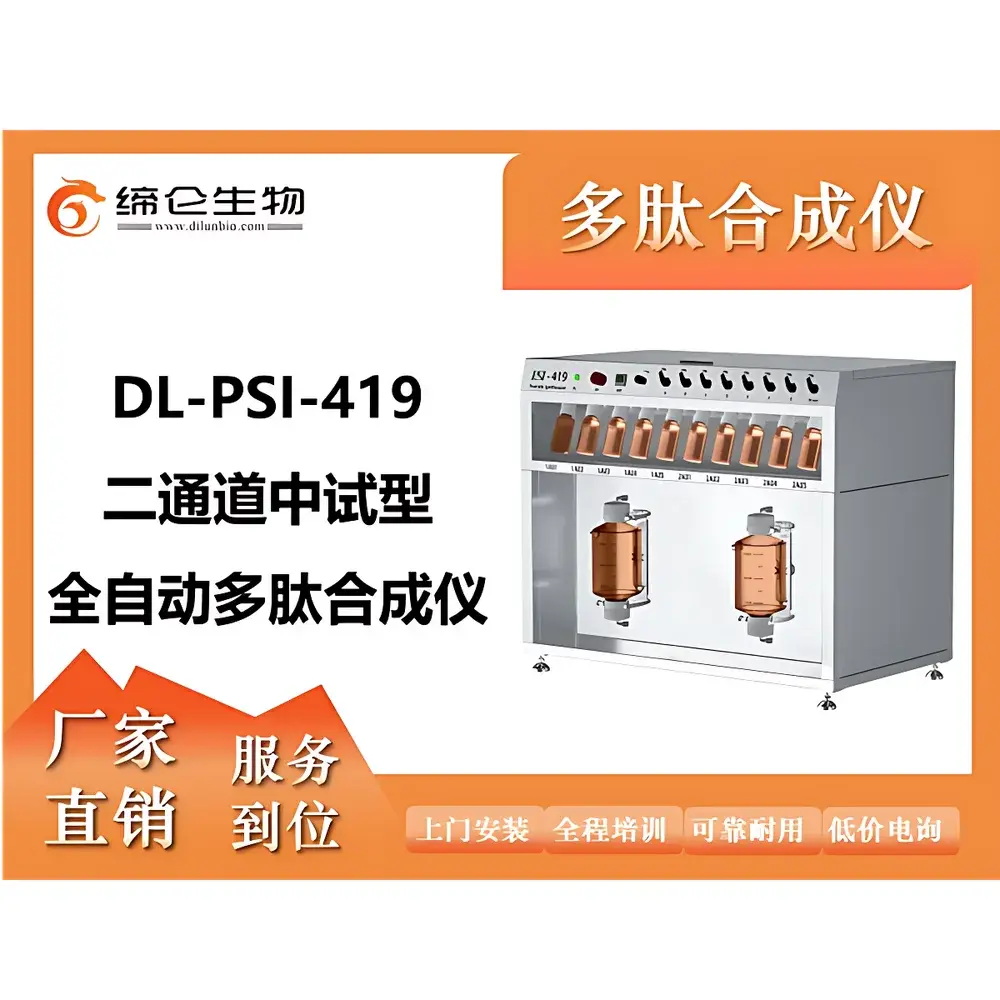
PSI DL-PSI419 Dual-Channel Pilot-Scale Automated Peptide Synthesizer
| Brand | PSI |
|---|---|
| Origin | USA |
| Model | DL-PSI419 |
| Amino Acid Delivery | Automated |
| Reagent Delivery | Automated |
| Synthesis Scale per Channel | 2.5–20 mmol |
| Number of Reaction Vessels | 2 |
| Vessel Capacities | 0.5 L, 1 L, 2 L (jacketed) |
| Syringe Pump Accuracy | ±0.1 mL |
| Synthesis Purity | ≥99.5% |
| Solvent Flow Rate | 200 mL/min |
Overview
The PSI DL-PSI419 is a dual-channel, pilot-scale automated peptide synthesizer engineered for robust, reproducible solid-phase peptide synthesis (SPPS) under GMP-adjacent and GLP-compliant laboratory environments. Unlike conventional synthesizers relying on mechanical stirring—where rotating impellers induce resin fragmentation, clogging frits and reducing coupling efficiency—the DL-PSI419 implements PSI’s proprietary 180° end-over-end vessel inversion mixing technology. This inertial tumbling motion ensures homogeneous suspension of resin beads without shear-induced damage, maintaining bead integrity across extended synthesis cycles and enabling coupling efficiencies consistently exceeding 99.5% even for sequences >100 residues. Designed for transition from lab-scale discovery to process validation, the system supports parallel, asynchronous synthesis of two distinct peptides—each with independent reaction protocols, reagent schedules, temperature profiles, and solvent delivery parameters—making it ideal for comparative route scouting, impurity profiling, or co-synthesis of analogues and controls.
Key Features
- Dual independent synthesis channels with fully programmable, non-interfering operation—enabling true asynchronous synthesis of two different peptide sequences.
- Jacketed reaction vessels (0.5 L, 1 L, 2 L) compatible with precise water-bath temperature control (±0.5 °C), supporting both Fmoc- and Boc-based chemistries requiring low-temperature deprotection or elevated coupling temperatures.
- 10 dedicated amino acid reservoirs and 8 solvent/reagent reservoirs—configured for custom loading of protected amino acids, coupling agents (e.g., HATU, DIC), activators, scavengers, and side-chain deprotection cocktails.
- End-over-end vessel inversion mixing (0–25 rpm, infinitely variable) driven by high-torque electronic servo motors—eliminating mechanical agitators, minimizing resin attrition, and ensuring uniform mass transfer in viscous slurries.
- Automated nitrogen (or argon) blanketing throughout all synthesis stages—maintaining an oxygen- and moisture-free environment per USP <797> and ISO 14644-1 Class 7 cleanroom recommendations.
- Stainless steel 304 chassis with chemical-resistant wetted-path components—designed for compatibility with DMF, DCM, NMP, piperidine, TFA, and other aggressive SPPS solvents.
Sample Compatibility & Compliance
The DL-PSI419 accommodates standard polystyrene, PEG-PS, and ChemMatrix® resins (100–200 mesh), as well as specialty functionalized supports for cyclization, lipidation, or click-chemistry handle incorporation. Its modular fluidic architecture supports both batch-mode and flow-through washing protocols, with gravimetric or volumetric endpoint detection options. The system meets key regulatory expectations for instrument qualification: IQ/OQ documentation packages are available upon request; audit trails, user access controls, and electronic signature support align with FDA 21 CFR Part 11 requirements when integrated with compliant LIMS or ELN platforms. All firmware logs—including vessel position, pump actuation timestamps, gas pressure events, temperature setpoints, and reagent dispense volumes—are time-stamped and exportable in CSV/JSON format for traceability.
Software & Data Management
The embedded control software (v4.2+) provides a browser-based interface accessible via local network or secure remote VPN. Users define synthesis methods using hierarchical protocol templates—covering coupling, deprotection, washing, capping, and cleavage steps—with conditional branching (e.g., “if residue = Cys, add Trt protection step”). Real-time monitoring includes live plots of solvent flow rate, vessel tilt angle, bath temperature, and nitrogen purge pressure. All method files, run logs, and raw sensor data are stored in AES-256 encrypted SQLite databases, with optional synchronization to enterprise NAS or cloud storage (AWS S3, Azure Blob). Backup intervals, retention policies, and role-based permissions (admin/operator/auditor) are configurable to meet internal SOPs and external audit readiness standards.
Applications
- Pilot-scale production of clinical trial materials (CTM) for Phase I/II peptides, including GLP-1 analogues, antimicrobial peptides, and constrained macrocycles.
- Parallel optimization of coupling reagents, activation times, and resin swelling conditions during process development.
- Synthesis of isotopically labeled peptides for structural biology (NMR, HDX-MS) where batch-to-batch consistency is critical.
- Manufacture of reference standards and calibration peptides for LC-MS/MS assay validation per ICH Q5C and USP <1225>.
- Supporting CRDMO workflows—enabling rapid turnaround of multi-variant peptide libraries for structure–activity relationship (SAR) studies.
FAQ
Does the DL-PSI419 support both Fmoc and Boc chemistry?
Yes—its chemically resistant fluid path, programmable temperature control (−10 °C to +60 °C), and customizable reagent delivery enable full compatibility with either strategy.
Can synthesis data be exported for regulatory submission?
All raw instrument data—including timestamps, dispense volumes, temperature logs, and method versions—is exportable in audit-ready formats (CSV, PDF, XML) with cryptographic hash verification.
Is validation documentation provided?
Comprehensive IQ/OQ protocols, factory test reports, and material certifications (e.g., 304 SS mill test reports) are included; PQ support is available through qualified third-party partners.
What maintenance is required for long-term reliability?
Scheduled quarterly verification of syringe pump accuracy, vessel seal integrity, and nitrogen purge flow rate; no routine lubrication or belt replacement due to brushless servo motor design.
How is resin loading handled for different vessel sizes?
Resin mass is calculated automatically based on vessel volume, swelling ratio, and desired loading density (0.1–0.6 mmol/g); users input resin type and theoretical substitution level to generate optimized load protocols.





