
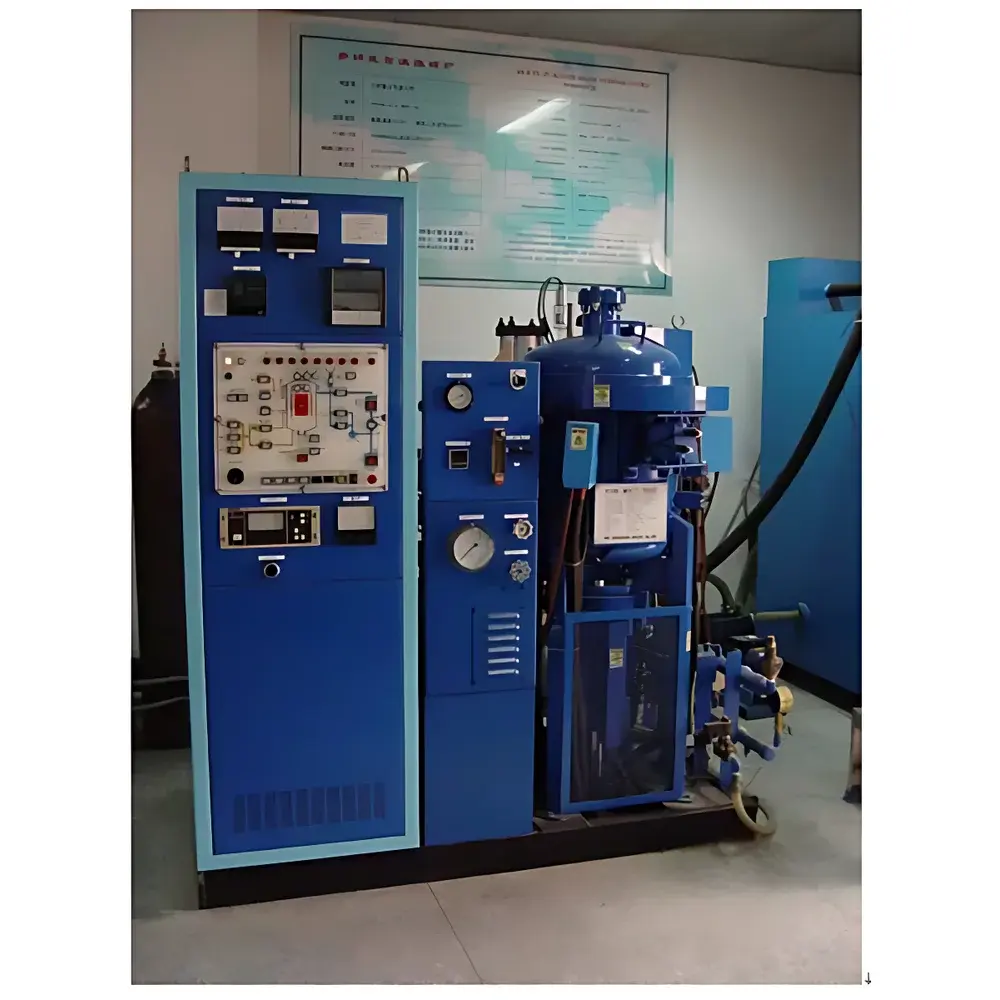
Fuji Denpa HIGH-MULTI-5000/10000 Multi-Mode Sintering Furnace for Ultra-Hard Materials
| Origin | Japan |
|---|---|
| Manufacturer | Fuji Denpa Co., Ltd. |
| Type | Imported Industrial Sintering System |
| Model | HIGH-MULTI-5000 / HIGH-MULTI-10000 |
| Maximum Pressing Force | 5,000 kN (HIGH-MULTI-5000) / 10,000 kN (HIGH-MULTI-10000) |
| Operating Modes | Vacuum Sintering, Controlled-Atmosphere Sintering, Hot Pressing (Manual & Automated) |
| Temperature Range | Up to 2,200 °C |
| Vacuum Level | ≤5 × 10⁻³ Pa |
| Heating Method | Graphite or Molybdenum Heater with PID-Controlled Zoning |
| Chamber Dimensions (Typical) | Ø300 × H400 mm (5,000 kN variant) |
| Compliance | ISO 9001–certified manufacturing |
Overview
The Fuji Denpa HIGH-MULTI-5000/10000 is a dual-capacity, multi-mode sintering system engineered for high-precision consolidation of ultra-hard and refractory materials—including silicon carbide (SiC), cubic boron nitride (cBN), tungsten carbide (WC-Co), polycrystalline diamond (PCD), and advanced ceramics such as Al₂O₃, ZrO₂, and Si₃N₄. Based on Fuji Denpa’s proprietary resistive heating architecture and integrated mechanical press design, the furnace operates across three fundamental sintering regimes: high-vacuum sintering (≤5 × 10⁻³ Pa), controlled-atmosphere sintering (Ar, N₂, H₂, or forming gas), and uniaxial hot pressing under programmable load profiles. Its modular thermal zone configuration—comprising independently controlled upper, middle, and lower heater sections—ensures axial temperature uniformity within ±3 °C over the full working height, critical for density homogeneity in near-net-shape components. The system is designed for R&D laboratories and pilot-scale production environments requiring traceable, repeatable thermal-mechanical cycles compliant with GLP and pre-GMP material qualification protocols.
Key Features
- Two scalable configurations: HIGH-MULTI-5000 (5,000 kN max pressing force) and HIGH-MULTI-10000 (10,000 kN), both sharing identical control architecture, vacuum integrity, and thermal management logic
- Triple-mode operation with fully decoupled pressure, temperature, and atmosphere control—enabling synchronized ramp-hold-sinter-cool sequences under load
- Graphite or molybdenum heating elements with water-cooled copper flanges and radiation shields, optimized for rapid thermal cycling up to 2,200 °C with <15-minute cool-down from 1,800 °C to 100 °C (under inert purge)
- Integrated PLC-based motion control system with load cell feedback, capable of real-time force modulation during dwell phases to compensate for creep or shrinkage-induced stress relaxation
- Double-walled stainless steel vacuum chamber with metal-sealed viewports, leak-tested to ≤1 × 10⁻⁸ Pa·m³/s (He), and equipped with turbomolecular + roots backing pump train
- Redundant safety interlocks including overtemperature cutoff, overpressure venting, cooling water flow monitoring, and emergency hydraulic depressurization
Sample Compatibility & Compliance
The HIGH-MULTI series accommodates cylindrical, disc-shaped, and prismatic compacts up to Ø300 mm × 400 mm (5,000 kN) or Ø400 mm × 500 mm (10,000 kN), compatible with graphite, BN, and TZP dies. It supports sintering of powder metallurgy preforms, CVD-coated substrates, and multilayer ceramic green tapes requiring co-firing with constrained deformation. All operational parameters—including pressure ramp rate (0.1–50 MPa/min), heating rate (0.1–50 °C/min), and dwell time resolution (1 second)—are logged with timestamped audit trails. The system conforms to ISO 9001:2015 quality management requirements and supports validation documentation packages aligned with ASTM C770 (hot pressing of ceramics) and JIS H 8601 (sintering behavior testing). Optional 21 CFR Part 11–compliant software modules are available for regulated pharmaceutical excipient or battery electrode material development workflows.
Software & Data Management
Fuji Denpa’s proprietary SINTER-LOGIC™ control interface runs on an industrial PC with deterministic real-time OS, offering dual-mode operation: guided wizard mode for routine sintering recipes and expert script mode supporting custom IF-THEN-ELSE logic for adaptive cycle control. All process data—including thermocouple readings (Type C, ±0.5 °C accuracy), load cell output (±0.25% FS), vacuum transducer values, and atmosphere composition (via optional mass flow controller feedback)—are sampled at 10 Hz and archived in HDF5 format. Export options include CSV, MATLAB .mat, and ASTM E1434-compliant XML for third-party analysis. Remote diagnostics and firmware updates are supported via TLS-encrypted Ethernet connection; local USB backup and network share synchronization ensure data resilience.
Applications
- Development and optimization of wear-resistant tooling inserts (e.g., WC-10Co sintered at 1,450 °C/30 MPa under Ar)
- Consolidation of nanostructured SiC and TiB₂ composites for aerospace turbine components
- Hot pressing of transparent YAG and spinel ceramics for optical window applications
- Reaction sintering of Si₃N₄–SiC nanocomposites under nitrogen partial pressure
- Pilot-scale densification of solid-state battery electrolyte pellets (LLZO, LATP) with simultaneous grain boundary engineering
- Thermal stability assessment of magnetic hard phases (NdFeB, SmCo) under compressive constraint
FAQ
What vacuum level can the HIGH-MULTI-5000/10000 achieve, and how is it maintained during hot pressing?
The system achieves and sustains ≤5 × 10⁻³ Pa throughout the entire sintering cycle—including under maximum load—using a dual-stage pumping strategy: a dry scroll backing pump paired with a magnetically levitated turbomolecular pump. Continuous vacuum integrity is monitored via cold cathode gauge and backed by automatic purge-and-repump routines triggered by pressure drift exceeding 1 × 10⁻⁴ Pa/min.
Is the furnace compatible with graphite tooling and die sets?
Yes—standard configurations include water-cooled graphite platens, spacers, and dies rated to 2,200 °C. Optional Mo-based tooling is available for ultra-high-purity applications where carbon contamination must be minimized.
Can the system perform two-step sintering or pressure-assisted sintering with hold-and-release profiles?
Absolutely. The PLC control architecture supports up to 99 programmable segments per recipe, each with independent setpoints for temperature, pressure, atmosphere flow, and dwell duration. Pressure can be ramped, held, reduced incrementally, or fully released—all while maintaining precise thermal control.
Does Fuji Denpa provide IQ/OQ documentation and installation qualification support?
Yes—factory-issued IQ/OQ protocols, calibration certificates for all critical sensors (thermocouples, load cells, vacuum gauges), and on-site commissioning with witness testing are available as optional service packages.
What maintenance intervals are recommended for the hydraulic press and vacuum system?
Hydraulic oil and filter replacement every 2,000 operating hours; turbomolecular pump bearing inspection every 12,000 hours; graphite heater element life expectancy exceeds 150 cycles at 2,000 °C with proper cooldown protocol. Full preventive maintenance checklist is included in the operator manual.



