
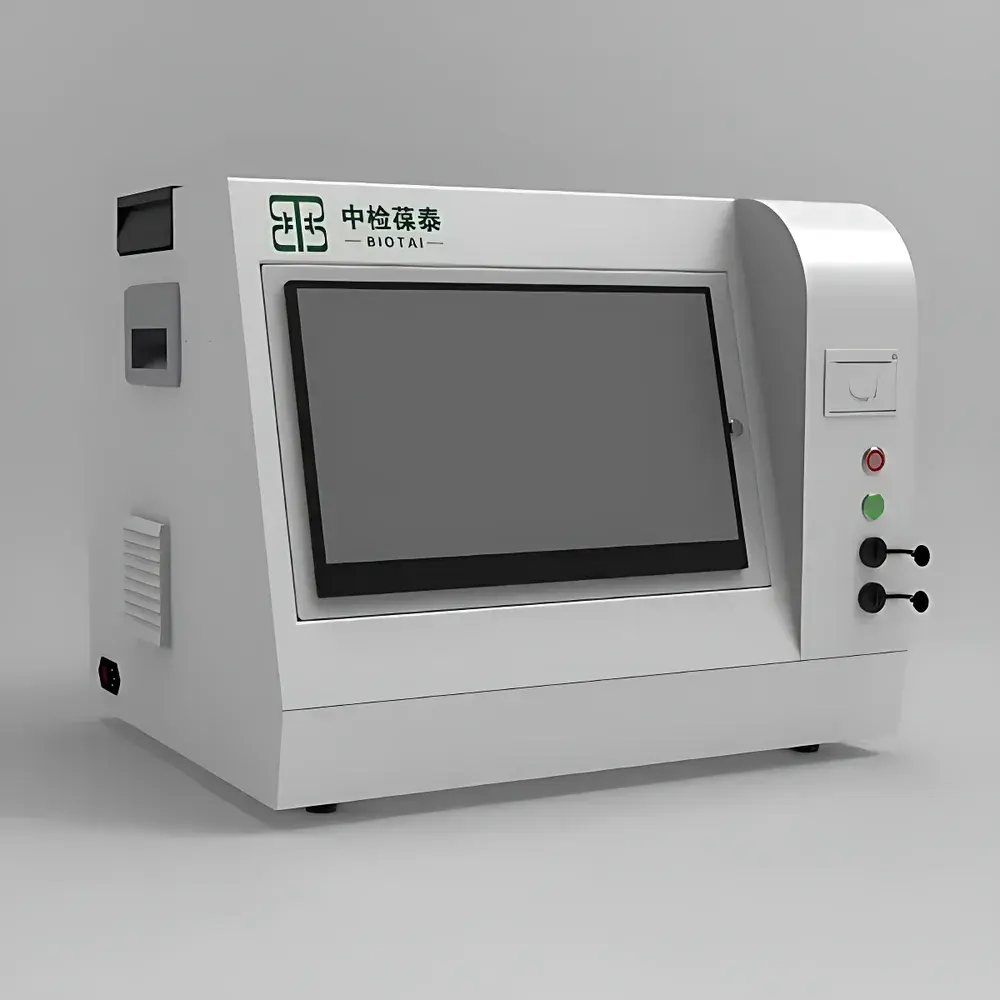
Biotai CUKA-IX Grain Imperfect Kernel Analyzer
| Brand | Biotai |
|---|---|
| Origin | Beijing, China |
| Manufacturer Type | Authorized Distributor |
| Country of Origin | China |
| Model | CUKA-IX |
| Price Range | USD 21,000 – 28,000 |
| Grain Types Supported | Wheat, Corn, Paddy Rice, Soybean, Peanut, Sunflower Seed |
| Detection Targets | Insect-Damaged Kernels, Diseased Kernels (Black Germ, Gibberella-Damaged), Broken Kernels, Sprouted Kernels, Moldy Kernels, Heat-Damaged Kernels |
| Imaging System | Conveyor-Based Linear High-Resolution Scan |
| Spatial Resolution | 0.024 mm |
| Throughput | Full Sample Analysis in ≤120 s |
| User Interface | Capacitive Touchscreen with Onboard Data Storage |
| Automation | Auto-Start on Feed Detection, Auto-Stop Post-Analysis |
| Traceability | Full Audit Trail of Operator Actions and Measurement Events |
| Compliance Framework | Designed to Support ISO 712, ISO 6540, GB/T 5494–2019, and AACCI Method 47–01 workflows |
Overview
The Biotai CUKA-IX Grain Imperfect Kernel Analyzer is an industrial-grade, vision-based inspection system engineered for objective, high-throughput quantification of imperfect kernels in bulk cereal grains and oilseeds. It operates on the principle of high-resolution linear scanning coupled with supervised machine learning algorithms trained on validated reference grain samples. Unlike subjective visual grading by human inspectors—prone to fatigue-induced variability and inter-operator inconsistency—the CUKA-IX delivers repeatable, traceable, and metrologically defensible classification results aligned with internationally recognized grain quality standards. The system is deployed at critical control points across grain supply chains: procurement centers, port terminals, storage facilities, and processing plants where rapid, auditable decisions on grade assignment, pricing, and acceptance/rejection are required.
Key Features
- Conveyor-integrated linear imaging architecture delivering uniform illumination and sub-25 µm spatial resolution across the full sample width—enabling pixel-level morphological and textural feature extraction.
- Multi-class kernel defect classifier trained on >12,000 manually verified grain images, covering six defined imperfection categories per ISO 6540 and GB/T 5494–2019: insect damage, disease-related discoloration (including black germ and gibberellic acid–induced red mold), mechanical breakage, sprouting, surface mold colonization, and thermal denaturation.
- Real-time analysis engine processes up to 3,200 kernels per minute with <±0.8% relative standard deviation (RSD) in replicate measurements under controlled ambient lighting conditions.
- Capacitive touchscreen interface with intuitive workflow navigation, multilingual UI support (English, Spanish, Arabic, Vietnamese), and embedded calibration verification tools.
- Automated operational sequencing: feed detection triggers acquisition; analysis completes within 120 seconds; system halts automatically upon sample exhaustion—minimizing operator intervention and cross-contamination risk.
- Onboard non-volatile memory stores ≥10,000 test records with timestamp, operator ID, sample ID, environmental metadata (ambient temperature/humidity), and raw image thumbnails for retrospective review.
Sample Compatibility & Compliance
The CUKA-IX accepts whole, unground kernels of wheat, corn (dent and flint), paddy rice (rough and milled), soybean, peanut (in-shell and shelled), and sunflower seed without pre-sorting or size fractionation. Its optical path and algorithmic training set are optimized for natural variations in kernel shape, surface reflectance, and moisture content (10–18% w.b.). The system supports compliance-driven workflows including ISO 712 (moisture determination context), ISO 6540 (imperfect kernel definitions), GB/T 5494–2019 (Chinese national standard for grain inspection), and AACCI Method 47–01 (American Association of Cereal Chemists protocol for visual grading correlation). While not a regulated medical device, its data integrity framework—including immutable audit logs, user authentication, and electronic signature capability—facilitates alignment with GLP and GMP documentation requirements for food safety management systems (e.g., FSSC 22000, BRCGS).
Software & Data Management
Firmware v3.2 includes embedded Linux OS with deterministic real-time image capture scheduling. The proprietary GrainVision™ analysis suite provides dual-mode operation: standalone mode (local report generation in PDF/CSV) and networked mode (via Ethernet or optional Wi-Fi) for integration into LIMS or ERP platforms using RESTful API endpoints. All measurement data—including raw scan buffers, classified kernel masks, confidence scores per detection, and statistical summaries—is stored with SHA-256 hashing to ensure data provenance. Exported reports comply with FDA 21 CFR Part 11 principles through configurable electronic signature enforcement and role-based access controls (admin, analyst, reviewer). Calibration history, software version logs, and sensor health diagnostics are retained for internal QA audits.
Applications
- Grain procurement: Objective, standardized acceptance testing at elevator intake points to enforce contractual quality clauses.
- Export certification: Generation of auditable, export-ready inspection certificates compliant with importing country phytosanitary and quality specifications.
- Storage monitoring: Trend analysis of imperfection rates across multiple仓 batches to identify early signs of insect infestation or mold development during long-term storage.
- Processing line QC: Verification of cleaning and sorting efficacy upstream of milling or oil extraction units.
- Research & breeding programs: High-volume phenotyping of kernel integrity traits across segregating populations under controlled environmental conditions.
- Regulatory laboratory support: Supplemental evidence generation for dispute resolution between buyers and sellers under GAFTA or FOSFA arbitration frameworks.
FAQ
Does the CUKA-IX require daily recalibration?
No. The system performs automatic optical self-checks at power-on and before each analysis batch. Full calibration validation is recommended every 30 days or after hardware maintenance, using NIST-traceable grain reference standards provided with the instrument.
Can it distinguish between superficial mold and internal fungal infection?
The CUKA-IX detects surface mycelial growth, spore clusters, and associated discoloration visible in reflected light at 0.024 mm resolution. It does not perform subsurface imaging; internal infection assessment requires complementary methods such as NIR spectroscopy or PCR-based assays.
Is raw image data export supported?
Yes. Raw linear scan TIFF stacks (16-bit grayscale, geotagged with conveyor position metadata) can be exported via USB or network share for third-party algorithm development or forensic reanalysis.
What environmental conditions affect measurement stability?
Ambient lighting must be diffused and non-directional (≤500 lux variation across field of view); operating temperature range is 15–30 °C; relative humidity should remain below 70% non-condensing to prevent lens fogging or static-induced kernel adhesion.
How is operator training delivered?
Biotai provides remote video-based commissioning, a bilingual (EN/CN) digital operations manual, and optional on-site technician certification courses accredited by the China National Institute of Standardization (CNIS).






