
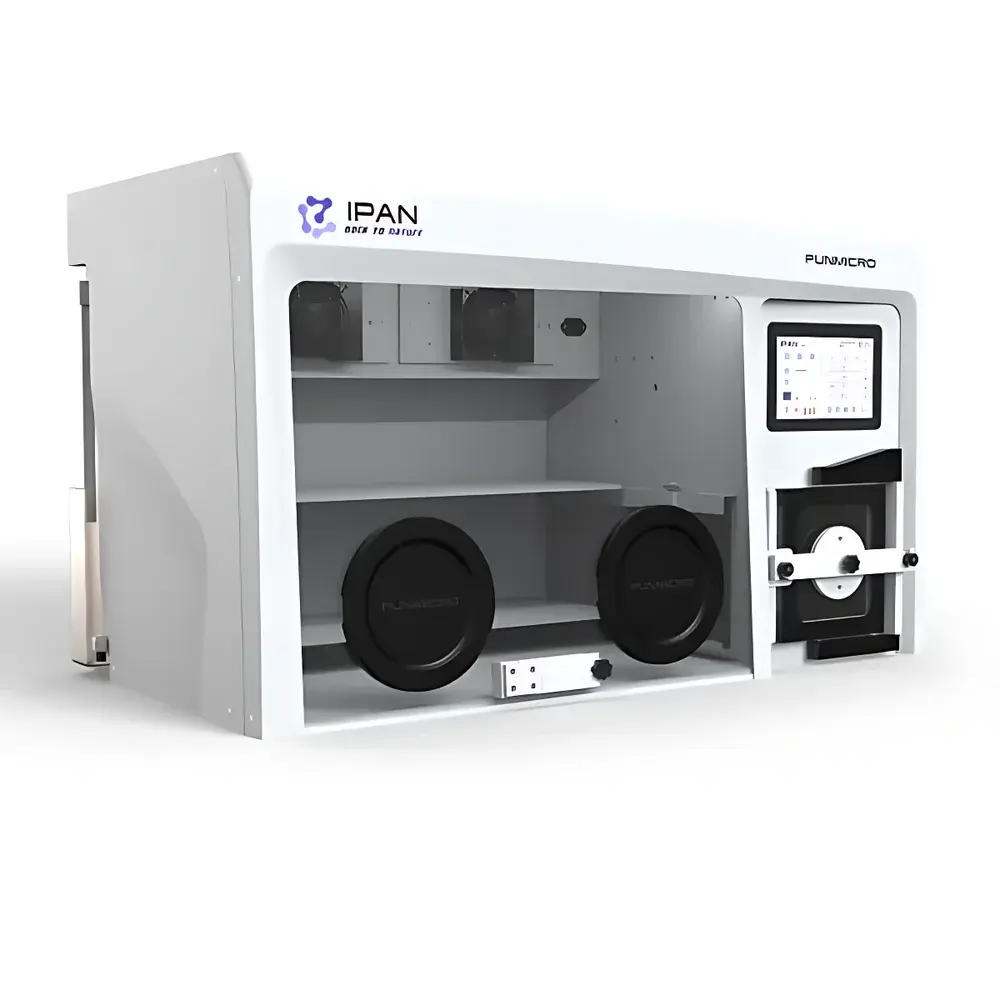
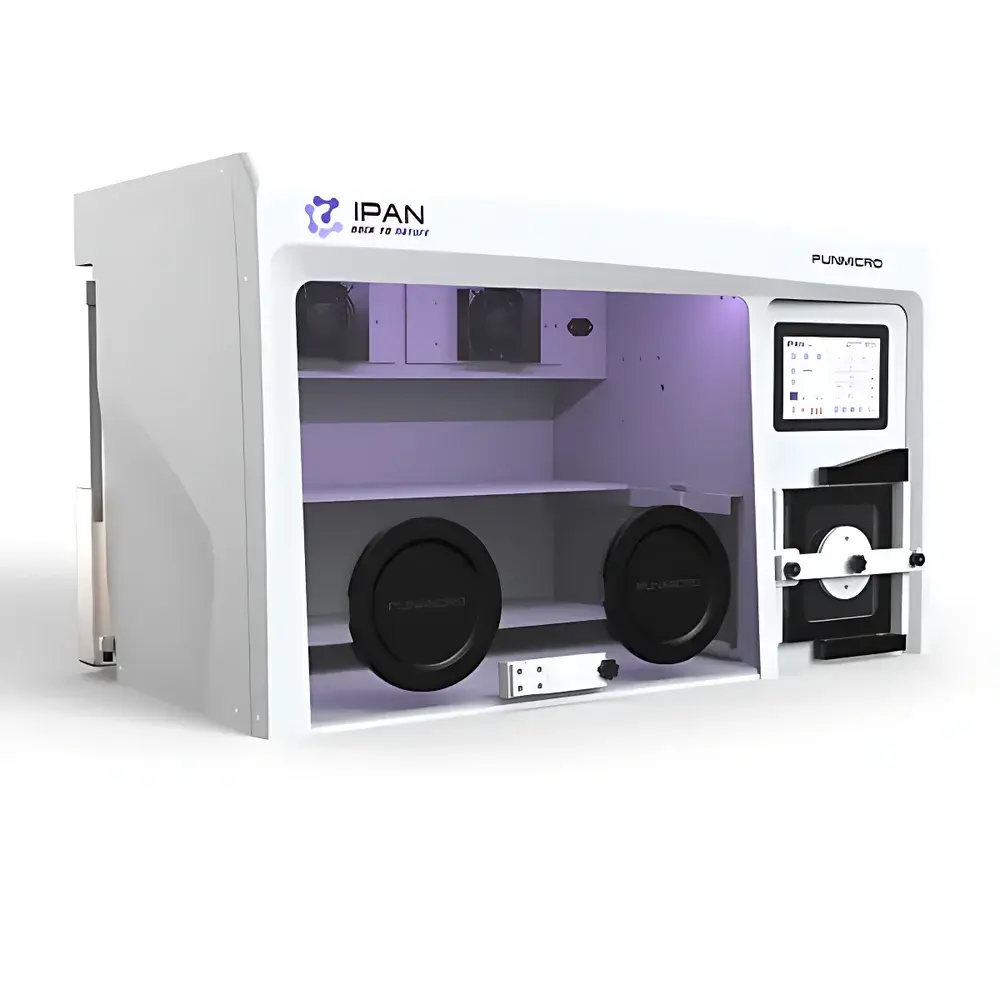
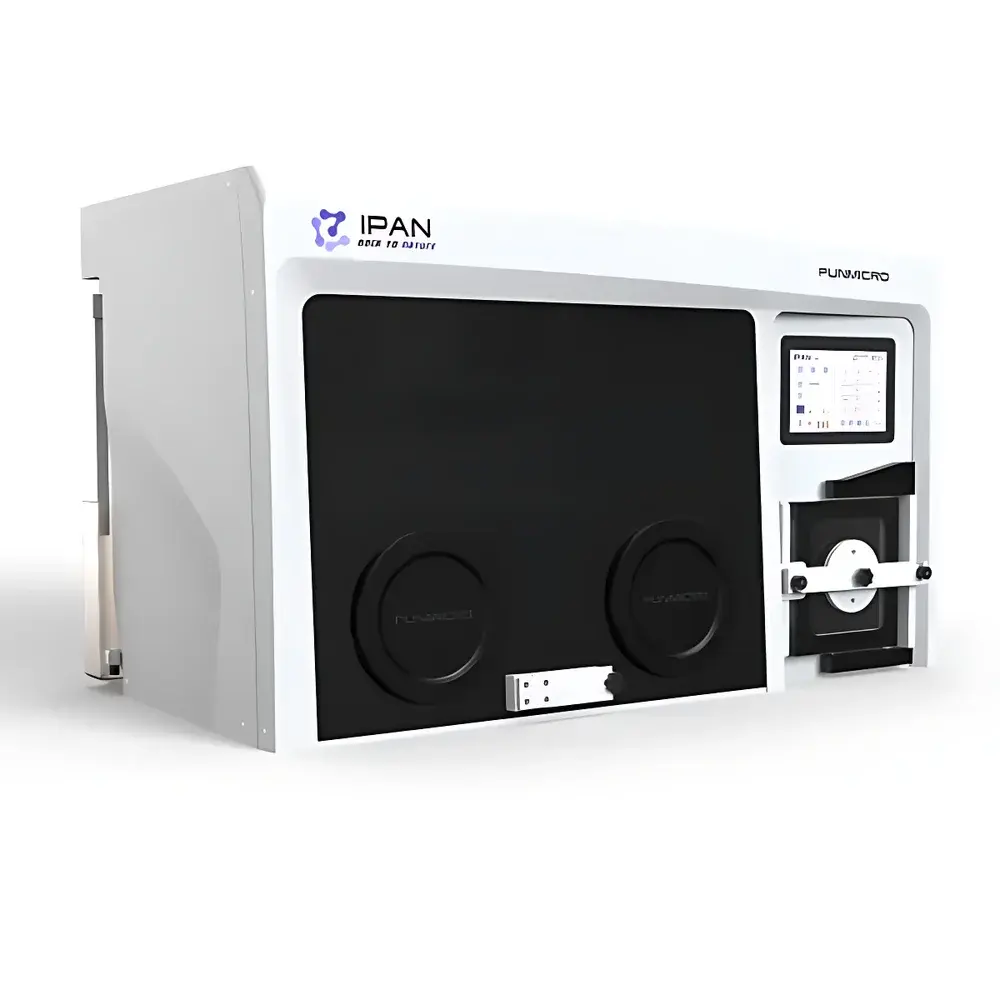
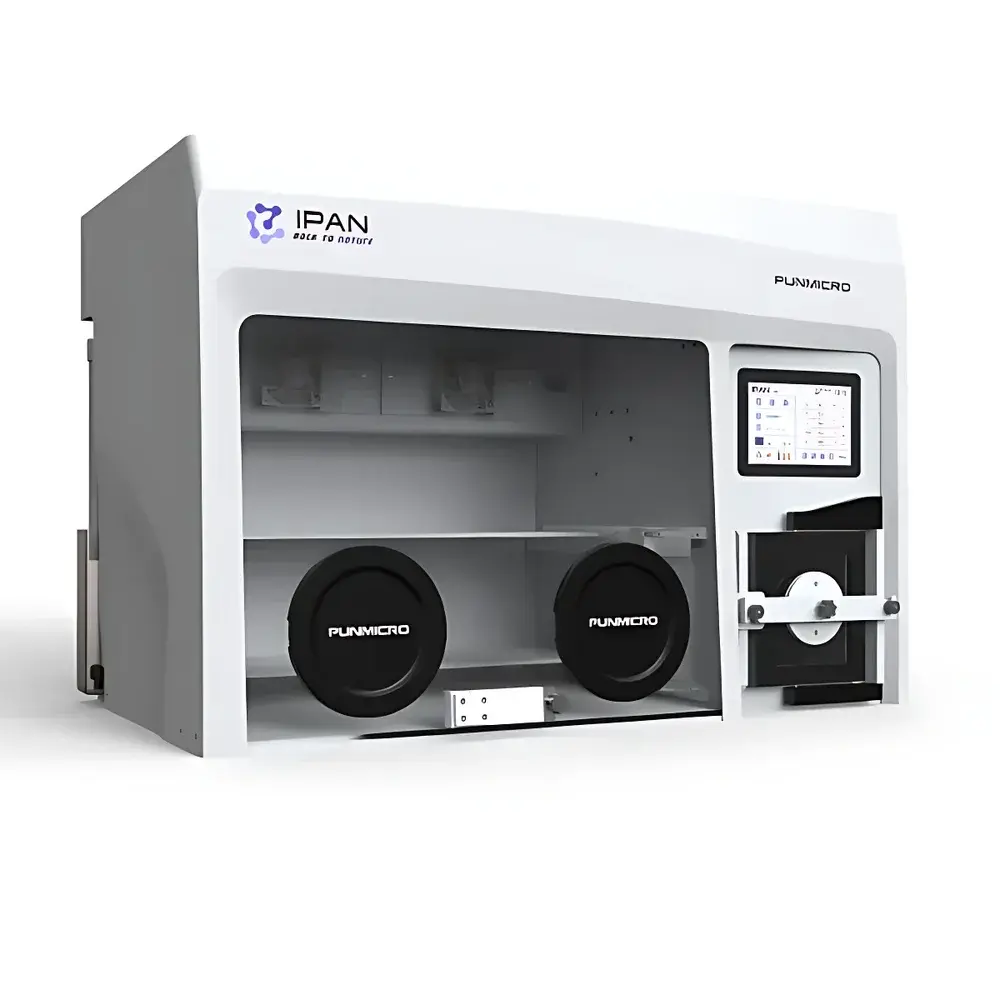
PUNMICRO IPAN Advanced Anaerobic Workstation
| Brand | PUNMICRO |
|---|---|
| Origin | Shanghai, China |
| Manufacturer Type | Authorized Distributor |
| Country of Origin | China |
| Model | IPAN |
| Oxygen Concentration Range | 0–21% (operational anaerobic range: ≤5 ppm O₂) |
| Temperature Control Range | Ambient +4°C to 48°C |
| Temperature Uniformity & Stability | ±0.5°C |
| Temperature Accuracy | ±0.1°C |
| Humidity Range | 0–100% RH (controlled via precision condensation dehumidification) |
| Gas Supply Configuration | Dual-gas system (high-purity N₂ + anaerobic gas mixture: 80% N₂ / 10% CO₂ / 10% H₂) |
| Chamber Volume | 480 L |
| Transfer Lock Capacity | 60 standard Petri dishes |
| Sample Capacity | 500–810 × 90 mm Petri dishes or 90 × 250 mL Erlenmeyer flasks |
| Lighting | Adjustable monochromatic LED system (625 nm red / 470 nm blue / 525 nm green |
| Internal Illumination | Diffuse LED, 300 lux |
| Viewing Window | 7° ergonomic tilt angle |
| Chamber Material | NPL-UV specialty polymer with long-term pressure-tight integrity |
| Safety Systems | Leak self-diagnostic with automatic gas cutoff, marine-grade arc-resistant circuitry, explosion-proof heating elements, arc-resistant internal power sockets |
| Pressure Management | Pneumatic auto-depressurization system with water-level monitoring and alarm |
| Catalyst Module | Super-Pd oxygen scavenger (maintenance-free, no baking required) |
| Decontamination | UV-C (254 nm) lamp + integrated alcohol spray bottle + compatibility with NaOCl, H₂O₂ vapor, and ethanol protocols |
| Oxygen Sensor | In-situ ppm-grade electrochemical sensor, resolution 1 ppm, display on dual-layer ITO touchscreen |
Overview
The PUNMICRO IPAN Advanced Anaerobic Workstation is an engineered platform for strict anaerobic microbiology, designed to maintain a stable, reproducible, and biologically relevant low-oxygen environment (≤5 ppm O₂) across its 480 L working chamber. It operates on the principle of catalytic oxygen removal combined with continuous gas-phase management—utilizing a dual-gas supply (high-purity nitrogen and pre-mixed anaerobic gas: 80% N₂ / 10% CO₂ / 10% H₂) and an integrated Super-Pd catalyst module that eliminates residual O₂ without requiring periodic thermal reactivation. The workstation employs micro-positive pressure control to prevent ambient air ingress while ensuring physiological relevance for obligate anaerobes such as Clostridium, Bacteroides, and methanogenic archaea. Its NPL-UV polymer construction provides long-term structural integrity and gas-tightness under sustained pressurized operation, meeting ISO 14644-1 Class 5 cleanroom-compatible sealing standards.
Key Features
- Integrated “Tornado” rapid-transfer airlock with vortex purge technology and built-in Super-Pd catalyst—enables full deoxygenation in ≤90 seconds with one-touch activation.
- Bare-hand direct-entry operation using rigid, zero-dead-volume sealing plugs—eliminates secondary inner doors and associated O₂-trapping cavities.
- Dual-layer ITO capacitive touchscreen controller with real-time graphical visualization of O₂ (ppm), temperature (±0.1°C accuracy), humidity (0–100% RH), and pressure profiles.
- Monochromatic LED illumination system (625 nm red / 470 nm blue / 525 nm green) supports photobiological assays including photosynthetic bacterial growth, light-regulated gene expression, and circadian rhythm studies under strict anaerobiosis.
- Directional forced-air convection with laminar flow design ensures uniform thermal and humid conditions (±0.5°C uniformity) and enables recovery to ≤5 ppm O₂ within 12 minutes post-sample transfer.
- Pneumatic auto-depressurization system permits simultaneous two-handed manipulation inside the chamber while incorporating water-level monitoring and leak-detection alarms.
- Comprehensive safety architecture: real-time gas-leak self-diagnosis with automatic shutoff, marine-grade arc-resistant internal wiring, explosion-proof heating elements, and arc-suppressed power outlets compliant with IEC 61000-4-5 surge immunity.
- Multi-modal decontamination support—including 254 nm UV-C irradiation, integrated ethanol spray delivery, sodium hypochlorite wipe-down, and hydrogen peroxide vapor (HPV) compatibility—validated per ISO 14644-1 and CLSI M22-A3 guidelines.
Sample Compatibility & Compliance
The IPAN accommodates diverse sample formats—including up to 810 standard 90 mm Petri dishes or 90 × 250 mL anaerobic culture flasks—within its spacious 480 L chamber, which also allows integration of small benchtop instruments (e.g., portable pH meters, microcentrifuges). Its internal bio-decontamination module uses composite adsorbent media to neutralize volatile fatty acids (VFAs), hydrogen sulfide, and other metabolic byproducts, preventing culture inhibition during extended incubations. All operational parameters—including O₂ concentration, temperature, humidity, and gas flow—are continuously logged with timestamped metadata, supporting compliance with GLP, GMP, and FDA 21 CFR Part 11 requirements when paired with validated electronic record systems. The workstation conforms to ISO 13408-1 (aseptic processing), ASTM D6329 (microbial containment), and EN 12469 (biosafety cabinet performance) for controlled-environment microbiological work.
Software & Data Management
The dual-layer ITO touchscreen interface runs embedded Linux-based firmware with audit-trail-enabled parameter logging (O₂, T, RH, pressure, catalyst status, alarm events). Data export is supported via USB 3.0 in CSV format, compatible with LIMS integration and statistical process control (SPC) platforms. Optional Ethernet/WiFi connectivity enables remote monitoring and centralized fleet management across multi-lab installations. All configuration changes are time-stamped and user-identified, satisfying traceability requirements under ISO/IEC 17025 and CLIA regulations. Firmware updates are digitally signed and verified to ensure system integrity and cybersecurity resilience per NIST SP 800-53 controls.
Applications
- Cultivation and isolation of obligate and facultative anaerobes from clinical, environmental, and industrial samples.
- Gut microbiome research—including fecal microbiota transplantation (FMT) preparation and anaerobic co-culture modeling.
- Biogas and biohydrogen production strain development under defined redox potentials.
- Functional screening of anaerobic enzymes (e.g., nitrogenases, hydrogenases) and metabolic engineering of Clostridia and Desulfovibrio spp.
- Phototrophic anaerobe studies (e.g., Rhodobacter, Chlorobium) using wavelength-selective illumination.
- Antimicrobial susceptibility testing (AST) under physiologically relevant O₂ gradients per CLSI M11-A9.
- Long-term stability studies of probiotic formulations and lyophilized cultures.
FAQ
What is the minimum achievable oxygen concentration inside the chamber?
The IPAN achieves and maintains ≤5 ppm O₂ under steady-state operation, verified by in-situ electrochemical ppm-grade sensors calibrated traceably to NIST standards.
Can the workstation accommodate third-party instrumentation inside the chamber?
Yes—the 480 L volume and reinforced floor structure support placement of compact devices such as microplate readers, small centrifuges, or handheld spectrophotometers, provided they meet intrinsic safety and off-gas emission criteria.
Is hydrogen gas handling certified to international safety standards?
The dual-gas manifold includes fail-safe solenoid valves, H₂-specific leak detectors, and automatic purge protocols aligned with CGA G-5.5 and ISO 22734 for hydrogen-rich atmospheres.
How often does the Super-Pd catalyst require replacement or maintenance?
The catalyst is maintenance-free for ≥18 months under typical usage (8 h/day, 5 days/week); lifetime is extended by the workstation’s integrated moisture and sulfur scavenging modules.
Does the system support 21 CFR Part 11-compliant electronic records?
Yes—when deployed with optional networked data server and digital signature module, the IPAN meets electronic signature, audit trail, and role-based access control requirements for regulated pharmaceutical and clinical labs.




