
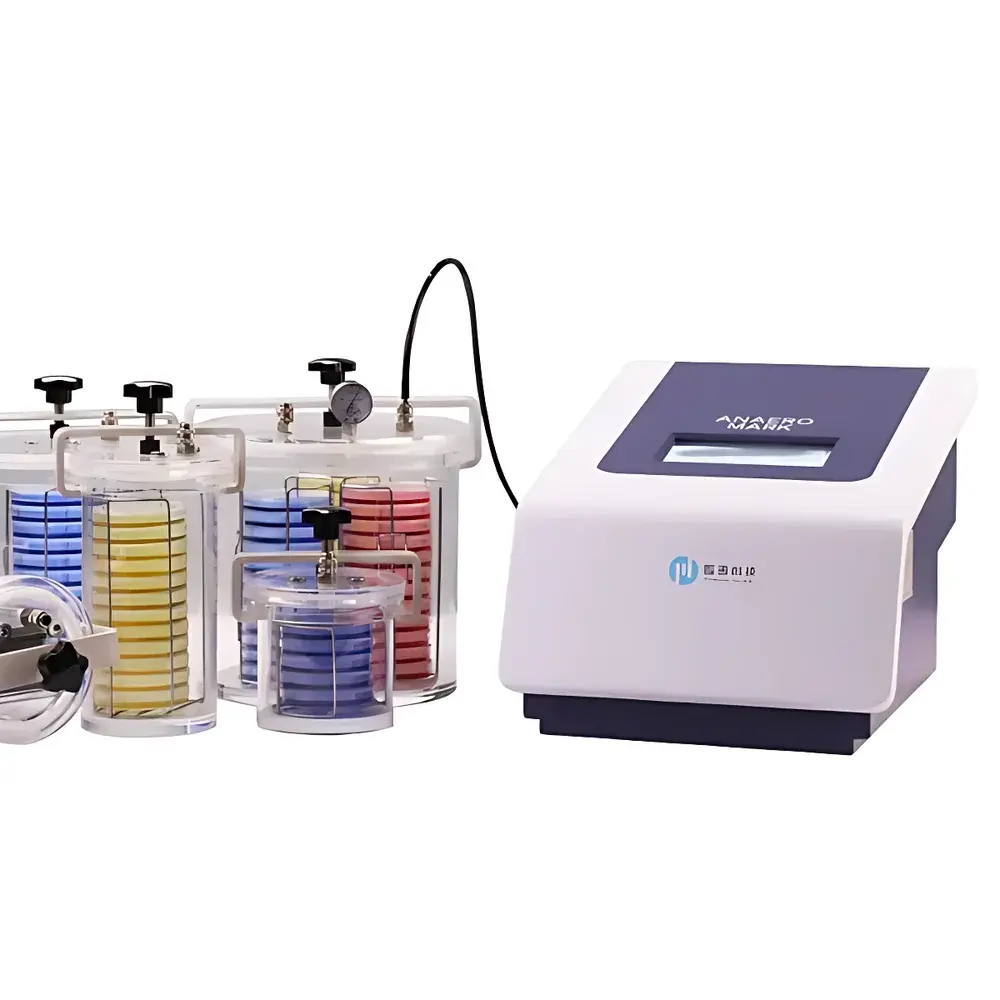
Punmicro Anaero Mark Automated Anaerobic Incubation System
| Brand | Punmicro |
|---|---|
| Origin | Shanghai, China |
| Manufacturer Type | Authorized Distributor |
| Product Category | Domestic |
| Model | Punmicro Anaero Mark |
| Instrument Type | Automated Anaerobic Incubator |
| O₂ Concentration Range | 0–21% (adjustable in 0.1% increments) |
| CO₂ Concentration Range | 0–20% (adjustable in 0.1% increments) |
| Chamber Volumes | 1.35 L / 2.5 L / 2.75 L / 3 L / 6 L / 7 L / 10 L / 15 L (user-selectable) |
| Temperature Range | Ambient +5°C to 70°C |
| Temperature Uniformity | ±0.5°C |
| Max Working Pressure | ≥1.5 bar |
| Catalyst | Regenerable Palladium-Based Hydrogen Catalyst (O₂ < 5 ppm) |
| Gas Interface | 3 gas cylinder ports + 4 incubation chamber ports + 1 reserved port |
| Vacuum Pump | Oil-free |
| Gas Consumption | ~2 L per 12×90 mm plates (microaerophilic) |
| Self-Test Duration | ≤5 s at power-on |
| Program Switching Time | ≤10 s |
| Anaerobic Condition Establishment | <3 min |
| Microaerophilic Condition Establishment | <1 min |
| Pre-reduction Module Capacity | ≥10×90 mm plates |
| Data Traceability | Built-in thermal printer + optional data export module |
| Compliance | Designed for GLP/GMP-aligned workflows |
Overview
The Punmicro Anaero Mark Automated Anaerobic Incubation System is an engineered platform for precise, reproducible control of gaseous microenvironments in microbiological culture. It operates on the principle of automated vacuum-gas exchange—repeated evacuation followed by metered re-filling with defined gas mixtures—to establish and maintain rigorously controlled oxygen partial pressures (0–21%), carbon dioxide concentrations (0–20%), hydrogen levels (for catalytic O₂ scavenging), and nitrogen balance. Unlike passive jar-based systems or static glove boxes, the Anaero Mark dynamically regulates gas composition in real time across multiple independent chambers, enabling concurrent cultivation of strict anaerobes (e.g., <5 ppm O₂), microaerophiles (e.g., Campylobacter jejuni at 5–10% O₂), capnophiles (e.g., Helicobacter pylori requiring 5–10% CO₂), and custom-defined atmospheres—all without manual gas cylinder switching or hardware reconfiguration.
Key Features
- Multi-chamber autonomy: Up to four incubation chambers operate independently, each with dedicated pressure monitoring, programmable gas profiles, and real-time status feedback.
- High-fidelity gas delivery: Triple gas inlet architecture (N₂, CO₂, anaerobic mix) enables seamless blending across full O₂ (0.1–21.0%) and CO₂ (0.1–20.0%) ranges with 0.1% resolution.
- Regenerable palladium catalyst system: Integrated Pd/H₂ catalysis reduces residual O₂ to 10,000 cycles without regeneration or replacement.
- Rapid environmental equilibration: Achieves microaerophilic conditions (<10% O₂) in under 60 seconds and true anaerobiosis (<5 ppm O₂) in <180 seconds—validated via onboard electrochemical O₂ sensor calibration traceability.
- Comprehensive self-diagnostic suite: Automated pre-run verification includes valve actuation testing, pressure integrity checks (5-level leak detection), catalyst activity assessment, and gas line pressure validation—all completed in ≤5 seconds at startup.
- Modular chamber design: Optional chamber materials include medical-grade PVC (autoclavable to 100°C), optical-grade PMMA (for visual monitoring), and electropolished stainless steel (for high-corrosion environments).
- Pre-reduction module: Dedicated chamber accommodates ≥10×90 mm Petri dishes; fully reduces thioglycollate or reinforced clostridial media in <45 minutes prior to inoculation—critical for isolation of fastidious strict anaerobes such as Methanobrevibacter smithii or Syntrophomonas wolfei.
Sample Compatibility & Compliance
The Anaero Mark supports a broad spectrum of clinical, environmental, and research isolates—including but not limited to Clostridioides difficile, Bifidobacterium spp., Fusobacterium nucleatum, Prevotella melaninogenica, Campylobacter jejuni, Helicobacter pylori, and Desulfovibrio desulfuricans. Chambers accommodate standard microbiological formats: Petri dishes (up to 150 mm), agar slants, broth tubes, microtiter plates (up to 96-well), API/ID32A strips, and commercial identification panels. All internal surfaces feature electropolished 316L stainless steel liners resistant to repeated exposure to H₂S, organic acids, and reducing agents. The system is designed to meet ISO 13485-aligned manufacturing controls and supports documentation practices compliant with CLIA, CAP, and EU IVDR requirements. Built-in thermal printing provides tamper-evident, time-stamped records of all operational parameters (gas ratios, vacuum depth, cycle duration, temperature setpoints)—enabling full traceability in GLP and GMP-regulated laboratories.
Software & Data Management
The embedded control interface runs on a deterministic real-time OS with a 7-inch capacitive touchscreen and native Chinese/English language support. Users define protocols via intuitive graphical menus—selecting from preset modes (Anaerobic, Microaerophilic, Campylobacter, Shigella) or constructing custom gas profiles with adjustable ramp rates, hold durations, and multi-step sequences. Each protocol stores complete metadata: date/time stamp, operator ID, chamber assignment, gas composition history, and catalyst health index. Audit trails are retained internally for ≥12 months and exportable via USB to CSV or PDF. Optional firmware upgrade enables HL7/FHIR-compliant integration with LIS systems and 21 CFR Part 11-compliant electronic signatures when paired with external authentication hardware.
Applications
- Clinical microbiology: Routine isolation and identification of obligate anaerobes from wound, stool, and abscess specimens per CLSI M11-A9 guidelines.
- Fecal microbiota transplantation (FMT): Controlled anaerobic processing of donor material to preserve viability of butyrate-producing Clostridia clusters.
- Gut microbiome research: High-throughput cultivation of previously uncultured taxa using targeted microaerophilic or hydrogen-enriched atmospheres.
- Food safety testing: Enumeration of Campylobacter spp. in poultry samples using ISO 10272-1:2017-compliant microaerophilic protocols.
- Pharmaceutical QC: Sterility testing of anaerobic biologics and validation of anaerobic depyrogenation cycles.
- Environmental microbiology: Enrichment of sulfate-reducing bacteria (SRB) and methanogens from sediment or bioreactor samples under precisely defined redox potentials.
FAQ
What gas cylinders are required for operation?
The system requires three standard 10 L/150 bar cylinders: one containing certified anaerobic gas mix (e.g., 5% H₂ / 10% CO₂ / 85% N₂), one pure CO₂, and one high-purity N₂. All connections use CGA-580/CGA-320 fittings with integrated pressure regulators.
Can the same chamber be reused for different gas protocols without cleaning?
Yes—chambers are inert to repeated gas cycling. However, biological contamination control requires standard aseptic handling; chamber interiors may be sterilized via autoclaving (PVC/PMMA) or vaporized hydrogen peroxide (stainless steel).
Is catalyst replacement necessary during routine use?
No. The palladium catalyst is regenerable indefinitely under normal H₂ flow conditions. Activity is continuously monitored; degradation triggers on-screen alert only after sustained loss of O₂-scavenging efficiency across ≥5 consecutive cycles.
How is data integrity ensured for regulatory submissions?
All printed records include unique batch IDs, digital timestamps, and checksum-verified parameter logs. Optional software modules provide encrypted database storage, role-based access control, and electronic signature workflows aligned with FDA 21 CFR Part 11 Annex 11 expectations.
Does the system support remote monitoring or network connectivity?
Standard configuration includes isolated RS-232 and USB host interfaces. Ethernet/Wi-Fi connectivity and SNMP-based telemetry are available via optional communication module—enabling integration into centralized lab infrastructure management platforms.






