
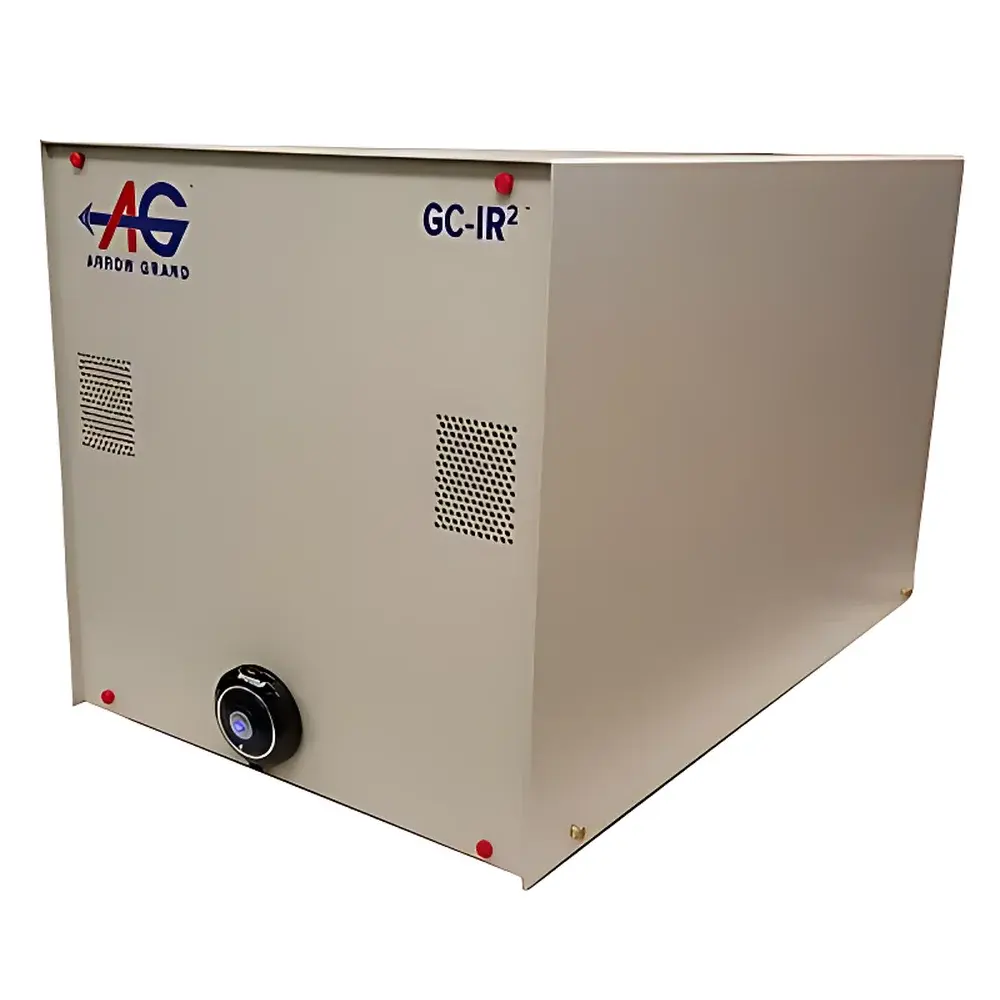
Arrow Grand Technologies GC-IR2 Isotope Ratio Gas Chromatograph with Integrated Infrared Laser Detection
| Brand | Arrow Grand Technologies |
|---|---|
| Origin | USA |
| Manufacturer Type | Authorized Distributor |
| Origin Category | Imported |
| Model | GC-IR2 |
| Pricing | Available Upon Request |
| Measurement Principle | Semiconductor Mid-IR Laser Absorption Spectroscopy Coupled with High-Resolution Capillary Gas Chromatography |
| Isotopes Measured | δ¹³C of CH₄ (C1), C₂H₆ (C2), C₃H₈ (C3), and n-C₄H₁₀ (C4) |
| Precision (δ¹³C) | <0.4 ‰ (30-day stability, no calibration gas) |
| Sample Throughput | One complete isotopic profile per 5 minutes |
| Detection Limits | CH₄ ≥ 0.5% v/v |
| CO₂ Concentration Accuracy | ±0.01% (full scale) |
| Total Carbon Compound Concentration Accuracy | ±0.01% |
| Spectral Acquisition Rate | 4 Hz |
| Dead Volume | <0.1 mL |
| Calibration Gas | CO₂ standard required for high-precision mode |
| Power Supply | 110/220 V AC, 1 kW average, 3 kW peak |
| Operating Temperature | 0–35 °C |
| Relative Humidity | 0–95% RH (non-condensing) |
Overview
The Arrow Grand Technologies GC-IR2 Isotope Ratio Gas Chromatograph is the world’s first field-deployable, real-time instrument engineered for compound-specific carbon isotope ratio analysis (δ¹³C) of individual hydrocarbon species in natural gas streams. Unlike conventional isotope-ratio mass spectrometry (IRMS) systems—which require cryogenic pre-concentration, offline sample preparation, and laboratory infrastructure—the GC-IR2 integrates high-resolution capillary gas chromatography with tunable semiconductor mid-infrared laser absorption spectroscopy through a hollow-waveguide optical cell. This architecture enables direct, continuous measurement of δ¹³C values for methane (C1), ethane (C2), propane (C3), and n-butane (C4) without derivatization or combustion. The system operates on the principle of wavelength-modulated absorption spectroscopy, where isotopologue-specific ro-vibrational transitions in the 2800–3000 cm⁻¹ region are resolved with sub-Doppler line-narrowing capability. Its design meets the operational demands of upstream oil & gas exploration, coal mine ventilation monitoring, shale gas fingerprinting, and biogenic vs. thermogenic gas source discrimination—delivering lab-grade isotopic precision in rugged, non-laboratory environments.
Key Features
- First commercially available in-situ, online δ¹³C analyzer for C1–C4 hydrocarbons—deployable at wellheads, compressor stations, and mine portals without external gas handling infrastructure
- Patented hollow-waveguide infrared absorption cell (US PCT No. 13/669,410) enabling high optical pathlength (>10 m) within <0.1 mL dead volume, minimizing memory effects and cross-contamination
- Simultaneous quantification and isotopic analysis: measures absolute concentrations (CH₄ ≥ 0.5%; C2–C4 ≥ 400 ppmv) and δ¹³C ratios in a single 5-minute chromatographic run
- Real-time spectral acquisition at 4 Hz, supporting dynamic process monitoring and transient event capture (e.g., gas migration pulses, venting episodes)
- Stability-optimized thermal management: maintains detector and waveguide temperature within ±0.05 °C over 0–35 °C ambient range, ensuring long-term δ¹³C reproducibility
- Modular calibration architecture: supports dual-mode operation—high-accuracy mode using certified CO₂ reference gas (<0.2 ‰ 30-day δ¹³C drift) and field-robust mode without calibration gas (<0.4 ‰ drift)
Sample Compatibility & Compliance
The GC-IR2 accepts raw, unfiltered natural gas samples—including wet gas, sour gas (H₂S ≤ 500 ppm), and landfill/coalbed methane—with no requirement for water removal or sulfur scavenging prior to injection. It complies with ASTM D1945 (Standard Test Method for Analysis of Natural Gas by Gas Chromatography) and ISO 6974-2 (Natural gas — Determination of composition — Part 2: Gas-chromatographic method for nitrogen, carbon dioxide and hydrocarbons up to C₁₀). For regulatory reporting under EPA Method TO-15 or ISO 14855 (biodegradability assessment), its δ¹³C data meet GLP traceability requirements when operated with audit-trail-enabled software and documented calibration protocols. The system’s electrical design conforms to UL 61010-1 and IEC 61000-6-2/6-4 for industrial electromagnetic compatibility.
Software & Data Management
Instrument control, spectral deconvolution, chromatogram integration, and δ¹³C calculation are executed via GC-IR2 Control Suite v3.x—a Windows-based application validated under FDA 21 CFR Part 11 for electronic records and signatures. The software provides full audit trail logging (user actions, parameter changes, calibration events), automated QC flagging for peak asymmetry or baseline drift, and export of NIST-traceable δ¹³C values in .csv and .xlsx formats. Raw interferograms and calibrated absorbance spectra are stored in HDF5 format for third-party reprocessing. Remote diagnostics and firmware updates are supported over secure TLS-encrypted Ethernet or LTE (optional module).
Applications
- Geochemical sourcing: Differentiation of microbial, thermogenic, and abiotic methane using multi-compound δ¹³C patterns (e.g., C1–C3 trends per Whiticar diagram)
- Leak detection & attribution: Real-time isotopic fingerprinting of fugitive emissions from pipelines, storage tanks, and LNG terminals
- Mine safety monitoring: Quantitative δ¹³C tracking of coal seam gas evolution during longwall mining to assess outburst risk
- Carbon credit verification: Field-based validation of methane oxidation rates in landfill cover soils via ¹³C-enrichment kinetics
- Shale play characterization: Mapping lateral and vertical δ¹³C gradients across hydraulic fracture stages to infer reservoir connectivity and fluid history
FAQ
Does the GC-IR2 require carrier gas or vacuum pumps?
No. It operates with ambient air as purge gas and uses a diaphragm pump for sample aspiration—eliminating helium dependency and high-vacuum maintenance.
Can it measure hydrogen isotopes (δ²H) or nitrogen isotopes (δ¹⁵N)?
Not natively. The current optical configuration targets only carbon isotopic ratios in C1–C4 alkanes. Dual-isotope expansion modules are under development but not yet commercially released.
How often must the CO₂ calibration gas be replaced?
Certified CO₂ standards (δ¹³C traceable to NBS-19) are consumed at ~15 mL per 8-hour shift in high-accuracy mode; typical cylinder life exceeds 30 days at standard flow rates.
Is the system compatible with SCADA or DCS integration?
Yes. Modbus TCP and OPC UA server interfaces are embedded, enabling direct data streaming to plant historians and alarm systems without middleware.
What maintenance intervals are recommended?
Optical alignment verification every 6 months; GC column replacement every 12–18 months depending on sample matrix; annual NIST-traceable performance validation using certified hydrocarbon standards.




