
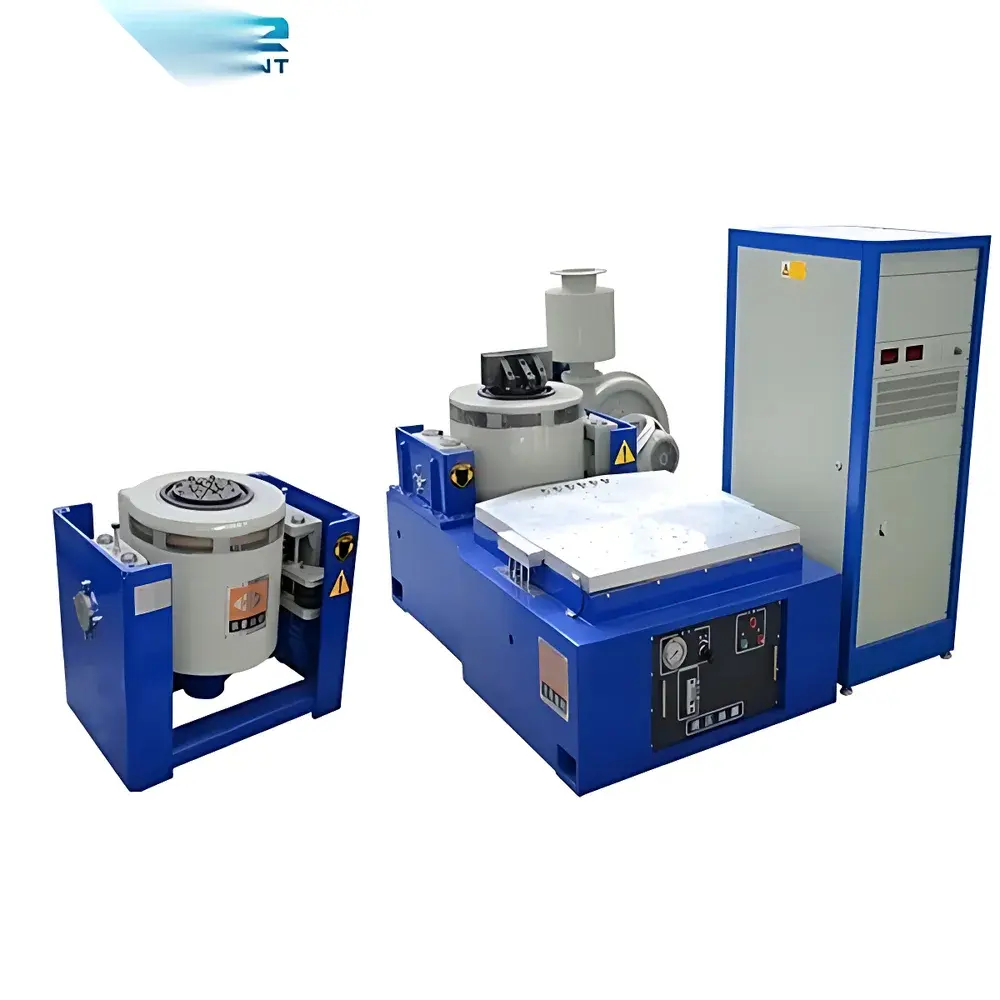
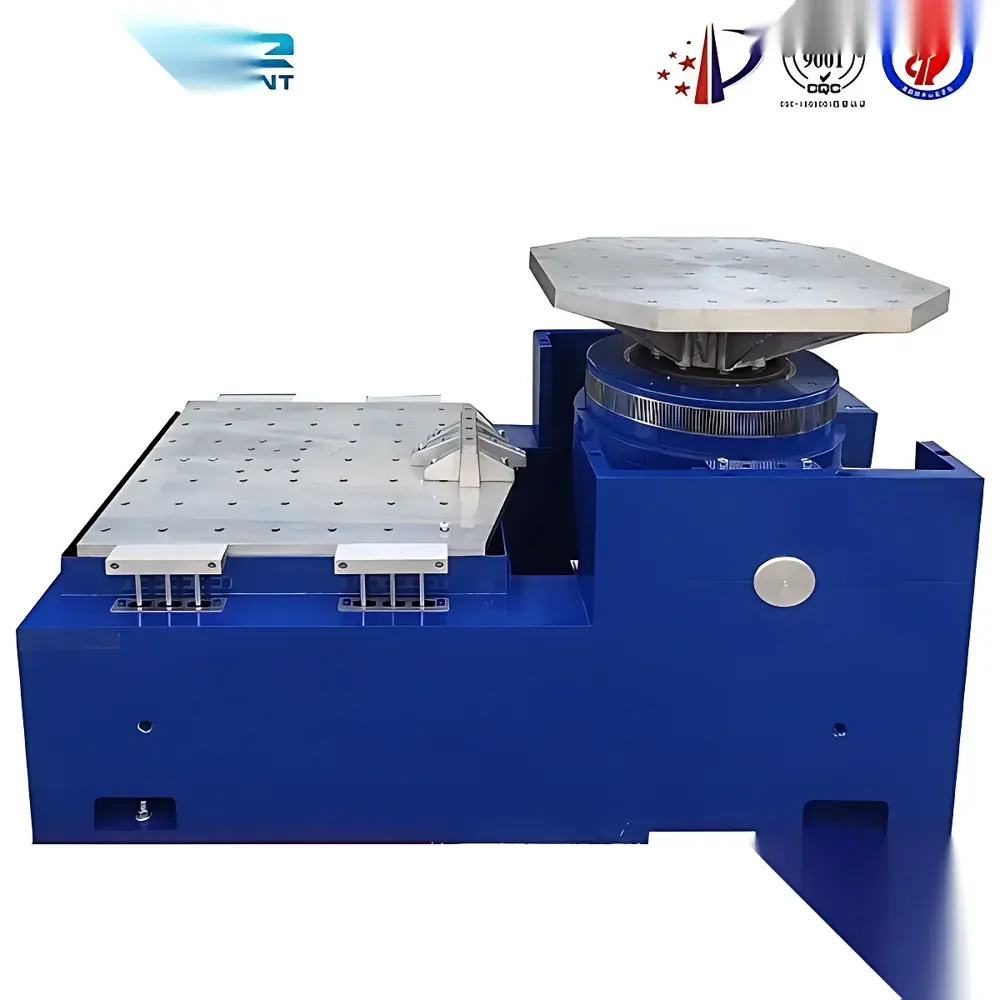
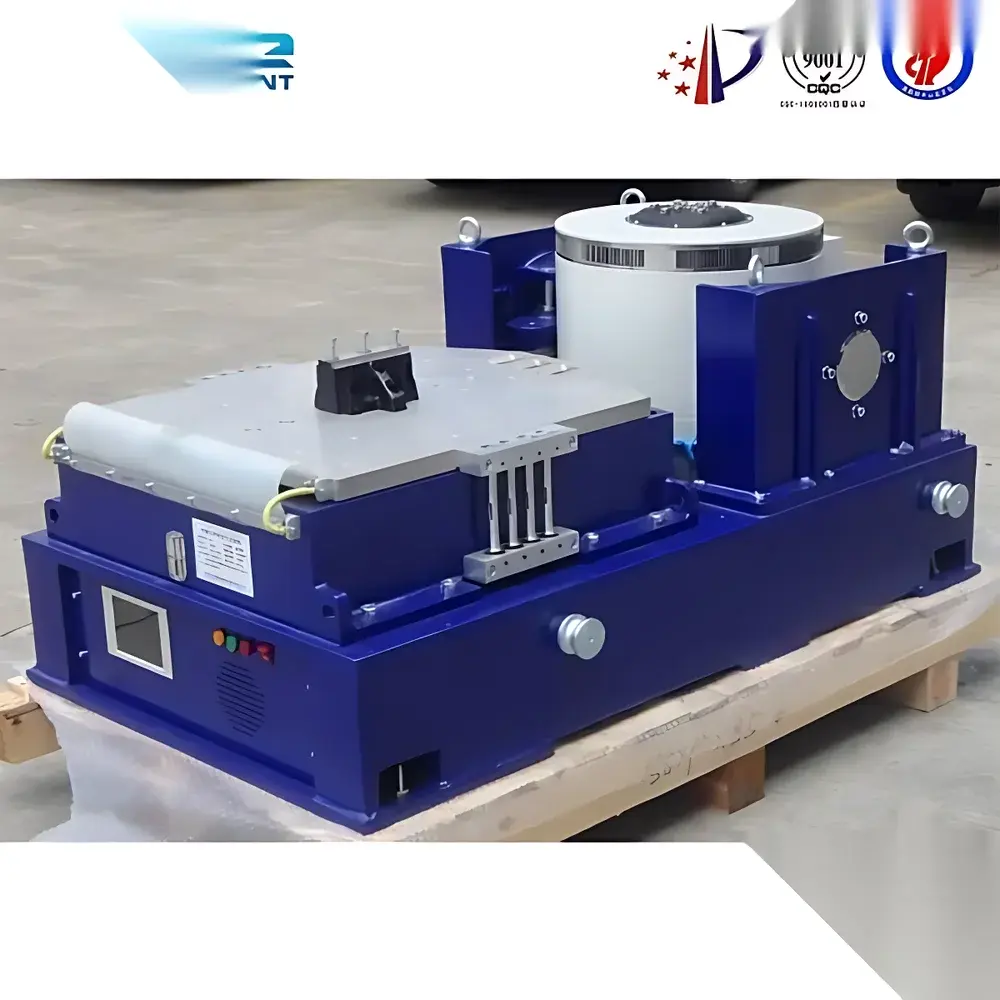
Electromagnetic Vibration Testing System
| Key | Frequency Range: 5–150 Hz |
|---|---|
| Vibration Modes | Sine, Random, Swept Sine (Linear & Logarithmic, Bidirectional Sweep) |
| Acceleration | 50 m/s² (RMS), 300 m/s² (Peak) |
| Displacement | 51 mm (p-p) |
| Stroke Duration for Pulse | 18 ms (configurable) |
| Magnetic Flux Leakage | ≤1 mT |
| Orientation | Vertical & Horizontal |
| Configuration | Dual-Head Electromagnetic Shaker with Shared Power Amplifier & Controller |
| Automatic Power & Blower Switching | Integrated Electro-Mechanical Relay System |
| Compliance | Designed for ISO 10816, ASTM D999, IEC 60068-2-6/2-64, and GLP/GMP-aligned test environments |
Overview
The Electromagnetic Vibration Testing System is a precision-engineered dual-axis electrodynamic shaker platform designed for laboratory-grade mechanical stress evaluation of components and assemblies under controlled dynamic loading conditions. Operating on the principle of Lorentz force actuation—where alternating current in the moving coil interacts with a static magnetic field to generate controlled inertial acceleration—the system delivers high-fidelity sinusoidal, random, and swept-sine excitations across a validated frequency range of 5 Hz to 150 Hz. Its core architecture comprises three integrated subsystems: the electromagnetic shaker台 (available in vertical and horizontal configurations), a high-efficiency linear power amplifier, and a real-time digital vibration controller with deterministic feedback loop architecture. Unlike hydraulic or servo-mechanical alternatives, this electromagnetic system offers superior phase linearity, low harmonic distortion (<1.5% THD at full output), and repeatable energy transfer characteristics essential for qualification testing in automotive electronics, consumer appliance modules, aerospace avionics enclosures, and medical device packaging.
Key Features
- Dual-head electromagnetic shaker configuration enabling seamless switching between vertical and horizontal excitation axes without manual reconfiguration
- Shared power amplifier and intelligent blower unit—reducing total cost of ownership and footprint while maintaining thermal stability across both orientations
- Automated relay-based power and excitation circuit switching, synchronized with directional parameter selection in the controller UI—eliminating risk of misalignment between coil drive, magnet excitation, and cooling airflow
- Configurable transient pulse profiles, including user-defined 18-ms duration shock pulses compliant with MIL-STD-810H Method 516.7 and ISO 16750-3
- Low magnetic leakage design (<1 mT at shaker surface), ensuring compatibility with magnetically sensitive instrumentation and adjacent measurement equipment
- Real-time closed-loop control with 24-bit ADC/DAC resolution, 50 kHz sampling rate, and sub-millisecond latency for accurate tracking of complex spectra
Sample Compatibility & Compliance
The system accommodates test specimens up to 100 kg (with appropriate fixture support) and features standardized 200 mm × 200 mm mounting surfaces conforming to ISO 5344 and ASTM E1435. Fixture interface options include threaded inserts (M6, M8), T-slots, and vacuum ports for non-contact mounting. All hardware and firmware are engineered to meet electromagnetic compatibility (EMC) requirements per EN 61326-1 and safety standards per IEC 61000-4-2/4/5/6. Test protocols executed on this platform satisfy traceability requirements under ISO/IEC 17025, support FDA 21 CFR Part 11-compliant audit trails via optional software licensing, and align with vibration severity classifications defined in ISO 10816-1 (machinery), ISO 16750-3 (road vehicles), and IEC 60068-2-64 (random vibration). Calibration certificates are issued per ISO 17025-accredited procedures and include amplitude linearity, frequency response flatness, and cross-axis sensitivity verification.
Software & Data Management
The embedded vibration controller runs proprietary deterministic real-time OS supporting multi-channel input/output synchronization. The host PC application provides intuitive GUI-based test definition—including sweep profiles (linear/logarithmic), dwell segments, breakpoint tables, and PSD generation for random spectra. Data acquisition supports simultaneous recording of acceleration, velocity, displacement, and drive voltage at user-selectable rates up to 50 kHz. Export formats include UFF58, MATLAB (.mat), CSV, and HDF5. Built-in data integrity safeguards include cyclic redundancy checks (CRC), automatic timestamping with NTP synchronization, and encrypted local storage. Optional modules enable automated report generation compliant with internal QA templates or external regulatory submissions (e.g., AEC-Q200, UL 60730).
Applications
This system serves as a primary tool for reliability validation in Tier-1 automotive suppliers conducting component-level durability screening per GMW14872 and Ford CETP 00.00-L-467; for consumer electronics manufacturers performing drop-and-vibration correlation per IPC-J-STD-002 and JEDEC JESD22-B103; and for industrial IoT sensor developers verifying structural integrity under simulated transportation conditions (ASTM D4728, ISTA 3A). It is also deployed in academic research laboratories investigating fatigue crack initiation thresholds in polymer composites and solder joint reliability under spectral loading.
FAQ
What is the maximum payload capacity for vertical vs. horizontal operation?
Vertical operation supports up to 100 kg with active center-of-gravity compensation; horizontal operation is rated for 75 kg due to bearing load constraints.
Does the system support remote monitoring and control over Ethernet?
Yes—TCP/IP interface enables full bidirectional communication, including real-time waveform streaming, alarm status polling, and parameter upload/download via standard SCPI commands.
Is third-party calibration documentation included with delivery?
Each unit ships with an ISO/IEC 17025-accredited factory calibration certificate covering amplitude accuracy (±1.5%), frequency deviation (<±0.1%), and phase consistency across the operational bandwidth.
Can the system perform mixed-mode testing (e.g., sine-on-random)?
Yes—the controller firmware natively supports superposition of deterministic sine tones onto broadband random base spectra, configurable per IEC 60068-2-82.
What maintenance intervals are recommended for the electromagnetic actuator and cooling system?
Routine inspection every 500 operating hours; blower filter replacement every 1,000 hours; full magnetic gap inspection and coil resistance verification annually or after 2,000 h of cumulative operation.
Related Products



